
About this resource
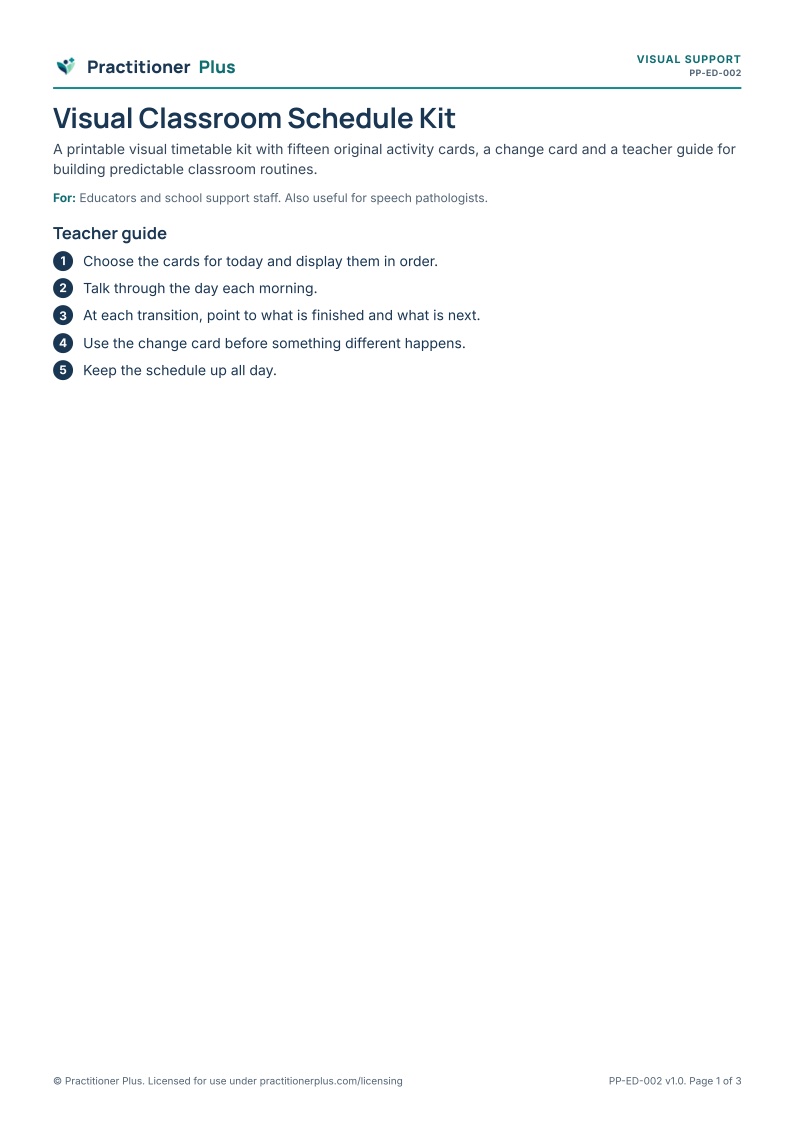
A visual timetable shows the shape of the day at a glance. This kit includes fifteen original activity cards, a Something different today card for changes, and a short teacher guide on displaying, using and teaching the schedule for the whole class or individual students.
Purpose
To make the school day predictable and to prepare students for changes using a consistent visual schedule.
Who it is for
Primary profession: Educators and school support staff. Also relevant for speech pathologists.
Client or participant group: Primary school classes and individual students who benefit from visual structure.
Practice setting: Mainstream and specialist primary classrooms.
Suggested uses
- A whole-class visual timetable
- An individual schedule on a desk strip
- Preparing students for changes such as excursions or relief teachers
- Supporting transitions between activities
Instructions for practitioners
- Display the schedule at student eye level, left to right or top to bottom.
- Go through the day each morning and refer to it at each transition.
- Move or turn over cards as activities finish.
- Use the change card to prepare students before a change happens.
- Ask learning support or speech pathology staff about individual schedules for students who need them.
Instructions for clients or participants
- Look at the schedule to see what is happening.
- Move the card when an activity is finished.
Accessibility considerations
Pair symbols with words. Print larger for students with low vision, and add photos of your own classroom where symbols are not meaningful.
Scope and limitations
A general classroom visual support. Individual students may need personalised schedules developed with their support team.
Research basis
Visual schedules and other visual supports are established evidence-based practices for autistic children and young people, and are widely used with others who benefit from visual information. Clear expectations, explicit teaching of routines and frequent positive feedback are evidence-based classroom practices; adjustments for students with disability are required under the Disability Standards for Education.
- Australian Government. Disability Standards for Education 2005. https://www.education.gov.au/disability-standards-education-2005
- Knight, V., Sartini, E., & Spriggs, A. D. (2015). Evaluating Visual Activity Schedules as Evidence-Based Practice for Individuals with Autism Spectrum Disorders. Journal of Autism and Developmental Disorders, 45(1), 157–178. https://doi.org/10.1007/s10803-014-2201-z
- Simonsen, B., Fairbanks, S., Briesch, A., Myers, D., & Sugai, G. (2008). Evidence-based practices in classroom management: Considerations for research to practice. Education and Treatment of Children, 31, 351–380. https://doi.org/10.1353/etc.0.0007
- Steinbrenner, J. R., Hume, K., Odom, S. L., Morin, K. L., Nowell, S. W., Tomaszewski, B., Szendrey, S., McIntyre, N. S., Yücesoy-Özkan, S., & Savage, M. N. (2020). Evidence-based practices for children, youth, and young adults with autism. FPG Child Development Institute, University of North Carolina. https://ncaep.fpg.unc.edu/wp-content/uploads/EBP-Report-2020.pdf
What is included
A 3-page printable A4 PDF, including a practitioner notes page with the research basis (version 1.0).
Originality
Original Practitioner Plus content: wording, activity structure, layout and icons were created for this resource. No third-party worksheets, illustrations or text were reproduced. Symbols are original line drawings created for Practitioner Plus.


