
About this resource
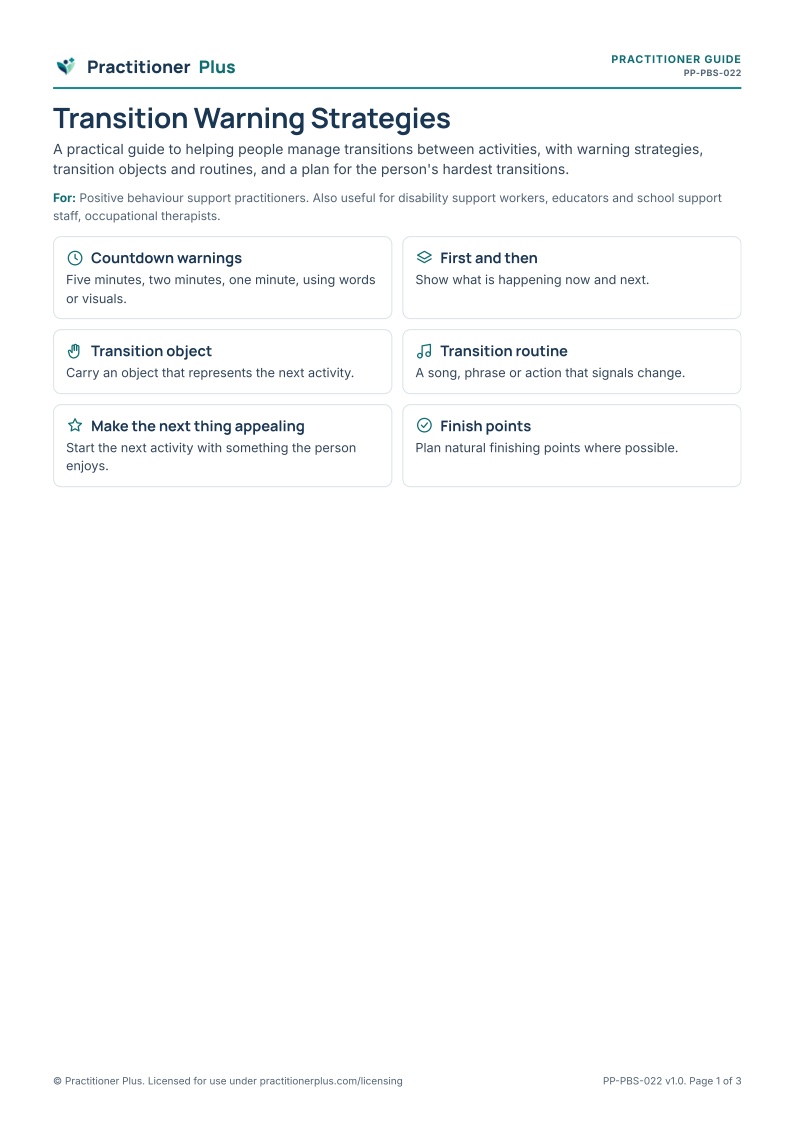
Moving from one activity to another can be hard, especially from something enjoyable. This guide offers warning strategies, such as countdowns, visual timers and first-then supports, transition objects and routines, and a plan for the person's hardest transitions.
Purpose
To make transitions predictable and less stressful.
Who it is for
Primary profession: Positive behaviour support practitioners. Also relevant for disability support workers, educators and school support staff, occupational therapists.
Client or participant group: Teams supporting people who find changing activities difficult.
Practice setting: Home, school, day programs and supported living.
Suggested uses
- Behaviour support planning
- Classroom transitions
- Leaving preferred activities
- Community outings
Instructions for practitioners
- Identify the hardest transitions first.
- Choose warning strategies that suit the person.
- Use them consistently across the team.
- Review with the behaviour support practitioner.
Accessibility considerations
Use the person's preferred visual, sound or object cues.
Scope and limitations
A practice guide. It is not a behaviour support plan.
Research basis
Visual schedules and other visual supports are established evidence-based practices for autistic children and young people, and are widely used with others who benefit from visual information. Positive behaviour support aims to improve quality of life and reduce behaviours of concern by understanding their function and changing environments and skills.
- Allen, D., James, W., Evans, J., Hawkins, S., & Jenkins, R. (2005). Positive Behavioural Support: Definition, Current Status and Future Directions. Tizard Learning Disability Review, 10(2), 4–11. https://doi.org/10.1108/13595474200500014
- Knight, V., Sartini, E., & Spriggs, A. D. (2015). Evaluating Visual Activity Schedules as Evidence-Based Practice for Individuals with Autism Spectrum Disorders. Journal of Autism and Developmental Disorders, 45(1), 157–178. https://doi.org/10.1007/s10803-014-2201-z
- NDIS Quality and Safeguards Commission. NDIS Practice Standards and Quality Indicators. https://www.ndiscommission.gov.au/rules-and-standards/ndis-practice-standards
- Steinbrenner, J. R., Hume, K., Odom, S. L., Morin, K. L., Nowell, S. W., Tomaszewski, B., Szendrey, S., McIntyre, N. S., Yücesoy-Özkan, S., & Savage, M. N. (2020). Evidence-based practices for children, youth, and young adults with autism. FPG Child Development Institute, University of North Carolina. https://ncaep.fpg.unc.edu/wp-content/uploads/EBP-Report-2020.pdf
What is included
A 3-page printable A4 PDF, including a practitioner notes page with the research basis (version 1.0).
Originality
Original Practitioner Plus content: wording, activity structure, layout and icons were created for this resource. No third-party worksheets, illustrations or text were reproduced.


