
About this resource
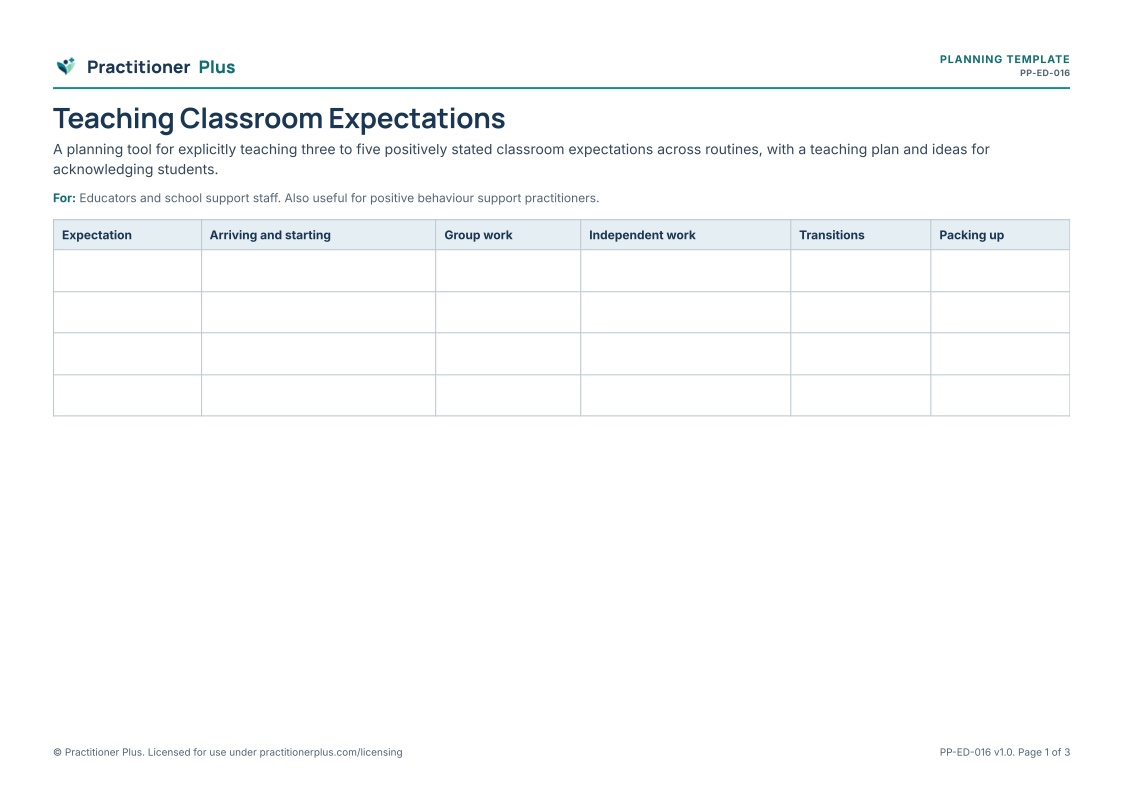
Students meet expectations more easily when they are taught, practised and acknowledged. This tool helps teachers write a few positively stated expectations, describe what they look like in different classroom routines, plan explicit teaching and choose ways to acknowledge students.
Purpose
To help teachers teach expectations explicitly and consistently, rather than only responding to behaviour.
Who it is for
Primary profession: Educators and school support staff. Also relevant for positive behaviour support practitioners.
Client or participant group: Teachers and school leaders.
Practice setting: Primary and secondary classrooms.
Suggested uses
- Start of year planning
- Resetting classroom culture
- Whole-school positive behaviour approaches
- Supporting graduate teachers
Instructions for practitioners
- Keep expectations few, positive and visible.
- Teach them like any other skill, with examples and practice.
- Acknowledge students often and specifically.
- Adapt for students with additional needs.
Accessibility considerations
Display expectations with visuals. Teach in multiple ways.
Scope and limitations
A planning tool. Align with your school's behaviour and wellbeing policies.
Research basis
Clear expectations, explicit teaching of routines and frequent positive feedback are evidence-based classroom practices; adjustments for students with disability are required under the Disability Standards for Education. Visual schedules and other visual supports are established evidence-based practices for autistic children and young people, and are widely used with others who benefit from visual information.
- Australian Government. Disability Standards for Education 2005. https://www.education.gov.au/disability-standards-education-2005
- Knight, V., Sartini, E., & Spriggs, A. D. (2015). Evaluating Visual Activity Schedules as Evidence-Based Practice for Individuals with Autism Spectrum Disorders. Journal of Autism and Developmental Disorders, 45(1), 157–178. https://doi.org/10.1007/s10803-014-2201-z
- Simonsen, B., Fairbanks, S., Briesch, A., Myers, D., & Sugai, G. (2008). Evidence-based practices in classroom management: Considerations for research to practice. Education and Treatment of Children, 31, 351–380. https://doi.org/10.1353/etc.0.0007
- Steinbrenner, J. R., Hume, K., Odom, S. L., Morin, K. L., Nowell, S. W., Tomaszewski, B., Szendrey, S., McIntyre, N. S., Yücesoy-Özkan, S., & Savage, M. N. (2020). Evidence-based practices for children, youth, and young adults with autism. FPG Child Development Institute, University of North Carolina. https://ncaep.fpg.unc.edu/wp-content/uploads/EBP-Report-2020.pdf
What is included
A 3-page printable A4 PDF, including a practitioner notes page with the research basis (version 1.0).
Originality
Original Practitioner Plus content: wording, activity structure, layout and icons were created for this resource. No third-party worksheets, illustrations or text were reproduced.


