
About this resource
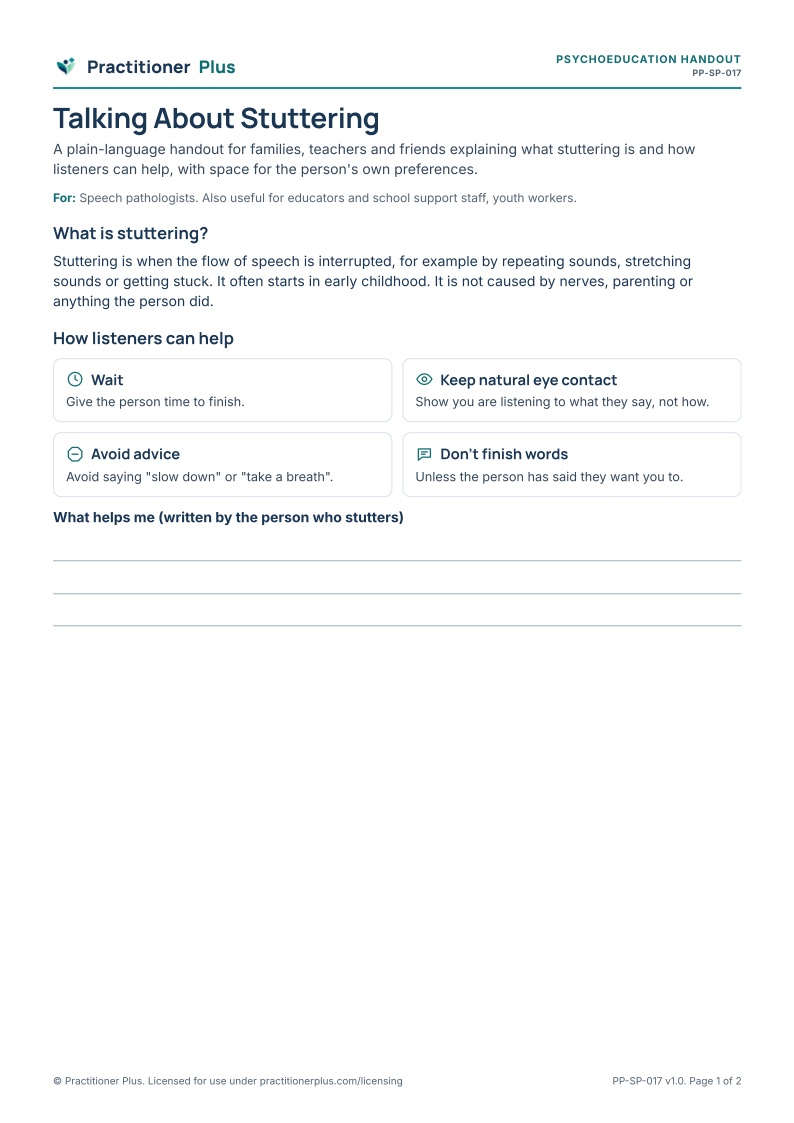
Stuttering is a difference in the flow of speech. It is not caused by nerves or parenting, and it is not a sign of lower intelligence. This handout explains stuttering simply and gives practical listener tips, with space for the person who stutters to share what helps them.
Purpose
To reduce misunderstanding about stuttering and help listeners respond supportively.
Who it is for
Primary profession: Speech pathologists. Also relevant for educators and school support staff, youth workers.
Client or participant group: Families, teachers and friends of children, young people and adults who stutter.
Practice setting: Speech pathology, schools and community settings.
Suggested uses
- Family education
- Teacher and school information
- Self-advocacy for young people and adults
- Group programs
Instructions for practitioners
- Share alongside individual speech pathology advice.
- Invite the person who stutters to add their preferences.
- Encourage open, relaxed conversation about stuttering.
- Refer early for assessment where a child has started stuttering.
Instructions for clients or participants
- Read the tips.
- Add what helps you.
- Share it with people you choose.
Accessibility considerations
Plain language. Can be shared digitally.
Scope and limitations
General information. It does not replace speech pathology assessment or treatment.
Research basis
Early stuttering intervention, such as the Lidcombe Program, is delivered by speech pathologists with parents. Training communication partners improves communication for people who use AAC and people with aphasia.
- Kent-Walsh, J., Murza, K. A., Malani, M. D., & Binger, C. (2015). Effects of Communication Partner Instruction on the Communication of Individuals using AAC: A Meta-Analysis. Augmentative and Alternative Communication, 31(4), 271–284. https://doi.org/10.3109/07434618.2015.1052153
- Onslow, M., Packman, A., & Harrison, E. (Eds.). (2003). The Lidcombe Program of early stuttering intervention: A clinician's guide. Pro-Ed.
- Simmons-Mackie, N., Raymer, A., & Cherney, L. R. (2016). Communication Partner Training in Aphasia: An Updated Systematic Review. Archives of Physical Medicine and Rehabilitation, 97(12), 2202–2221.e8. https://doi.org/10.1016/j.apmr.2016.03.023
What is included
A 2-page printable A4 PDF, including a practitioner notes page with the research basis (version 1.0).
Originality
Original Practitioner Plus content: wording, activity structure, layout and icons were created for this resource. No third-party worksheets, illustrations or text were reproduced.


