
,

Story Builder

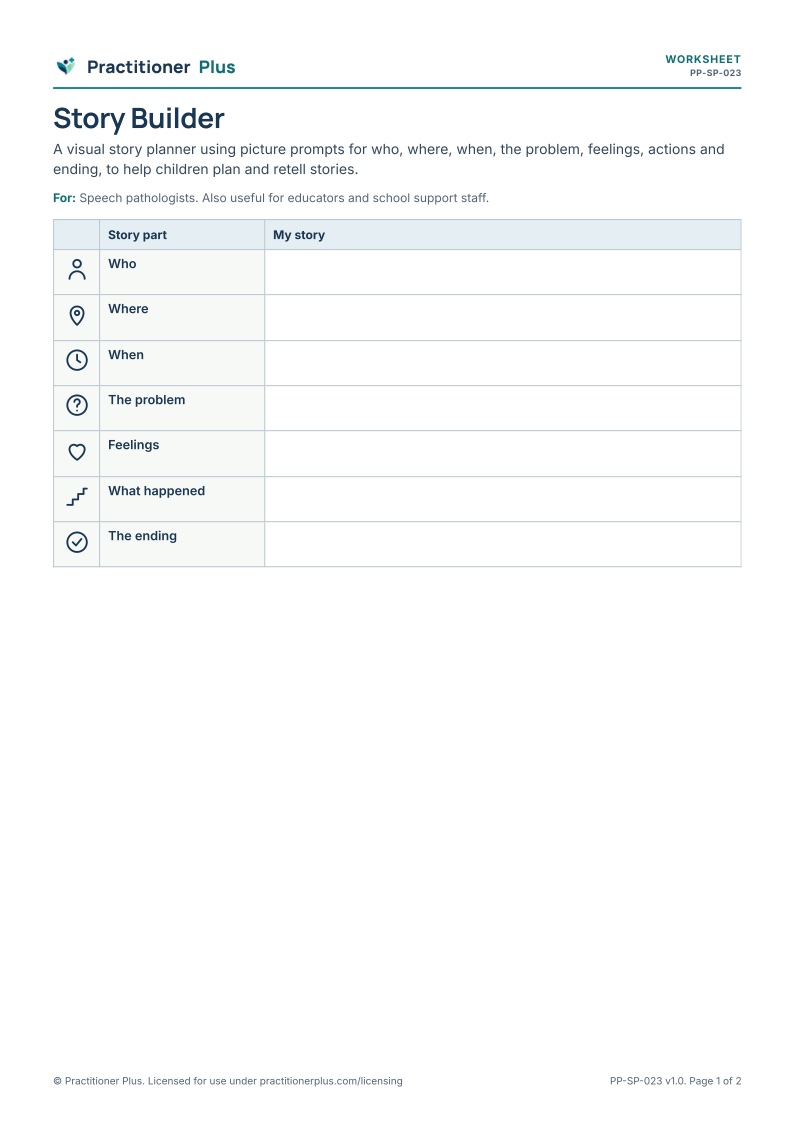
A visual story planner using picture prompts for who, where, when, the problem, feelings, actions and ending, to help children plan and retell stories.

Preview of the first page of Story Builder
Download PDF (2 pages)

Free to download. Plus members also get an editable Word version. See 399 more with Plus

Log in to save this resource

Primary profession
Speech pathologists
Client group
Children aged about 5 to 12, including those with language difficulties.
Practice setting
Speech pathology sessions, classrooms and home practice.
Format
Printable worksheets, Visual supports
Details
A4 PDF, printable
Pages
2
Editable version
Word (.docx), for Plus members
Demographics
Children
Age groups
Children
Access
Free
Resource code
PP-SP-023
Version
1.0

About this resource

Stories have a structure. This builder uses picture prompts for the main parts of a story: who, where, when, the problem, feelings, what happened and the ending. Children use it to plan their own stories or retell stories they have heard.

Purpose

To support children to tell and retell organised stories.

Who it is for

Primary profession: Speech pathologists. Also relevant for educators and school support staff.

Client or participant group: Children aged about 5 to 12, including those with language difficulties.

Practice setting: Speech pathology sessions, classrooms and home practice.

Suggested uses

  • Retelling stories after reading
  • Planning oral or written stories
  • Speech pathology sessions
  • Classroom literacy

Instructions for practitioners

  1. Model with a familiar story first.
  2. Use the picture prompts as cues.
  3. Gradually fade the prompts.
  4. Record the child's stories to track progress.

Instructions for clients or participants

  1. Fill in each box.
  2. Tell your story using the pictures.
  3. Add more detail.

Accessibility considerations

Children can draw or use pictures in each box.

Scope and limitations

A learning activity. It does not assess language.

Research basis

Parent-implemented language strategies and interactive shared reading support children's language development.

  • Mol, S. E., Bus, A. G., de Jong, M. T., & Smeets, D. J. H. (2008). Added Value of Dialogic Parent–Child Book Readings: A Meta-Analysis. Early Education and Development, 19(1), 7–26. https://doi.org/10.1080/10409280701838603
  • Roberts, M. Y., & Kaiser, A. P. (2011). The Effectiveness of Parent-Implemented Language Interventions: A Meta-Analysis. American Journal of Speech-Language Pathology, 20(3), 180–199. https://doi.org/10.1044/1058-0360(2011/10-0055)

What is included

A 2-page printable A4 PDF, including a practitioner notes page with the research basis (version 1.0).

Originality

Original Practitioner Plus content: wording, activity structure, layout and icons were created for this resource. No third-party worksheets, illustrations or text were reproduced. Symbols are original line drawings created for Practitioner Plus.

Members also use

Go further with Plus

Plus members get 399 more practical resources like these, each with practitioner notes, a research basis and an editable Word version, from $11.99 a month billed yearly ($143.88 a year).

See Plus membership
Plus membersVisual supports

For Speech pathologists

Reading Comprehension Bookmark

A printable bookmark with prompts to use before, during and after reading, helping students predict, check understanding, visualise, question and summarise.

Reading comprehension · Skill building

Plus membersInteractive activities

For Speech pathologists

Following Instructions Practice

A structured practice set for building understanding of spoken instructions, from one-step to three-step and concept-based instructions, with partner strategies and a progress record.

Communication partner strategies · Following instructions

Plus membersTemplates and planning tools

For Positive behaviour support practitioners

Coping Skills Teaching Plan

A plan for teaching a coping skill as a replacement for behaviours of concern, covering the skill, why it fits, teaching steps, practice when…

Proactive support strategies · Skill building

Practitioner Plus membership

Spend less time searching and more time with people.

Start with a free account, then upgrade to Plus for the full premium library, favourites and new releases.