
About this resource
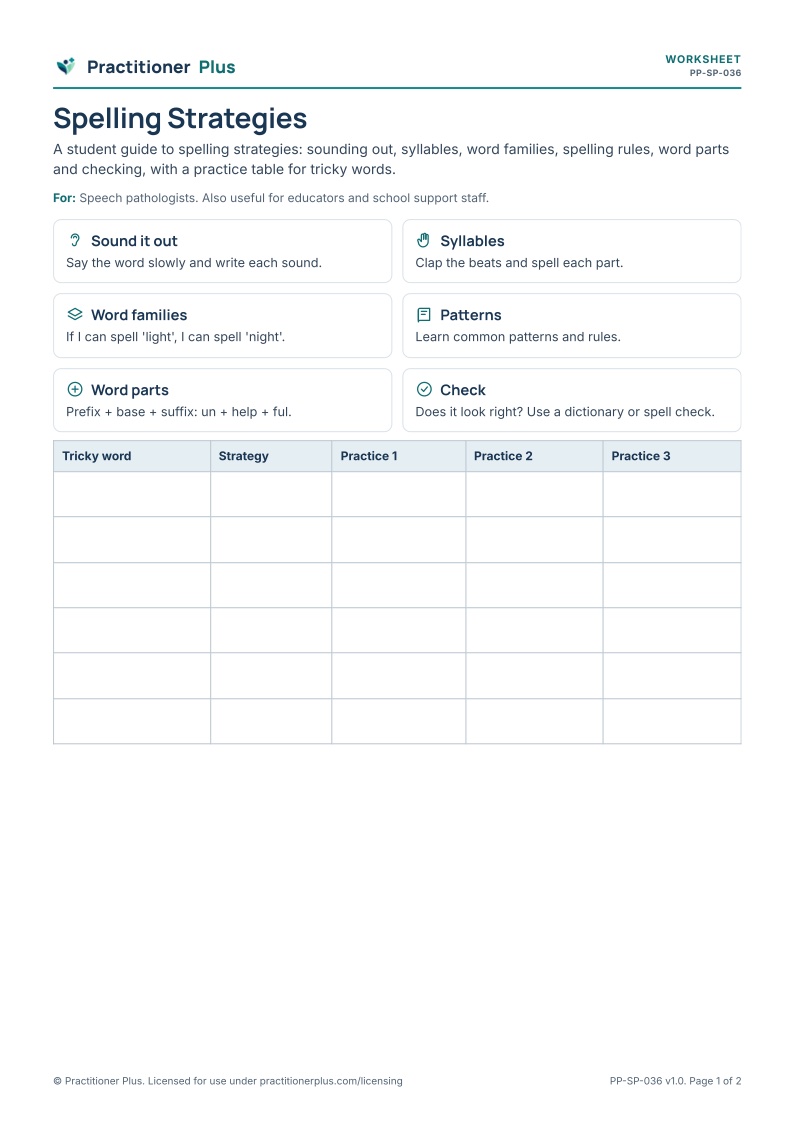
Good spellers use more than one strategy. This guide explains sounding out, breaking into syllables, word families, common patterns, word parts such as prefixes and suffixes, and checking, with a practice table for tricky words.
Purpose
To give students a toolkit of spelling strategies.
Who it is for
Primary profession: Speech pathologists. Also relevant for educators and school support staff.
Client or participant group: Students aged about 7 to 14, including those with literacy difficulties.
Practice setting: Speech pathology, classrooms and home practice.
Suggested uses
- Spelling instruction
- Speech pathology sessions
- Home practice
- Writing support
Instructions for practitioners
- Teach each strategy explicitly.
- Link to the student's phonological and morphological skills.
- Use words from the student's writing.
- Revisit strategies often.
Instructions for clients or participants
- Choose a strategy.
- Practise tricky words.
- Check your spelling.
Accessibility considerations
Use colour and visuals.
Scope and limitations
A learning support. It does not assess literacy.
Research basis
Explicit teaching of phonics, fluency, vocabulary and comprehension supports reading development. Explicit teaching of writing strategies improves students' writing.
- Castles, A., Rastle, K., & Nation, K. (2018). Ending the Reading Wars: Reading Acquisition From Novice to Expert. Psychological Science in the Public Interest, 19(1), 5–51. https://doi.org/10.1177/1529100618772271
- Graham, S., & Perin, D. (2007). A meta-analysis of writing instruction for adolescent students. Journal of Educational Psychology, 99(3), 445–476. https://doi.org/10.1037/0022-0663.99.3.445
What is included
A 2-page printable A4 PDF, including a practitioner notes page with the research basis (version 1.0).
Originality
Original Practitioner Plus content: wording, activity structure, layout and icons were created for this resource. No third-party worksheets, illustrations or text were reproduced.


