
About this resource
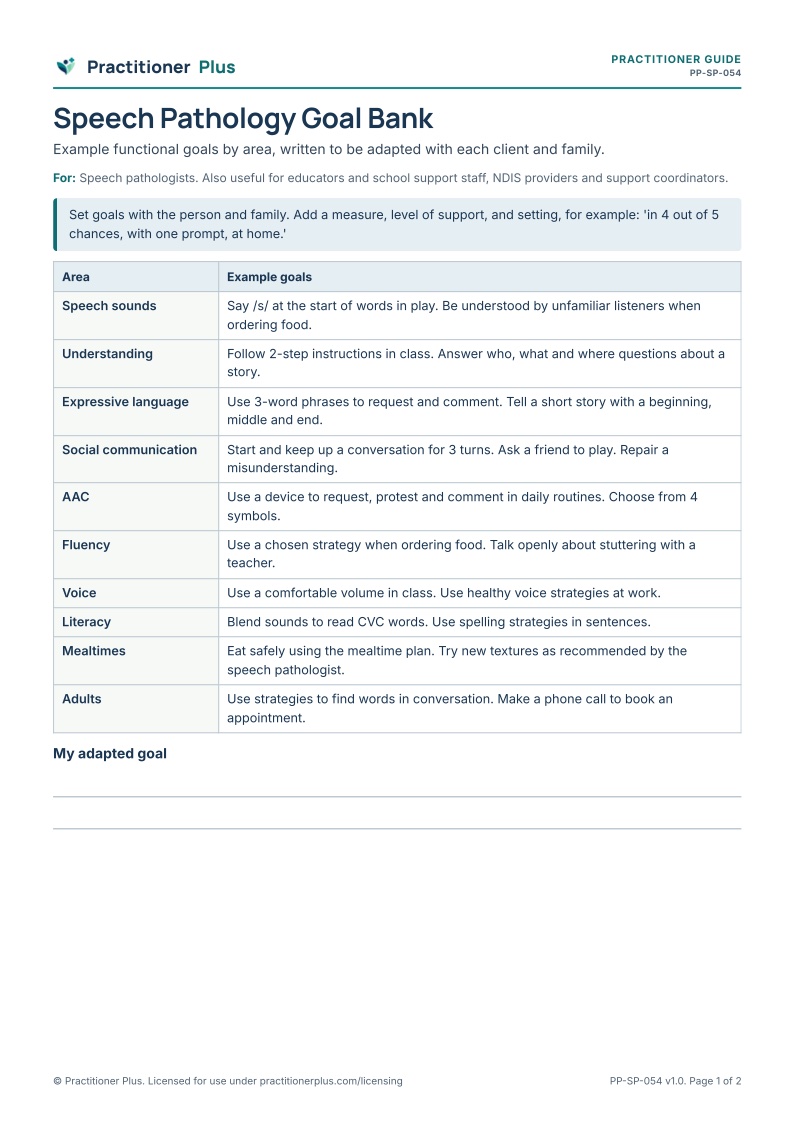
Speech pathologists often want a starting point for writing goals. This goal bank gives example functional goals in speech, language, social communication, AAC, fluency, voice, and mealtimes. Adapt each goal for the person, and make it measurable.
Purpose
Example functional goals by area, written to be adapted with each client and family.
Who it is for
Primary profession: Speech pathologists. Also relevant for educators and school support staff, NDIS providers and support coordinators.
Client or participant group: Speech pathologists and students.
Practice setting: Speech pathology practices and schools.
Suggested uses
- NDIS plans
- Therapy planning
- Student placement
Instructions for practitioners
- Add your details and delete what does not apply.
- Check it against your professional requirements.
- Explain it to the person in plain language.
- Store completed copies securely.
Accessibility considerations
Clear headings and tables. The Word version can be edited and filled in on screen.
Scope and limitations
Examples to adapt. They do not replace clinical assessment.
Research basis
Specific goals, if-then plans and regular progress monitoring all improve the chances of reaching goals. Training communication partners improves communication for people who use AAC and people with aphasia.
- Gollwitzer, P. M., & Sheeran, P. (2006). Implementation Intentions and Goal Achievement: A Meta‐analysis of Effects and Processes. Advances in Experimental Social Psychology, 69–119. https://doi.org/10.1016/s0065-2601(06)38002-1
- Harkin, B., Webb, T. L., Chang, B. P. I., Prestwich, A., Conner, M., Kellar, I., Benn, Y., & Sheeran, P. (2016). Does monitoring goal progress promote goal attainment? A meta-analysis of the experimental evidence. Psychological Bulletin, 142(2), 198–229. https://doi.org/10.1037/bul0000025
- Kent-Walsh, J., Murza, K. A., Malani, M. D., & Binger, C. (2015). Effects of Communication Partner Instruction on the Communication of Individuals using AAC: A Meta-Analysis. Augmentative and Alternative Communication, 31(4), 271–284. https://doi.org/10.3109/07434618.2015.1052153
- Locke, E. A., & Latham, G. P. (2002). Building a practically useful theory of goal setting and task motivation: A 35-year odyssey. American Psychologist, 57(9), 705–717. https://doi.org/10.1037/0003-066x.57.9.705
- Simmons-Mackie, N., Raymer, A., & Cherney, L. R. (2016). Communication Partner Training in Aphasia: An Updated Systematic Review. Archives of Physical Medicine and Rehabilitation, 97(12), 2202–2221.e8. https://doi.org/10.1016/j.apmr.2016.03.023
What is included
A 2-page printable A4 PDF, including a practitioner notes page with the research basis (version 1.0).
Originality
Original Practitioner Plus content: wording, activity structure, layout and icons were created for this resource. No third-party worksheets, illustrations or text were reproduced. Written for Practitioner Plus from the sources in the research basis.


