
About this resource
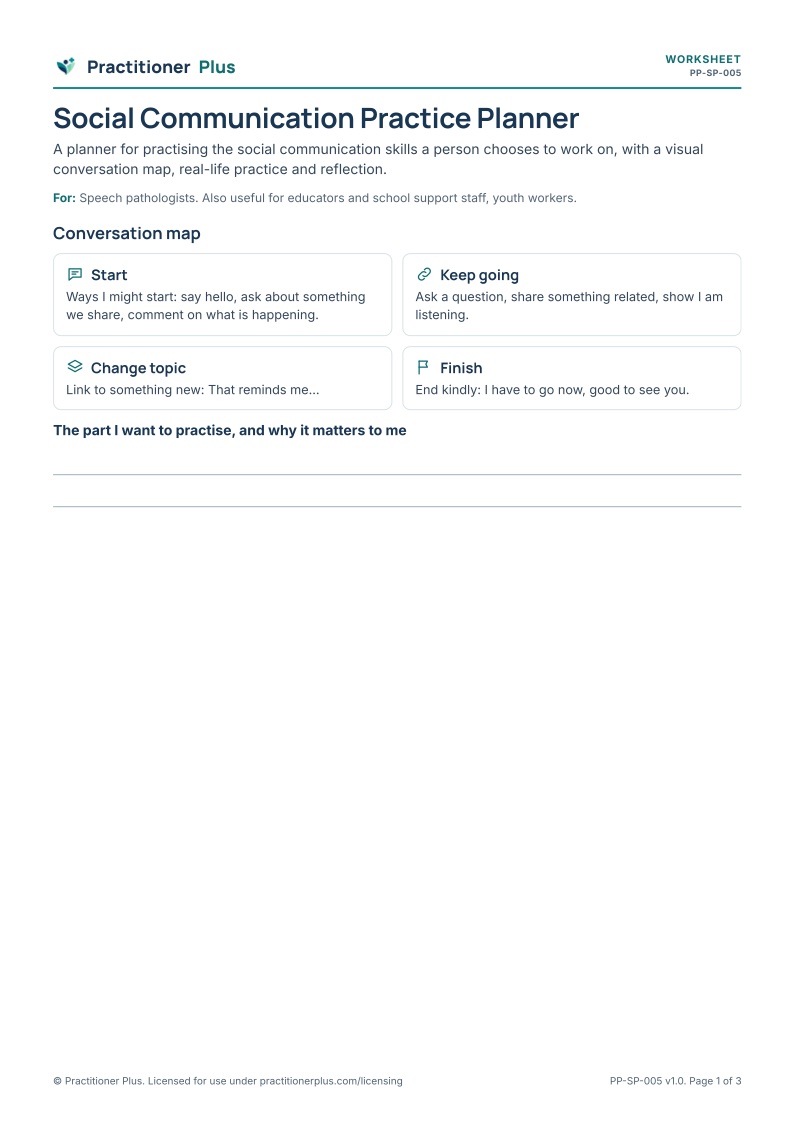
Social communication goals should be the person's own. This planner uses a simple conversation map (start, keep going, change topic and finish) to help the person choose a skill to practise, plan where and how, and reflect on what happened, respecting their natural communication style.
Purpose
To support person-chosen social communication goals through planning, practice in real situations and reflection.
Who it is for
Primary profession: Speech pathologists. Also relevant for educators and school support staff, youth workers.
Client or participant group: Adolescents and adults who want to build confidence in social communication.
Practice setting: Speech pathology sessions with practice at school, work or in the community.
Suggested uses
- Working towards person-chosen social goals
- Preparing for social situations at school or work
- Group programs on conversation skills
- Building confidence after social difficulties
Instructions for practitioners
- Ask what the person wants to change, if anything, and why.
- Respect neurodivergent communication styles; focus on the person's goals, not on masking.
- Use the conversation map to choose one skill to practise.
- Plan practice in a real situation, then reflect together.
Instructions for clients or participants
- Choose a part of conversation you want to practise.
- Plan where you will practise.
- Notice how it went.
Accessibility considerations
The conversation map is visual. Scripts can be written, recorded or programmed into AAC.
Scope and limitations
A goal-based practice planner. It does not replace speech pathology assessment and should not be used to require people to change their natural communication style.
Research basis
School-based social and emotional learning programs improve students' social skills, behaviour and academic results. Training communication partners improves communication for people who use AAC and people with aphasia.
- Durlak, J. A., Weissberg, R. P., Dymnicki, A. B., Taylor, R. D., & Schellinger, K. B. (2011). The Impact of Enhancing Students’ Social and Emotional Learning: A Meta-Analysis of School-Based Universal Interventions. Child Development, 82(1), 405–432. https://doi.org/10.1111/j.1467-8624.2010.01564.x
- Kent-Walsh, J., Murza, K. A., Malani, M. D., & Binger, C. (2015). Effects of Communication Partner Instruction on the Communication of Individuals using AAC: A Meta-Analysis. Augmentative and Alternative Communication, 31(4), 271–284. https://doi.org/10.3109/07434618.2015.1052153
- Simmons-Mackie, N., Raymer, A., & Cherney, L. R. (2016). Communication Partner Training in Aphasia: An Updated Systematic Review. Archives of Physical Medicine and Rehabilitation, 97(12), 2202–2221.e8. https://doi.org/10.1016/j.apmr.2016.03.023
What is included
A 3-page printable A4 PDF, including a practitioner notes page with the research basis (version 1.0).
Originality
Original Practitioner Plus content: wording, activity structure, layout and icons were created for this resource. No third-party worksheets, illustrations or text were reproduced.


