
About this resource
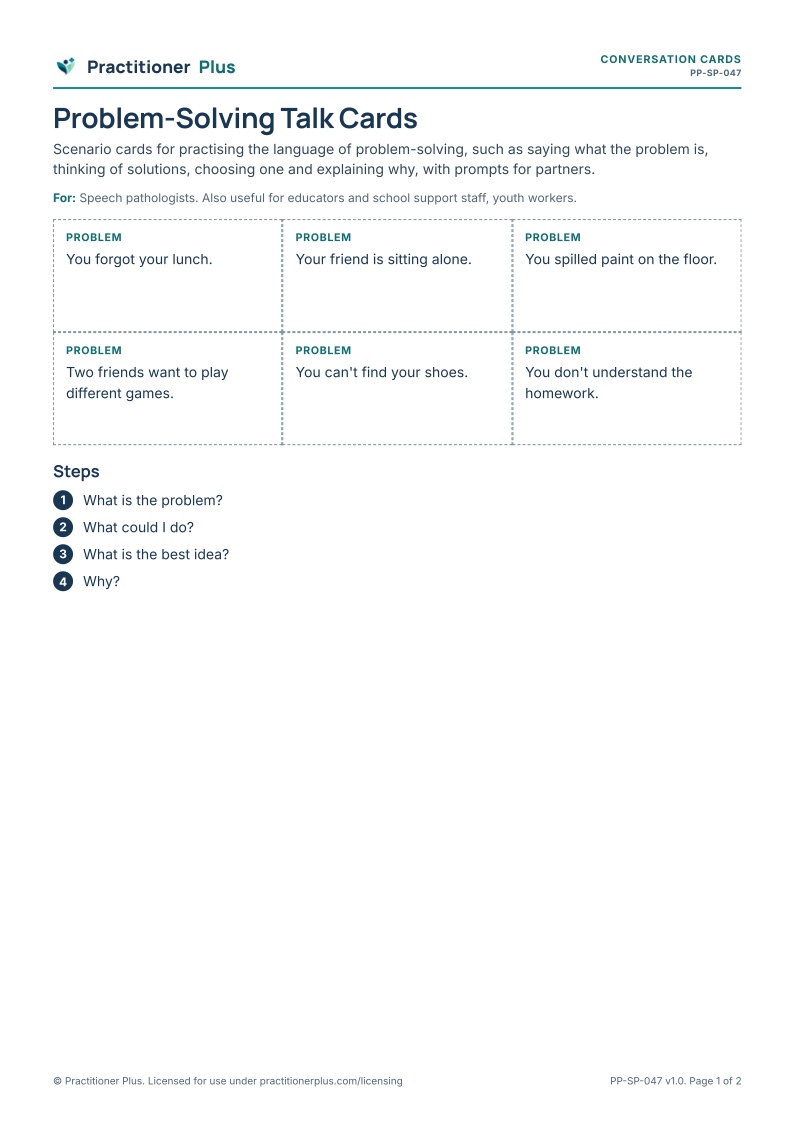
Talking through problems needs specific language. These scenario cards help children say what the problem is, think of solutions, choose one and explain why, with prompts for partners to scaffold their answers.
Purpose
To build the language needed to talk through problems.
Who it is for
Primary profession: Speech pathologists. Also relevant for educators and school support staff, youth workers.
Client or participant group: Children and adolescents building reasoning and problem-solving language.
Practice setting: Speech pathology, classrooms and social skills groups.
Suggested uses
- Speech pathology sessions
- Social skills groups
- Classroom discussion
- Home practice
Instructions for practitioners
- Model the steps.
- Scaffold with prompts.
- Accept different solutions.
- Link to real situations.
Instructions for clients or participants
- Read the problem.
- Think of solutions.
- Choose one and say why.
Accessibility considerations
Read aloud. Use pictures.
Scope and limitations
A learning activity.
Research basis
Parent-implemented language strategies and interactive shared reading support children's language development. School-based social and emotional learning programs improve students' social skills, behaviour and academic results.
- Durlak, J. A., Weissberg, R. P., Dymnicki, A. B., Taylor, R. D., & Schellinger, K. B. (2011). The Impact of Enhancing Students’ Social and Emotional Learning: A Meta-Analysis of School-Based Universal Interventions. Child Development, 82(1), 405–432. https://doi.org/10.1111/j.1467-8624.2010.01564.x
- Mol, S. E., Bus, A. G., de Jong, M. T., & Smeets, D. J. H. (2008). Added Value of Dialogic Parent–Child Book Readings: A Meta-Analysis. Early Education and Development, 19(1), 7–26. https://doi.org/10.1080/10409280701838603
- Roberts, M. Y., & Kaiser, A. P. (2011). The Effectiveness of Parent-Implemented Language Interventions: A Meta-Analysis. American Journal of Speech-Language Pathology, 20(3), 180–199. https://doi.org/10.1044/1058-0360(2011/10-0055)
What is included
A 2-page printable A4 PDF, including a practitioner notes page with the research basis (version 1.0).
Originality
Original Practitioner Plus content: wording, activity structure, layout and icons were created for this resource. No third-party worksheets, illustrations or text were reproduced.


