
About this resource
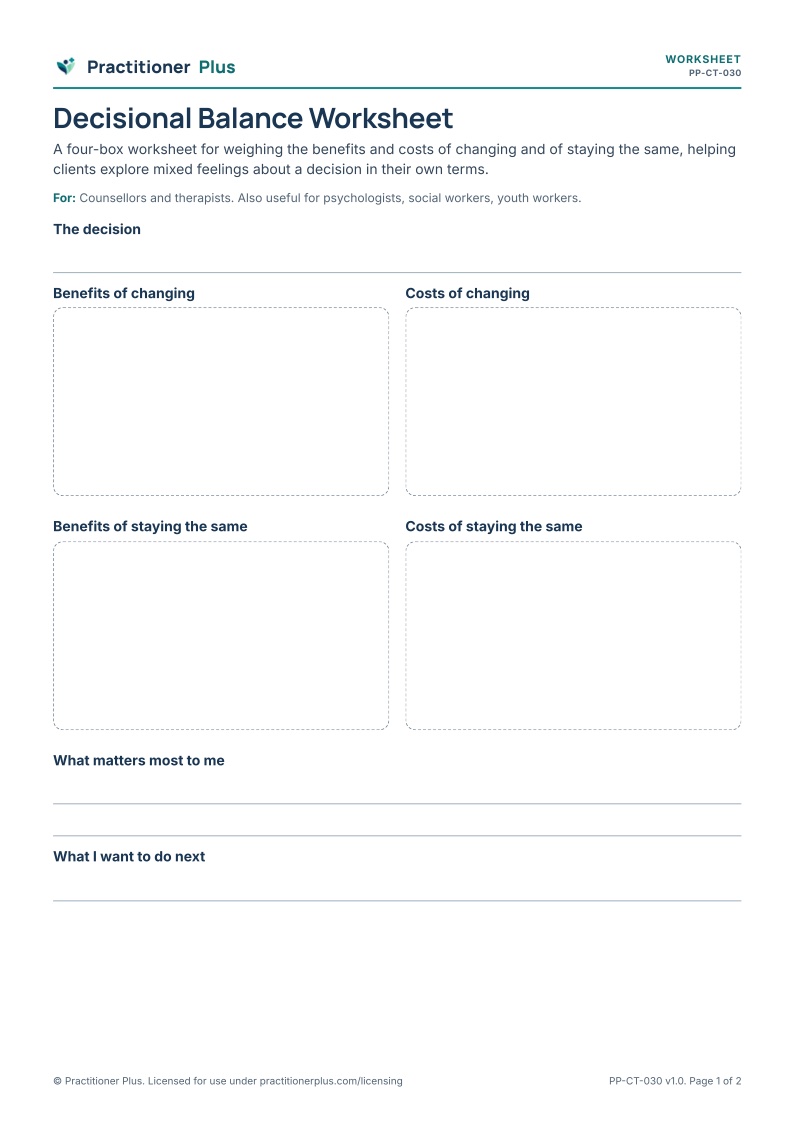
Most changes come with mixed feelings. This worksheet asks clients to consider the benefits and costs of making a change and of staying the same, then reflect on which matter most and what they want to do next.
Purpose
To help clients explore ambivalence and clarify what matters most to them.
Who it is for
Primary profession: Counsellors and therapists. Also relevant for psychologists, social workers, youth workers.
Client or participant group: Adolescents and adults with mixed feelings about a change.
Practice setting: Counselling and support conversations.
Suggested uses
- Exploring ambivalence
- Health behaviour change
- Relationship or work decisions
- Alcohol and other drug conversations
Instructions for practitioners
- Let the client fill in all four boxes, including the benefits of staying the same.
- Explore which items matter most, not how many there are.
- Avoid pushing for a decision.
- Link to values and next steps when ready.
Instructions for clients or participants
- Fill in all four boxes.
- Circle what matters most.
- Write what you want to do next, if anything.
Accessibility considerations
Can be completed verbally or with sticky notes.
Scope and limitations
A conversation tool for use within counselling.
Research basis
Motivational interviewing has consistent, modest benefits for behaviour change across health and social care settings. Structured problem solving (problem-solving therapy) is an effective treatment for depression.
- Bell, A. C., & D'Zurilla, T. J. (2009). Problem-solving therapy for depression: A meta-analysis. Clinical Psychology Review, 29(4), 348–353. https://doi.org/10.1016/j.cpr.2009.02.003
- Lundahl, B. W., Kunz, C., Brownell, C., Tollefson, D., & Burke, B. L. (2010). A Meta-Analysis of Motivational Interviewing: Twenty-Five Years of Empirical Studies. Research on Social Work Practice, 20(2), 137–160. https://doi.org/10.1177/1049731509347850
- Miller, W. R., & Rollnick, S. (2013). Motivational Interviewing: Helping People Change (3rd ed.). Guilford Press.
What is included
A 2-page printable A4 PDF, including a practitioner notes page with the research basis (version 1.0).
Originality
Original Practitioner Plus content: wording, activity structure, layout and icons were created for this resource. No third-party worksheets, illustrations or text were reproduced. Reflects widely used decisional balance approaches.


