
About this resource
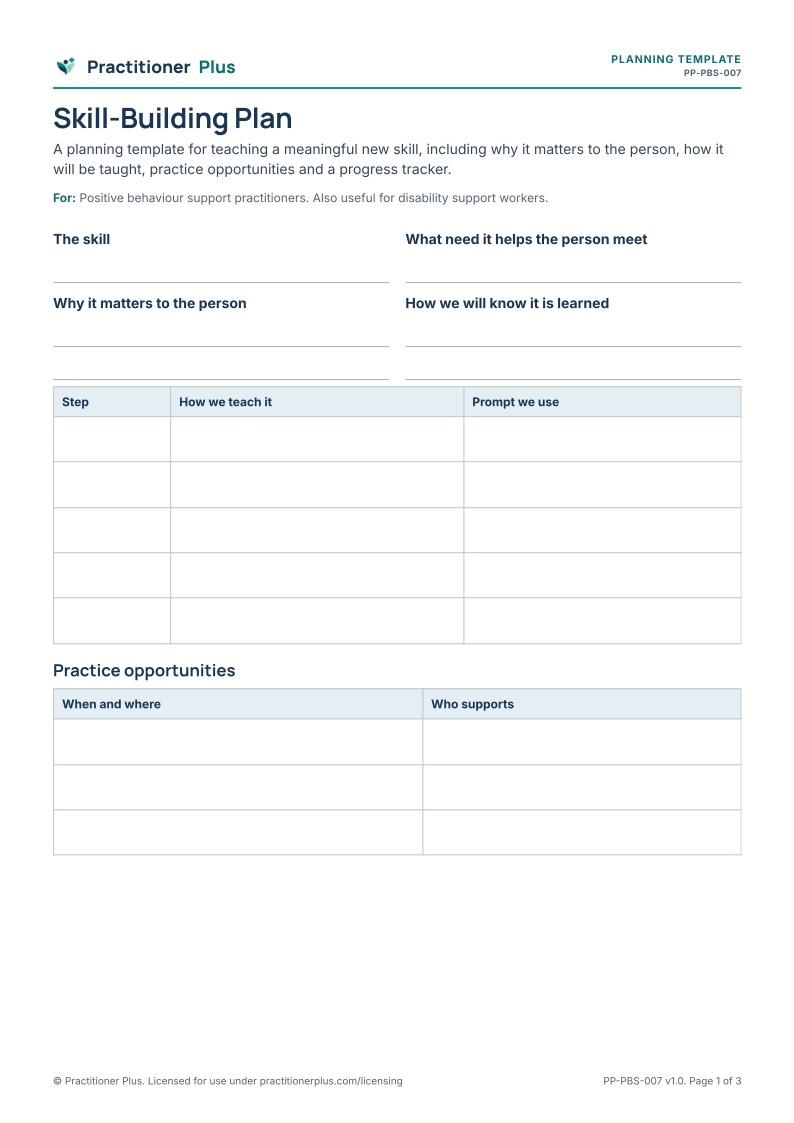
Building skills is central to positive behaviour support. This plan helps teams choose a meaningful skill, link it to what matters to the person, agree how it will be taught and prompted, create daily practice opportunities, acknowledge progress in ways the person values and track progress over time.
Purpose
To plan consistent teaching of skills that improve quality of life and give the person more effective ways to meet their needs.
Who it is for
Primary profession: Positive behaviour support practitioners. Also relevant for disability support workers.
Client or participant group: People receiving behaviour support and their support teams.
Practice setting: Supported living, day programs, schools and family homes, with a behaviour support practitioner.
Suggested uses
- Teaching communication, daily living or coping skills
- Building alternatives that meet the same need as a behaviour of concern
- Coordinating teaching across a team
- Reviewing progress with the behaviour support practitioner
Instructions for practitioners
- Choose a skill with the person, linked to their goals and quality of life.
- Break the skill into steps and agree prompts that everyone will use.
- Plan several daily opportunities to practise.
- Acknowledge progress in ways the person values.
- Track progress and review with the behaviour support practitioner.
Accessibility considerations
Use visual steps, modelling and the person's preferred communication. Teach in the settings where the skill will be used.
Scope and limitations
A general skill-teaching plan. It is not a behaviour support plan and does not recommend restrictive practices.
Research basis
Positive behaviour support aims to improve quality of life and reduce behaviours of concern by understanding their function and changing environments and skills. Active support, which gives people real opportunities and just-enough help to take part in everyday activities, increases engagement for people with intellectual disability.
- Allen, D., James, W., Evans, J., Hawkins, S., & Jenkins, R. (2005). Positive Behavioural Support: Definition, Current Status and Future Directions. Tizard Learning Disability Review, 10(2), 4–11. https://doi.org/10.1108/13595474200500014
- Mansell, J., & Beadle-Brown, J. (2012). Active support: Enabling and empowering people with intellectual disabilities. Jessica Kingsley Publishers.
- NDIS Quality and Safeguards Commission. NDIS Practice Standards and Quality Indicators. https://www.ndiscommission.gov.au/rules-and-standards/ndis-practice-standards
What is included
A 3-page printable A4 PDF, including a practitioner notes page with the research basis (version 1.0).
Originality
Original Practitioner Plus content: wording, activity structure, layout and icons were created for this resource. No third-party worksheets, illustrations or text were reproduced. Reflects widely described skill-teaching principles in positive behaviour support.


