
About this resource
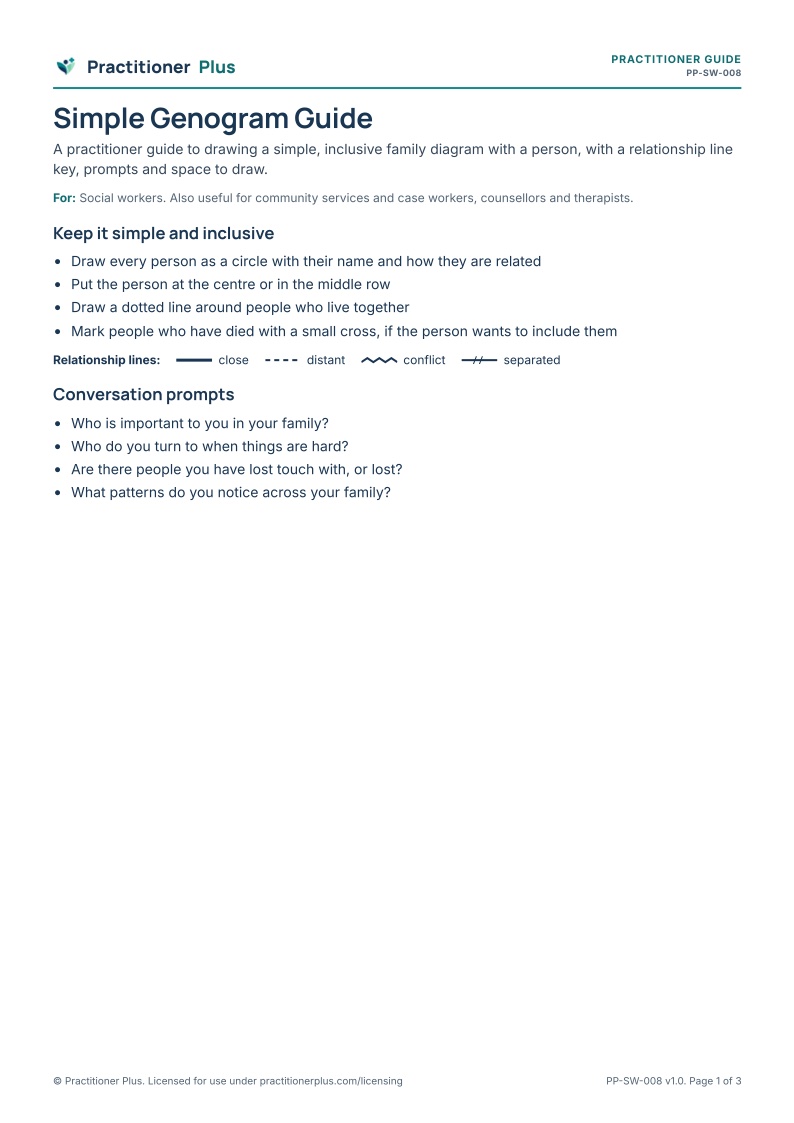
Family diagrams help people and practitioners see relationships, losses and patterns at a glance. This guide uses a simple, inclusive approach: everyone is drawn the same way and labelled with their name and relationship, and line styles show how relationships feel. Prompts guide the conversation and there is space to draw.
Purpose
To map family relationships and patterns across generations in a way the person can see, shape and own.
Who it is for
Primary profession: Social workers. Also relevant for community services and case workers, counsellors and therapists.
Client or participant group: Adolescents, adults and families, with the diagram drawn together with a social worker.
Practice setting: Family work, hospital, child and family services and casework.
Suggested uses
- Early family assessment conversations
- Exploring family patterns, supports and losses
- Kinship and carer arrangements
- Family meetings and planning
Instructions for practitioners
- Explain the purpose and that the person decides who is included and how they are described.
- Start with the person and their household, then add generations as relevant.
- Use the line key to show closeness, distance and conflict, in the person's words.
- Be sensitive to loss, estrangement, adoption, care experience and diverse family structures.
- Use the diagram to explore supports and patterns, not to judge.
Instructions for clients or participants
- Tell us who is in your family, in your own way.
- Choose how to show each relationship.
- Say what you notice when you look at it.
Accessibility considerations
Draw on paper, a whiteboard or with tokens. Use the person's words for relationships, including chosen family and kin.
Scope and limitations
A conversational mapping guide. It is not a formal family assessment and does not replace safeguarding or risk procedures.
Research basis
Genograms are a widely used way of mapping family relationships and patterns.
- McGoldrick, M., Gerson, R., & Petry, S. (2020). Genograms: Assessment and Treatment (4th ed.). W. W. Norton.
What is included
A 3-page printable A4 PDF, including a practitioner notes page with the research basis (version 1.0).
Originality
Original Practitioner Plus content: wording, activity structure, layout and icons were created for this resource. No third-party worksheets, illustrations or text were reproduced. Reflects the widely used practice of family diagramming; the inclusive symbol approach is original.


