
About this resource
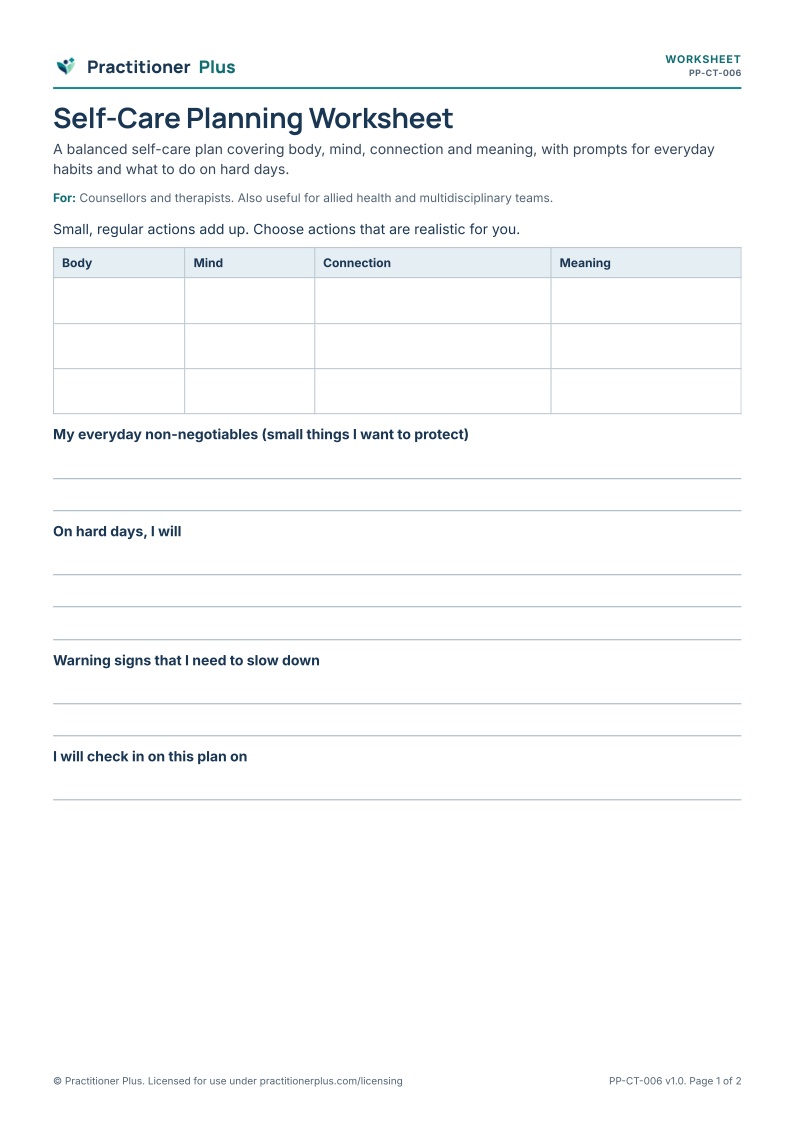
Self-care is more than occasional treats. This worksheet helps people plan small, regular actions across four areas of life, and decide in advance what they will do on harder days.
Purpose
To plan small, regular self-care actions and what to do on hard days.
Who it is for
Primary profession: Counsellors and therapists. Also relevant for allied health and multidisciplinary teams.
Client or participant group: Adults and young adults, including practitioners planning their own self-care.
Practice setting: Counselling sessions, practitioner supervision and team wellbeing sessions.
Suggested uses
- Planning everyday wellbeing habits
- Preparing for busy or stressful periods
- Practitioner self-care and supervision
- Group wellbeing sessions
Instructions for practitioners
- Explain the four areas: body, mind, connection and meaning.
- Ask for one or two realistic actions in each area.
- Plan a short list of what helps on hard days.
- Choose a time to check in on the plan.
Instructions for clients or participants
- Choose small actions for each area.
- Plan what you will do on hard days.
Accessibility considerations
Can be completed verbally or with images.
Scope and limitations
Self-care is not a substitute for addressing workload, safety or systemic stressors. Where those are significant, explore them alongside personal self-care.
Research basis
Understanding, naming and choosing strategies for emotions are central to emotion regulation; putting feelings into words and finer emotion distinctions are linked to better regulation. Gratitude and savouring practices have small but real effects on wellbeing, and are best used alongside support for any difficulties.
- Bryant, F. B., & Veroff, J. (2007). Savoring: A New Model of Positive Experience. Lawrence Erlbaum Associates.
- Davis, D. E., Choe, E., Meyers, J., Wade, N., Varjas, K., Gifford, A., Quinn, A., Hook, J. N., Van Tongeren, D. R., Griffin, B. J., & Worthington, E. L. (2016). Thankful for the little things: A meta-analysis of gratitude interventions. Journal of Counseling Psychology, 63(1), 20–31. https://doi.org/10.1037/cou0000107
- Gross, J. J. (2015). Emotion Regulation: Current Status and Future Prospects. Psychological Inquiry, 26(1), 1–26. https://doi.org/10.1080/1047840x.2014.940781
- Kashdan, T. B., Barrett, L. F., & McKnight, P. E. (2015). Unpacking Emotion Differentiation: Transforming Unpleasant Experience by Perceiving Distinctions in Negativity. Current Directions in Psychological Science, 24(1), 10–16. https://doi.org/10.1177/0963721414550708
- Kircanski, K., Lieberman, M. D., & Craske, M. G. (2012). Feelings Into Words: Contributions of Language to Exposure Therapy. Psychological Science, 23(10), 1086–1091. https://doi.org/10.1177/0956797612443830
What is included
A 2-page printable A4 PDF, including a practitioner notes page with the research basis (version 1.0).
Originality
Original Practitioner Plus content: wording, activity structure and layout were created for this resource. No third-party worksheets, illustrations or text were reproduced.


