
About this resource
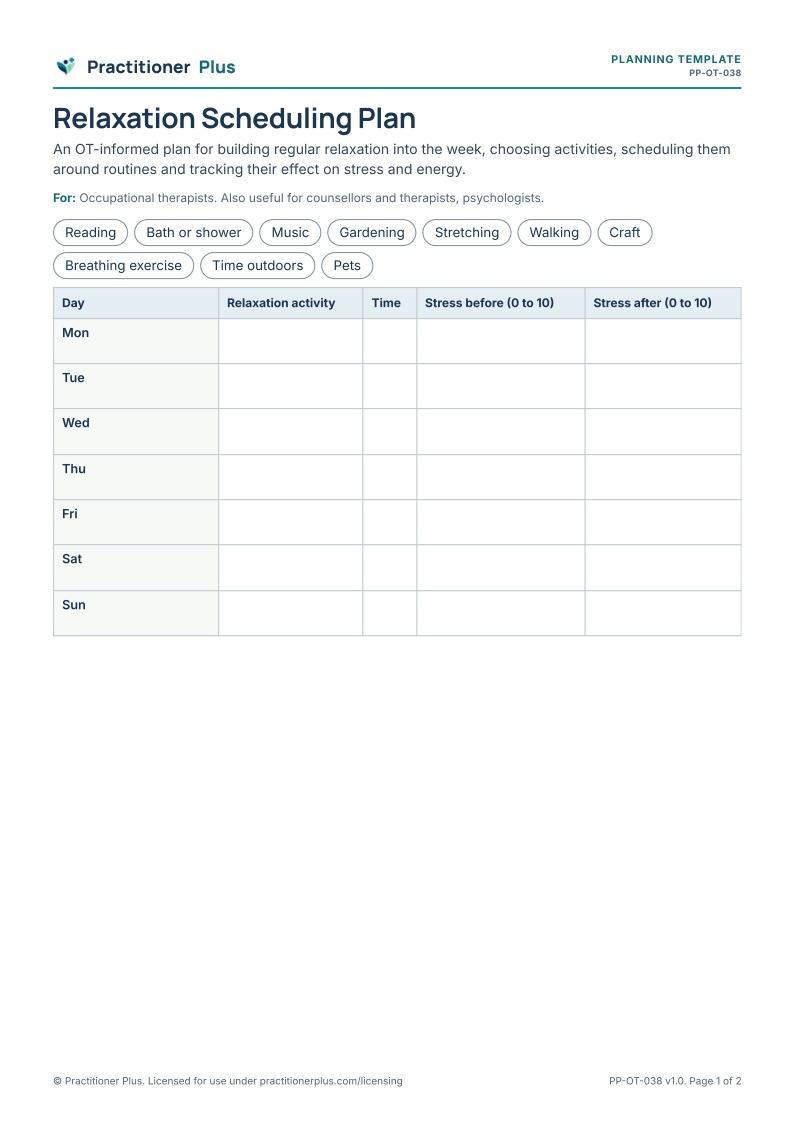
Relaxation is easier when it is planned. This plan helps people choose relaxing activities they enjoy, schedule them around existing routines and track their effect on stress and energy over a week.
Purpose
To make relaxation a planned, regular part of life.
Who it is for
Primary profession: Occupational therapists. Also relevant for counsellors and therapists, psychologists.
Client or participant group: Adolescents and adults with stress, fatigue or busy routines.
Practice setting: Occupational therapy, mental health and wellbeing programs.
Suggested uses
- Stress management
- Fatigue management
- Occupational balance
- Mental health recovery
Instructions for practitioners
- Choose activities the person finds relaxing.
- Schedule short, regular times.
- Review effects on stress and energy.
- Link to occupational balance goals.
Instructions for clients or participants
- Choose activities.
- Schedule them.
- Rate stress before and after.
Accessibility considerations
Use visual calendars or phone reminders.
Scope and limitations
A planning tool.
Research basis
Relaxation training, including breathing and muscle relaxation, reduces anxiety across a range of groups. Occupational therapy models describe how the person, their environment and their activities interact, and how a balance of meaningful activity supports health and participation.
- Law, M., Cooper, B., Strong, S., Stewart, D., Rigby, P., & Letts, L. (1996). The Person-Environment-Occupation Model: A Transactive Approach to Occupational Performance. Canadian Journal of Occupational Therapy, 63(1), 9–23. https://doi.org/10.1177/000841749606300103
- Manzoni, G. M., Pagnini, F., Castelnuovo, G., & Molinari, E. (2008). Relaxation training for anxiety: a ten-years systematic review with meta-analysis. BMC Psychiatry, 8(1), 41. https://doi.org/10.1186/1471-244x-8-41
- Wagman, P., Håkansson, C., & Björklund, A. (2012). Occupational balance as used in occupational therapy: A concept analysis. Scandinavian Journal of Occupational Therapy, 19(4), 322–327. https://doi.org/10.3109/11038128.2011.596219
- World Health Organization. (2001). International classification of functioning, disability and health (ICF). WHO. https://www.who.int/standards/classifications/international-classification-of-functioning-disability-and-health
What is included
A 2-page printable A4 PDF, including a practitioner notes page with the research basis (version 1.0).
Originality
Original Practitioner Plus content: wording, activity structure, layout and icons were created for this resource. No third-party worksheets, illustrations or text were reproduced.


