
About this resource
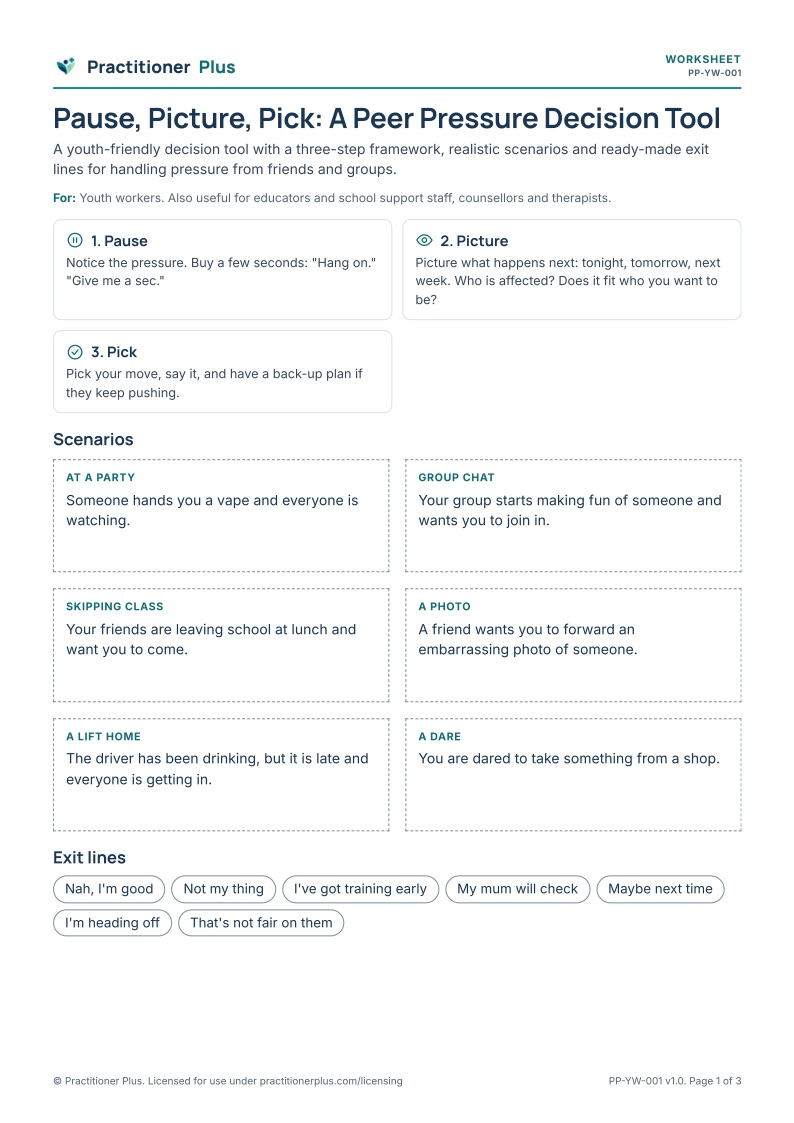
Pressure from friends rarely comes with time to think. Pause, Picture, Pick is a three-step framework young people can use in the moment: buy a few seconds, picture what happens next, then pick and say their choice. It comes with realistic scenarios and exit lines to practise.
Purpose
To give young people a quick, memorable way to slow down decisions under pressure and practise what to say.
Who it is for
Primary profession: Youth workers. Also relevant for educators and school support staff, counsellors and therapists.
Client or participant group: Young people aged about 12 to 18, one to one or in small groups.
Practice setting: Youth services, drop-in programs, schools and outreach.
Suggested uses
- Group sessions on friendships and decision-making
- One-to-one conversations after a difficult situation
- Building confidence to say no without losing face
- School wellbeing programs
Instructions for practitioners
- Introduce the three steps using a low-stakes example.
- Let young people choose which scenarios to work through.
- Ask what they would actually say, and build exit lines that sound like them.
- Avoid lecturing. Explore pressures honestly, including why saying yes can be tempting.
- Follow your duty of care if a young person discloses risk or harm.
Instructions for clients or participants
- Learn the three steps.
- Pick a scenario and work through it.
- Choose or write exit lines you would really use.
Accessibility considerations
Short text with scenarios that can be read aloud or acted out. Young people can talk rather than write. Adapt scenarios to local context and culture.
Scope and limitations
A skill-building activity. It does not address specific risks such as substance use or exploitation in depth, and disclosures must be handled under your organisation's procedures.
Research basis
School-based social and emotional learning programs improve students' social skills, behaviour and academic results.
- Durlak, J. A., Weissberg, R. P., Dymnicki, A. B., Taylor, R. D., & Schellinger, K. B. (2011). The Impact of Enhancing Students’ Social and Emotional Learning: A Meta-Analysis of School-Based Universal Interventions. Child Development, 82(1), 405–432. https://doi.org/10.1111/j.1467-8624.2010.01564.x
What is included
A 3-page printable A4 PDF, including a practitioner notes page with the research basis (version 1.0).
Originality
Original Practitioner Plus content: wording, activity structure, layout and icons were created for this resource. No third-party worksheets, illustrations or text were reproduced.


