
About this resource
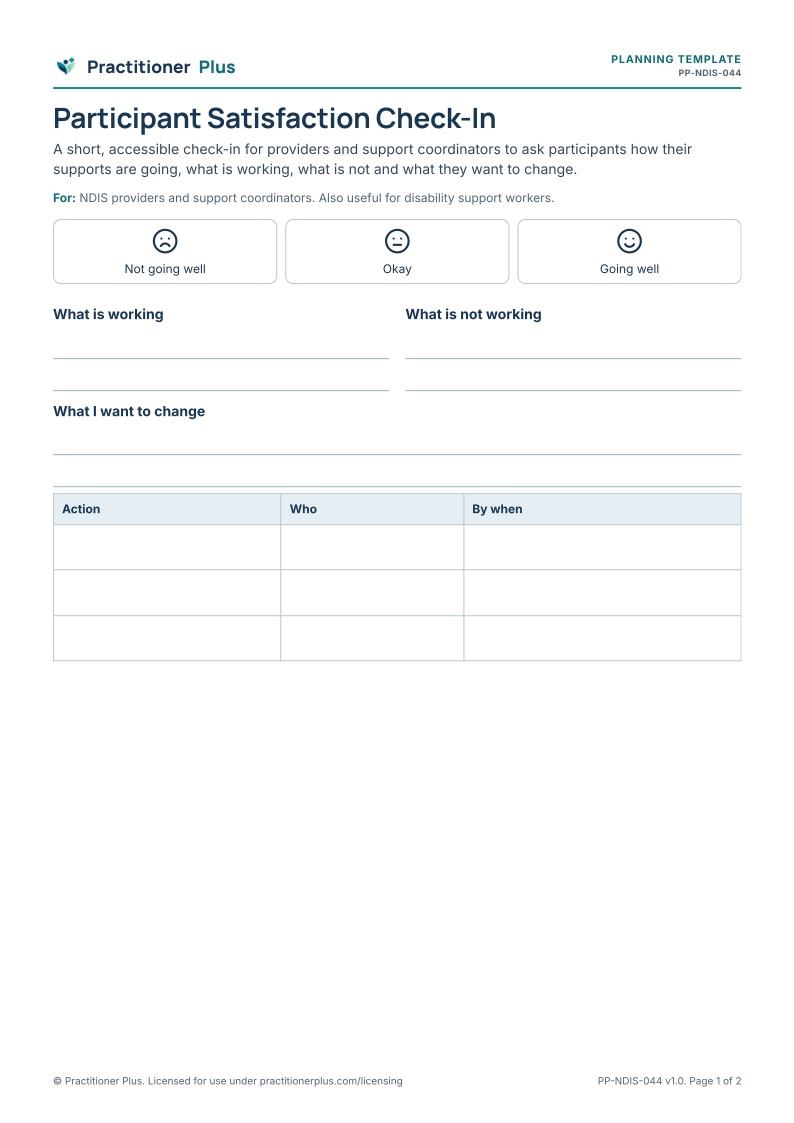
Regular check-ins help supports stay on track. This short check-in uses faces and simple questions to ask how supports are going, what is working, what is not and what the participant wants to change, with agreed actions.
Purpose
To keep supports responsive to participants' views.
Who it is for
Primary profession: NDIS providers and support coordinators. Also relevant for disability support workers.
Client or participant group: Participants and their providers or support coordinators.
Practice setting: Regular check-ins and reviews.
Suggested uses
- Quarterly check-ins
- Service reviews
- Support coordination
- Quality improvement
Instructions for practitioners
- Ask regularly, not only at plan reviews.
- Make it safe to give honest feedback.
- Act on what you hear.
- Record agreed actions.
Instructions for clients or participants
- Circle a face.
- Say what is working and what is not.
- Say what you want to change.
Accessibility considerations
Faces and plain language. Can be completed verbally.
Scope and limitations
A check-in template.
Research basis
Human rights frameworks and research on the dignity of risk support people's right to make their own choices, including choices that involve some risk. Easy Read standards and disability rights frameworks support people's right to accessible information; test Easy Read materials with the people who will use them.
- Ibrahim, J. E., & Davis, M. (2013). Impediments to applying the ‘dignity of risk’ principle in residential aged care services. Australasian Journal on Ageing, 32(3), 188–193. https://doi.org/10.1111/ajag.12014
- Inclusion Europe. (2009). Information for all: European standards for making information easy to read and understand. https://www.inclusion-europe.eu/easy-to-read-standards-guidelines/
- United Nations. (2006). Convention on the Rights of Persons with Disabilities. https://www.ohchr.org/en/instruments-mechanisms/instruments/convention-rights-persons-disabilities
What is included
A 2-page printable A4 PDF, including a practitioner notes page with the research basis (version 1.0).
Originality
Original Practitioner Plus content: wording, activity structure, layout and icons were created for this resource. No third-party worksheets, illustrations or text were reproduced.


