
About this resource
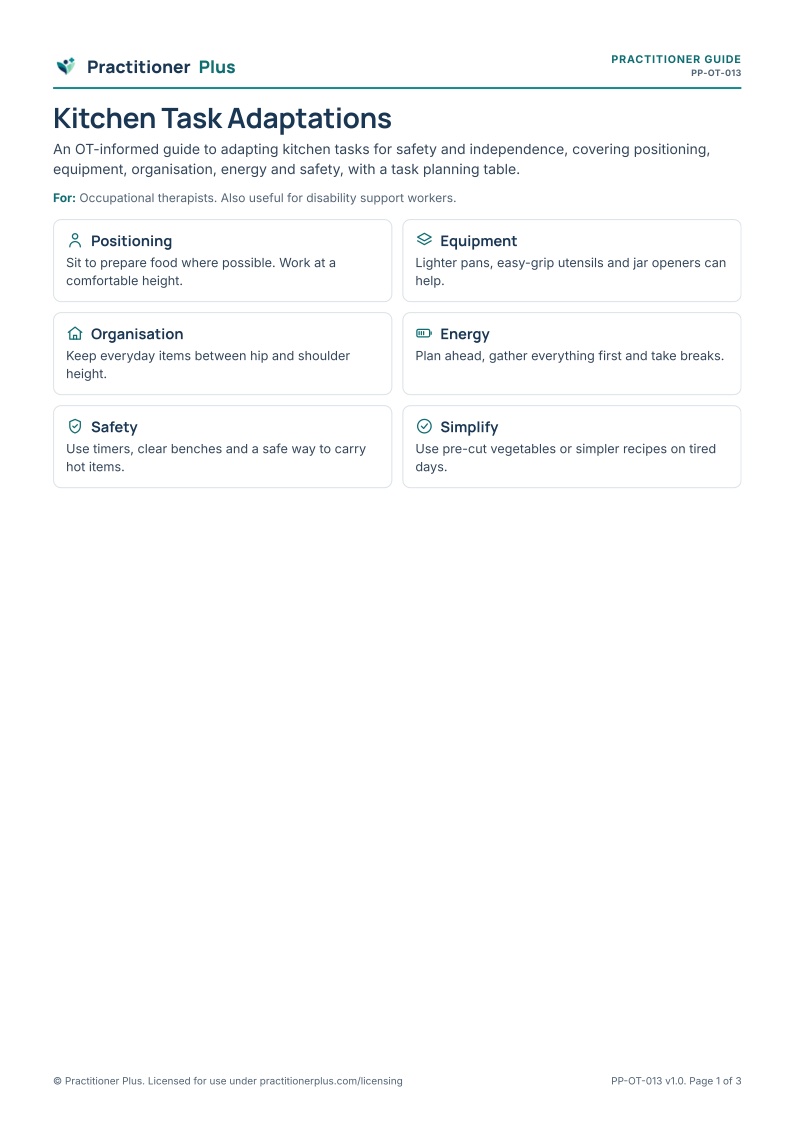
Small changes can make cooking safer and more manageable. This guide covers sitting to work, lighter equipment, keeping frequently used items within easy reach, planning to save energy and safety measures. A planning table helps match each task to adaptations to try.
Purpose
To help people and their supporters identify practical adaptations for kitchen tasks.
Who it is for
Primary profession: Occupational therapists. Also relevant for disability support workers.
Client or participant group: Adults with physical, sensory or cognitive changes who want to cook safely and independently.
Practice setting: Home and supported living, with occupational therapy input.
Suggested uses
- Following an OT home visit
- Planning independence goals
- Supporting people after illness or injury
- Training support workers
Instructions for practitioners
- Observe the person doing the task before suggesting changes.
- Trial adaptations and review together.
- Consider safety with heat, sharp objects and gas.
- Recommend specific equipment through individual assessment.
Instructions for clients or participants
- Choose a kitchen task you find hard.
- Pick adaptations to try.
- Note how it went.
Accessibility considerations
Large print. Can be completed with a worker or family member.
Scope and limitations
General information. Specific equipment recommendations and safety decisions need individual occupational therapy assessment.
Research basis
Occupational therapy models describe how the person, their environment and their activities interact, and how a balance of meaningful activity supports health and participation. Energy conservation education reduces the impact of fatigue, as shown in people with multiple sclerosis.
- Law, M., Cooper, B., Strong, S., Stewart, D., Rigby, P., & Letts, L. (1996). The Person-Environment-Occupation Model: A Transactive Approach to Occupational Performance. Canadian Journal of Occupational Therapy, 63(1), 9–23. https://doi.org/10.1177/000841749606300103
- Mathiowetz, V. G., Finlayson, M. L., Matuska, K. M., Chen, H. Y., & Luo, P. (2005). Randomized controlled trial of an energy conservation course for persons with multiple sclerosis. Multiple Sclerosis Journal, 11(5), 592–601. https://doi.org/10.1191/1352458505ms1198oa
- Wagman, P., Håkansson, C., & Björklund, A. (2012). Occupational balance as used in occupational therapy: A concept analysis. Scandinavian Journal of Occupational Therapy, 19(4), 322–327. https://doi.org/10.3109/11038128.2011.596219
- World Health Organization. (2001). International classification of functioning, disability and health (ICF). WHO. https://www.who.int/standards/classifications/international-classification-of-functioning-disability-and-health
What is included
A 3-page printable A4 PDF, including a practitioner notes page with the research basis (version 1.0).
Originality
Original Practitioner Plus content: wording, activity structure, layout and icons were created for this resource. No third-party worksheets, illustrations or text were reproduced.


