
About this resource
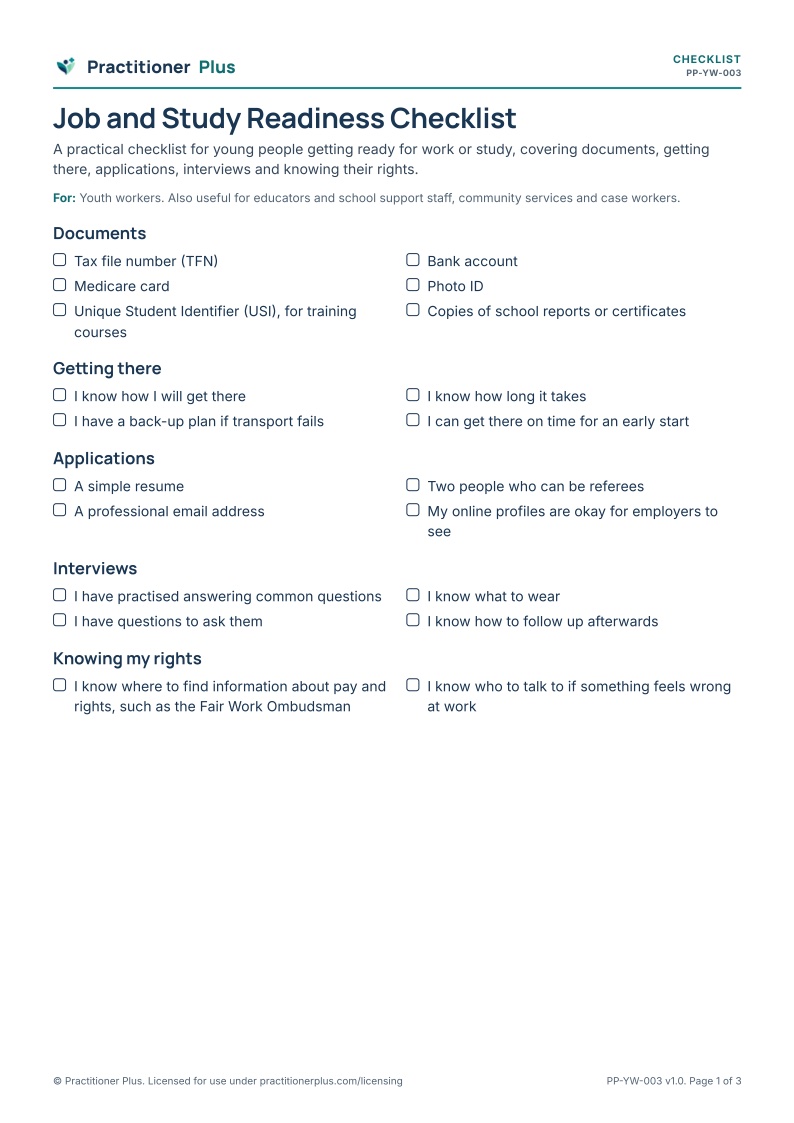
Getting ready for a first job or course involves lots of small tasks. This checklist groups them into documents, getting there, applications, interviews and knowing your rights, with an action plan to work through together.
Purpose
To break readiness for work or study into practical, achievable tasks and an action plan the young person owns.
Who it is for
Primary profession: Youth workers. Also relevant for educators and school support staff, community services and case workers.
Client or participant group: Young people aged about 15 to 24 preparing for work, training or further study.
Practice setting: Youth services, schools, transition programs and employment support.
Suggested uses
- Transition planning in the final years of school
- One-to-one employment readiness sessions
- Group programs on work and study
- Supporting young people re-engaging after time away
Instructions for practitioners
- Let the young person tick what is already done and celebrate it.
- Choose two or three next tasks together.
- Help with the practical steps, such as forms or practice interviews.
- Check information about pay, rights and documents is current before sharing.
Instructions for clients or participants
- Tick what you have already sorted.
- Choose what to work on next.
- Add your next steps to the action plan.
Accessibility considerations
Work through it in short sessions. Young people can photograph documents and keep the checklist on their phone.
Scope and limitations
A general readiness checklist. It does not provide employment, legal or financial advice. Check current requirements with the relevant agencies.
Research basis
Supported employment that focuses on rapid job search and ongoing support has strong evidence for helping people with serious mental illness find and keep work. Specific goals, if-then plans and regular progress monitoring all improve the chances of reaching goals.
- Bond, G. R., Drake, R. E., & Becker, D. R. (2008). An update on randomized controlled trials of evidence-based supported employment. Psychiatric Rehabilitation Journal, 31(4), 280–290. https://doi.org/10.2975/31.4.2008.280.290
- Gollwitzer, P. M., & Sheeran, P. (2006). Implementation Intentions and Goal Achievement: A Meta‐analysis of Effects and Processes. Advances in Experimental Social Psychology, 69–119. https://doi.org/10.1016/s0065-2601(06)38002-1
- Harkin, B., Webb, T. L., Chang, B. P. I., Prestwich, A., Conner, M., Kellar, I., Benn, Y., & Sheeran, P. (2016). Does monitoring goal progress promote goal attainment? A meta-analysis of the experimental evidence. Psychological Bulletin, 142(2), 198–229. https://doi.org/10.1037/bul0000025
- Locke, E. A., & Latham, G. P. (2002). Building a practically useful theory of goal setting and task motivation: A 35-year odyssey. American Psychologist, 57(9), 705–717. https://doi.org/10.1037/0003-066x.57.9.705
What is included
A 3-page printable A4 PDF, including a practitioner notes page with the research basis (version 1.0).
Originality
Original Practitioner Plus content: wording, activity structure, layout and icons were created for this resource. No third-party worksheets, illustrations or text were reproduced. Document names should be checked against current official guidance before publication.


