
About this resource
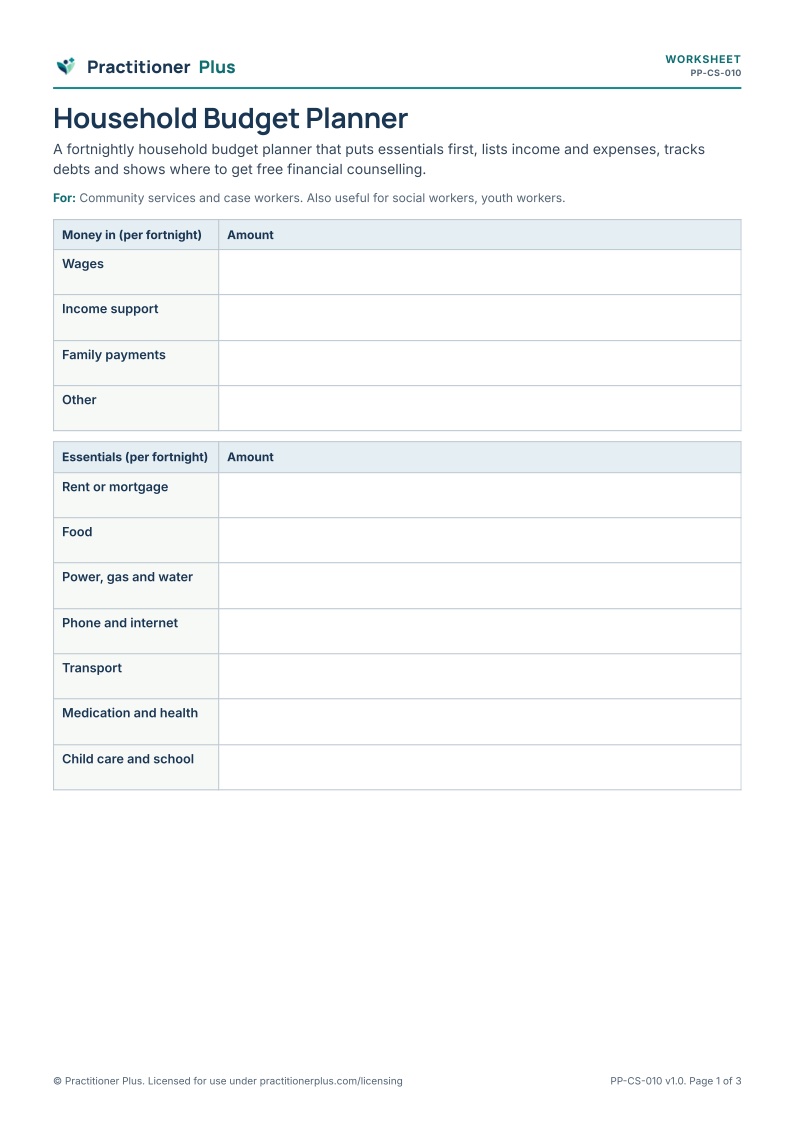
A budget is a plan, not a judgement. This planner works fortnightly, lists income and essential expenses first, then other spending and debts, and shows what is left. It includes a short action plan and points to free financial counselling.
Purpose
To give a clear picture of money in and money out, so essentials are covered and next steps are clear.
Who it is for
Primary profession: Community services and case workers. Also relevant for social workers, youth workers.
Client or participant group: Adults and families who want to get on top of their money, with a case worker.
Practice setting: Casework, financial wellbeing and emergency relief settings.
Suggested uses
- Getting a clear picture of finances
- Preparing for financial counselling
- Planning around a change in income
- Building money confidence
Instructions for practitioners
- Work through it together, without judgement.
- Use real figures from statements where possible.
- Prioritise essentials: housing, food, utilities, medication and transport.
- Refer to free financial counselling for debts or complex situations.
Instructions for clients or participants
- Write your money in.
- Write your essential costs first.
- See what is left and plan next steps.
Accessibility considerations
Round figures if that is easier. Work through bank statements together if helpful.
Scope and limitations
A budgeting tool. It does not provide financial advice. Free financial counselling is available through the National Debt Helpline.
Research basis
Debt and financial stress are strongly linked with poorer mental and physical health, so practical financial support is part of holistic care. Case management practice standards describe assessment, planning, coordination, review and planned exits with the person at the centre.
- Case Management Society of Australia and New Zealand. (2013). National standards of practice for case management (3rd ed.). https://www.cmsa.org.au/
- Richardson, T., Elliott, P., & Roberts, R. (2013). The relationship between personal unsecured debt and mental and physical health: A systematic review and meta-analysis. Clinical Psychology Review, 33(8), 1148–1162. https://doi.org/10.1016/j.cpr.2013.08.009
What is included
A 3-page printable A4 PDF, including a practitioner notes page with the research basis (version 1.0).
Originality
Original Practitioner Plus content: wording, activity structure, layout and icons were created for this resource. No third-party worksheets, illustrations or text were reproduced.


