
About this resource
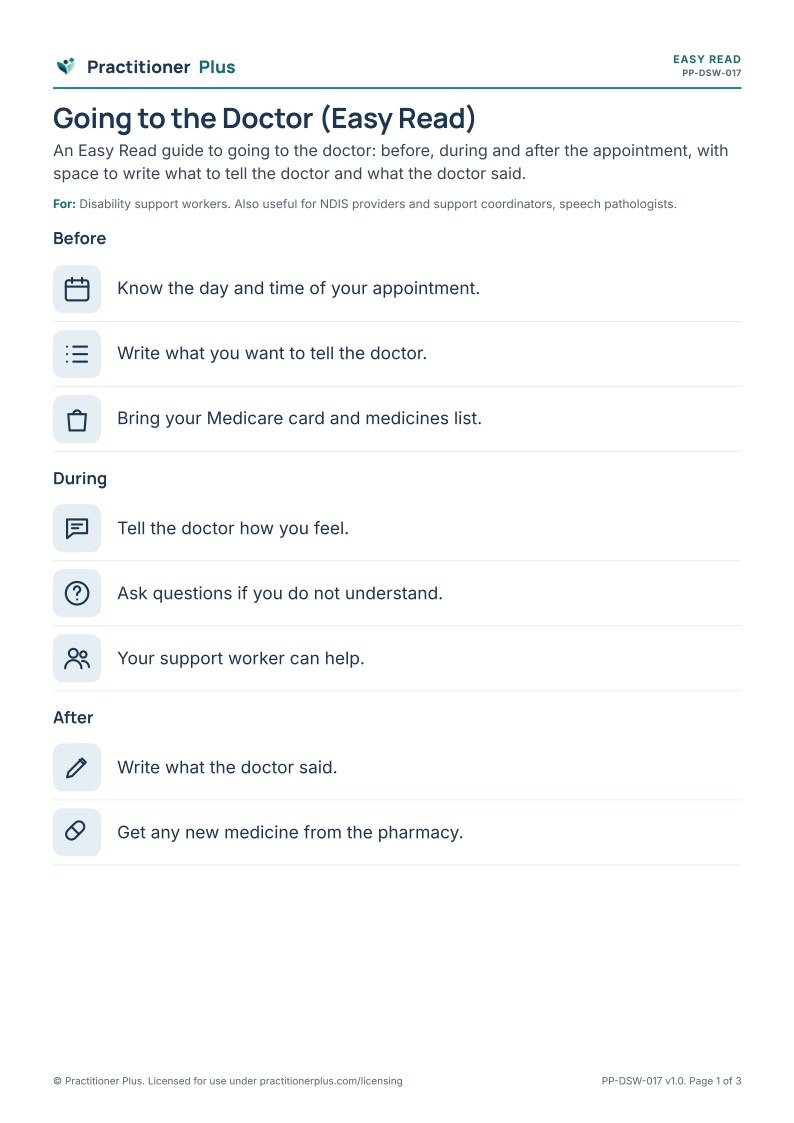
Going to the doctor can feel confusing or stressful. This Easy Read guide explains what happens before, during and after an appointment, and gives space to write what the person wants to tell the doctor and what the doctor said.
Purpose
To help people prepare for, take part in and remember their doctor's appointments.
Who it is for
Primary profession: Disability support workers. Also relevant for NDIS providers and support coordinators, speech pathologists.
Client or participant group: Adults with intellectual disability or low literacy.
Practice setting: Preparing for GP and health appointments, with a support worker.
Suggested uses
- Preparing for GP visits
- Annual health assessments
- Building confidence in health appointments
- Supporting the person to speak for themselves
Instructions for practitioners
- Prepare together before the appointment.
- Support the person to speak for themselves.
- Ask the doctor to explain things in plain language.
- Help record what the doctor said.
Instructions for clients or participants
- Write or draw what you want to tell the doctor.
- Bring this sheet to your appointment.
- Write what the doctor said.
Accessibility considerations
Easy Read layout with one idea per line and symbols. Should be user tested with people with intellectual disability.
Scope and limitations
General Easy Read information. It does not replace medical advice.
Research basis
Easy Read standards and disability rights frameworks support people's right to accessible information; test Easy Read materials with the people who will use them. Clear, plain-language information and checking understanding (teach-back) improve understanding, safety and quality of care.
- Australian Commission on Safety and Quality in Health Care. (2014). Health literacy: Taking action to improve safety and quality. ACSQHC. https://www.safetyandquality.gov.au/publications-and-resources/resource-library/health-literacy-taking-action-improve-safety-and-quality
- Australian Government. Style Manual: Plain language and word choice. https://www.stylemanual.gov.au/writing-and-designing-content/clear-language-and-writing-style/plain-language-and-word-choice
- Inclusion Europe. (2009). Information for all: European standards for making information easy to read and understand. https://www.inclusion-europe.eu/easy-to-read-standards-guidelines/
- Talevski, J., Wong Shee, A., Rasmussen, B., Kemp, G., & Beauchamp, A. (2020). Teach-back: A systematic review of implementation and impacts. PLOS ONE, 15(4), e0231350. https://doi.org/10.1371/journal.pone.0231350
- United Nations. (2006). Convention on the Rights of Persons with Disabilities. https://www.ohchr.org/en/instruments-mechanisms/instruments/convention-rights-persons-disabilities
What is included
A 3-page printable A4 PDF, including a practitioner notes page with the research basis (version 1.0).
Originality
Original Practitioner Plus content: wording, activity structure, layout and icons were created for this resource. No third-party worksheets, illustrations or text were reproduced. Symbols are original line drawings created for Practitioner Plus.


