
About this resource
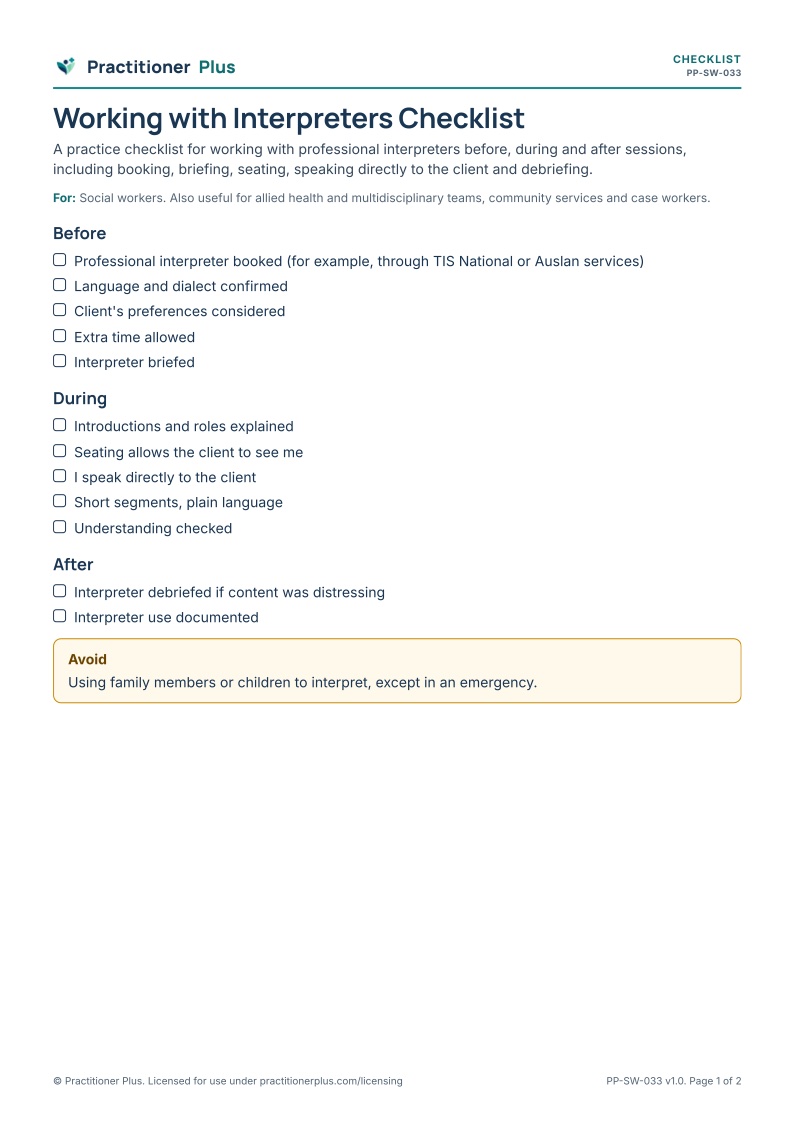
Professional interpreters make communication accurate and safe. This checklist covers booking the right interpreter, briefing before the session, seating and introductions, speaking directly to the client in short segments, checking understanding and debriefing, and explains why family members, especially children, should not interpret.
Purpose
To support effective, respectful and safe communication through interpreters.
Who it is for
Primary profession: Social workers. Also relevant for allied health and multidisciplinary teams, community services and case workers.
Client or participant group: Social workers and practitioners working with interpreters.
Practice setting: Any service working with people who prefer a language other than English.
Suggested uses
- Every session with an interpreter
- Staff orientation
- Supervision
- Service audits
Instructions for practitioners
- Use professional interpreters, not family or friends.
- Ask the client's preferences about the interpreter's gender and dialect.
- Brief and debrief the interpreter, particularly after distressing content.
- Allow extra time.
Accessibility considerations
Consider Auslan and other sign language interpreters for Deaf clients.
Scope and limitations
A practice checklist.
Research basis
Professional interpreters improve communication, understanding and care for people with limited English. Cultural safety asks practitioners to examine their own power and bias, and is defined by the experience of the person receiving care. Clear, plain-language information and checking understanding (teach-back) improve understanding, safety and quality of care.
- Australian Commission on Safety and Quality in Health Care. (2014). Health literacy: Taking action to improve safety and quality. ACSQHC. https://www.safetyandquality.gov.au/publications-and-resources/resource-library/health-literacy-taking-action-improve-safety-and-quality
- Australian Government. Style Manual: Plain language and word choice. https://www.stylemanual.gov.au/writing-and-designing-content/clear-language-and-writing-style/plain-language-and-word-choice
- Curtis, E., Jones, R., Tipene-Leach, D., Walker, C., Loring, B., Paine, S. J., & Reid, P. (2019). Why cultural safety rather than cultural competency is required to achieve health equity: a literature review and recommended definition. International Journal for Equity in Health, 18(1), 174. https://doi.org/10.1186/s12939-019-1082-3
- Karliner, L. S., Jacobs, E. A., Chen, A. H., & Mutha, S. (2007). Do Professional Interpreters Improve Clinical Care for Patients with Limited English Proficiency? A Systematic Review of the Literature. Health Services Research, 42(2), 727–754. https://doi.org/10.1111/j.1475-6773.2006.00629.x
- Talevski, J., Wong Shee, A., Rasmussen, B., Kemp, G., & Beauchamp, A. (2020). Teach-back: A systematic review of implementation and impacts. PLOS ONE, 15(4), e0231350. https://doi.org/10.1371/journal.pone.0231350
What is included
A 2-page printable A4 PDF, including a practitioner notes page with the research basis (version 1.0).
Originality
Original Practitioner Plus content: wording, activity structure, layout and icons were created for this resource. No third-party worksheets, illustrations or text were reproduced.


