
About this resource
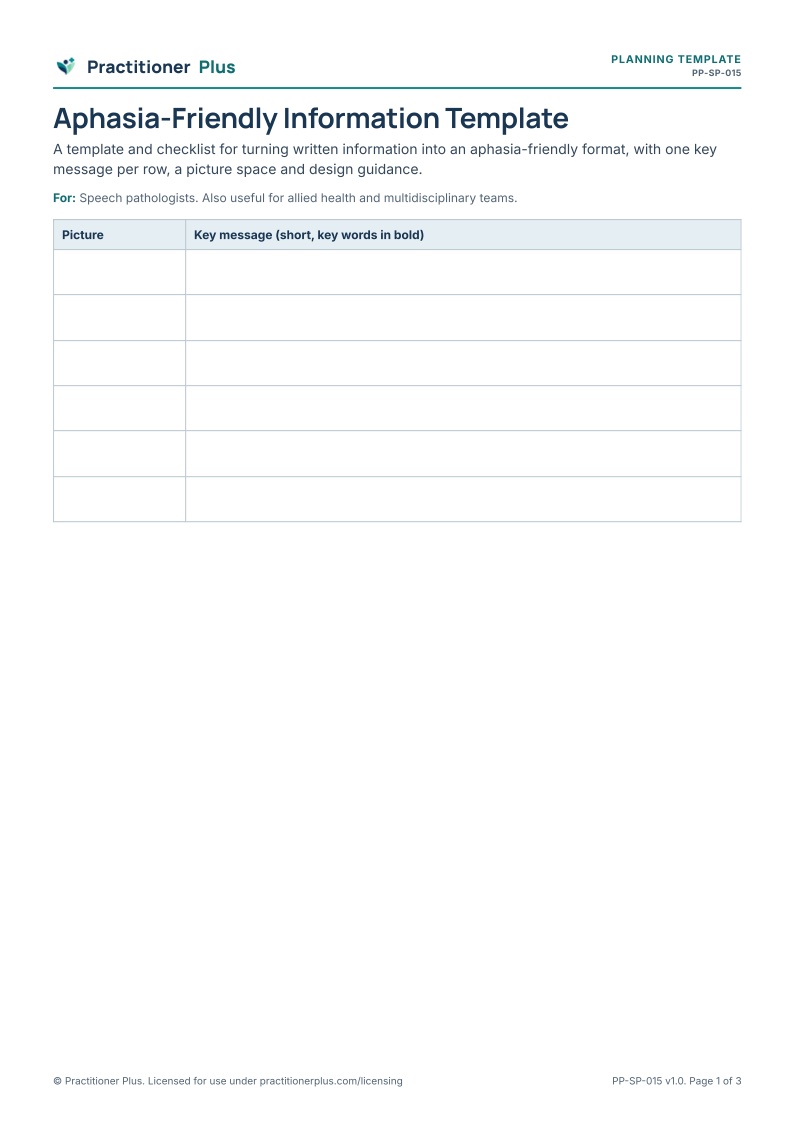
People with aphasia often find dense text hard to read. This template supports practitioners to create aphasia-friendly information, with one key message per row, a space for a picture, key words in bold and plenty of white space, plus a checklist to review the finished document.
Purpose
To help practitioners make written information easier to understand for people with aphasia.
Who it is for
Primary profession: Speech pathologists. Also relevant for allied health and multidisciplinary teams.
Client or participant group: Practitioners preparing written information for adults with aphasia.
Practice setting: Hospital, rehabilitation and community services.
Suggested uses
- Appointment letters
- Health information
- Consent conversations
- Discharge information
Instructions for practitioners
- Choose the most important messages only.
- Use one idea per row with a clear picture.
- Check with the person with aphasia that it works for them.
- Seek speech pathology input for important documents.
Accessibility considerations
Large font, clear pictures and white space. Test with people with aphasia.
Scope and limitations
A template. Important documents, such as consent information, need individualised speech pathology input.
Research basis
Speech and language therapy benefits people with aphasia after stroke. Easy Read standards and disability rights frameworks support people's right to accessible information; test Easy Read materials with the people who will use them. Clear, plain-language information and checking understanding (teach-back) improve understanding, safety and quality of care.
- Australian Commission on Safety and Quality in Health Care. (2014). Health literacy: Taking action to improve safety and quality. ACSQHC. https://www.safetyandquality.gov.au/publications-and-resources/resource-library/health-literacy-taking-action-improve-safety-and-quality
- Australian Government. Style Manual: Plain language and word choice. https://www.stylemanual.gov.au/writing-and-designing-content/clear-language-and-writing-style/plain-language-and-word-choice
- Brady, M. C., Kelly, H., Godwin, J., Enderby, P., & Campbell, P. (2016). Speech and language therapy for aphasia following stroke. Cochrane Database of Systematic Reviews, Article CD000425. https://doi.org/10.1002/14651858.cd000425.pub4
- Inclusion Europe. (2009). Information for all: European standards for making information easy to read and understand. https://www.inclusion-europe.eu/easy-to-read-standards-guidelines/
- Talevski, J., Wong Shee, A., Rasmussen, B., Kemp, G., & Beauchamp, A. (2020). Teach-back: A systematic review of implementation and impacts. PLOS ONE, 15(4), e0231350. https://doi.org/10.1371/journal.pone.0231350
- United Nations. (2006). Convention on the Rights of Persons with Disabilities. https://www.ohchr.org/en/instruments-mechanisms/instruments/convention-rights-persons-disabilities
What is included
A 3-page printable A4 PDF, including a practitioner notes page with the research basis (version 1.0).
Originality
Original Practitioner Plus content: wording, activity structure, layout and icons were created for this resource. No third-party worksheets, illustrations or text were reproduced.


