
About this resource
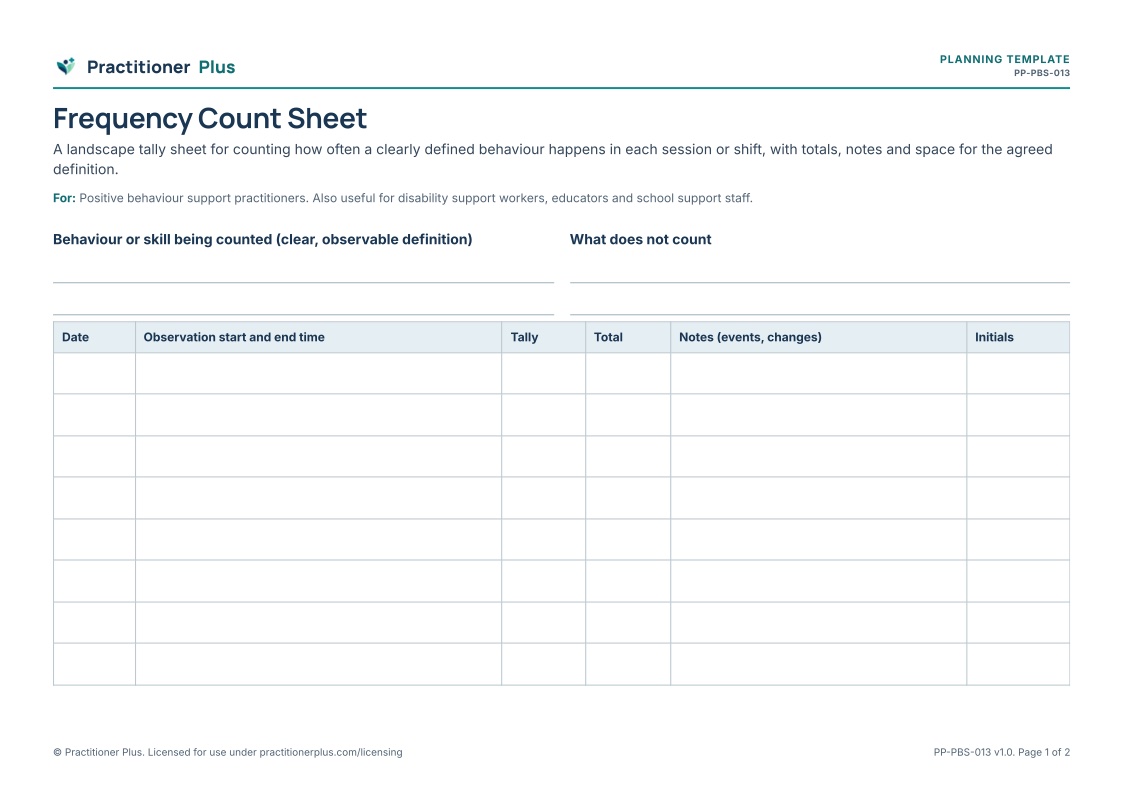
Counting how often a behaviour happens helps teams see whether things are changing. This sheet records the agreed definition, then a tally for each session or shift with the observation times, totals and notes. Consistent definitions and observation times make the data meaningful.
Purpose
To collect consistent frequency data for assessment and review.
Who it is for
Primary profession: Positive behaviour support practitioners. Also relevant for disability support workers, educators and school support staff.
Client or participant group: Teams supporting a person with a behaviour support plan or a referral for behaviour support.
Practice setting: Supported living, schools, day programs and family homes, guided by a behaviour support practitioner.
Suggested uses
- Baseline data collection
- Reviewing the effect of proactive strategies
- Sharing data with the behaviour support practitioner
- Tracking positive behaviours and skills too
Instructions for practitioners
- Agree a clear, observable definition before counting.
- Record the observation times so counts can be compared.
- Count skills and positive behaviours, not only behaviours of concern.
- Review data with the behaviour support practitioner.
Accessibility considerations
Use clear tallies. Digital versions can be created from the editable source.
Scope and limitations
A data collection tool. It does not determine the function of behaviour and must not be used to plan restrictive practices.
Research basis
Understanding what happens before and after behaviour is the basis of functional assessment, which guides support.
- Hanley, G. P., Iwata, B. A., & McCord, B. E. (2003). FUNCTIONAL ANALYSIS OF PROBLEM BEHAVIOR: A REVIEW. Journal of Applied Behavior Analysis, 36(2), 147–185. https://doi.org/10.1901/jaba.2003.36-147
What is included
A 2-page printable A4 PDF, including a practitioner notes page with the research basis (version 1.0).
Originality
Original Practitioner Plus content: wording, activity structure, layout and icons were created for this resource. No third-party worksheets, illustrations or text were reproduced.


