
About this resource
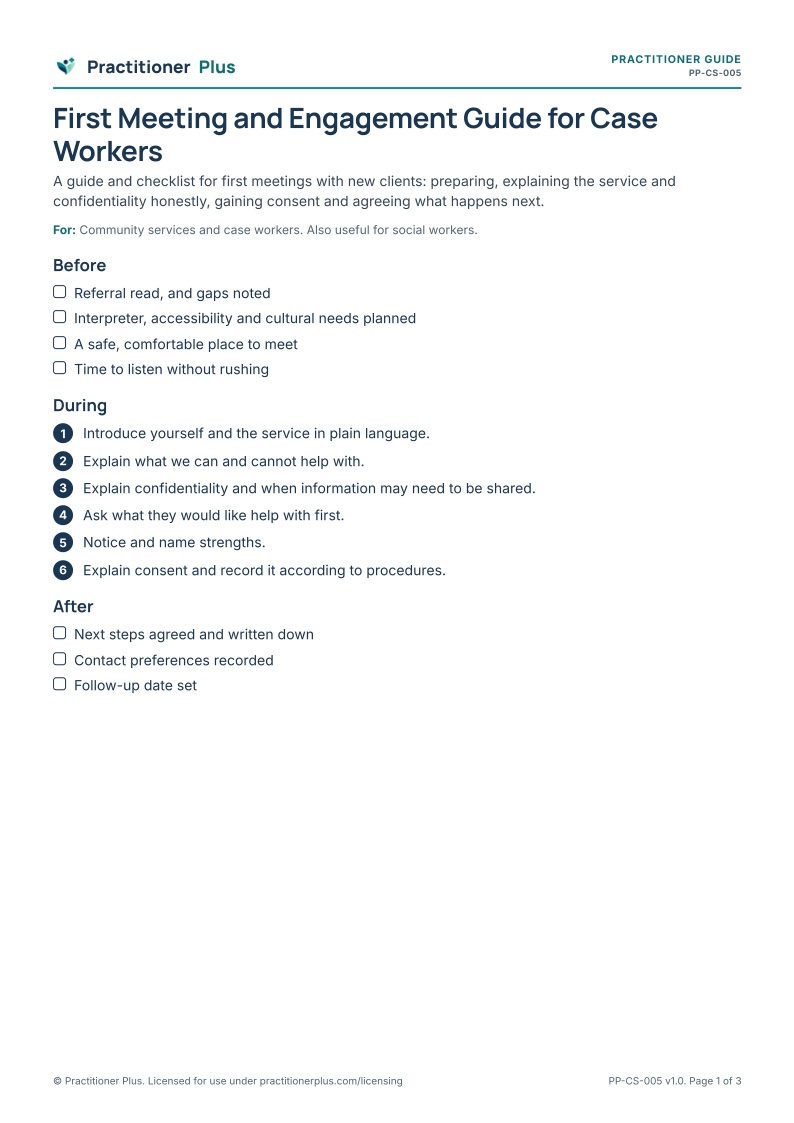
First meetings shape the working relationship. This guide covers preparation, introductions, explaining what the service can and cannot do, explaining confidentiality and its limits, gaining informed consent and agreeing next steps, with prompts that keep the person in control.
Purpose
To build trust from the first meeting through clear, honest and person-led engagement.
Who it is for
Primary profession: Community services and case workers. Also relevant for social workers.
Client or participant group: Case workers meeting new clients or families for the first time.
Practice setting: Community services, homelessness, family support and outreach settings.
Suggested uses
- Induction for new case workers
- Preparing for intake and first appointments
- Outreach first contacts
- Reviewing engagement practice in supervision
Instructions for practitioners
- Read the referral and plan for access, interpreter and cultural needs.
- Introduce yourself and the service in plain language.
- Explain confidentiality and its limits honestly.
- Ask what the person wants help with, before your own priorities.
- Agree next steps and how you will keep in touch.
Accessibility considerations
Meet in a place that suits the person, offer interpreters, use plain language and give a written summary if helpful.
Scope and limitations
A practice guide. Follow your organisation's intake, consent, privacy and risk procedures, which take precedence.
Research basis
A strong working alliance and routine progress feedback are among the most consistent predictors of good outcomes in therapy. Case management practice standards describe assessment, planning, coordination, review and planned exits with the person at the centre.
- Case Management Society of Australia and New Zealand. (2013). National standards of practice for case management (3rd ed.). https://www.cmsa.org.au/
- Flückiger, C., Del Re, A. C., Wampold, B. E., & Horvath, A. O. (2018). The alliance in adult psychotherapy: A meta-analytic synthesis. Psychotherapy, 55(4), 316–340. https://doi.org/10.1037/pst0000172
- Lambert, M. J., Whipple, J. L., & Kleinstäuber, M. (2018). Collecting and delivering progress feedback: A meta-analysis of routine outcome monitoring. Psychotherapy, 55(4), 520–537. https://doi.org/10.1037/pst0000167
What is included
A 3-page printable A4 PDF, including a practitioner notes page with the research basis (version 1.0).
Originality
Original Practitioner Plus content: wording, activity structure, layout and icons were created for this resource. No third-party worksheets, illustrations or text were reproduced.


