
About this resource
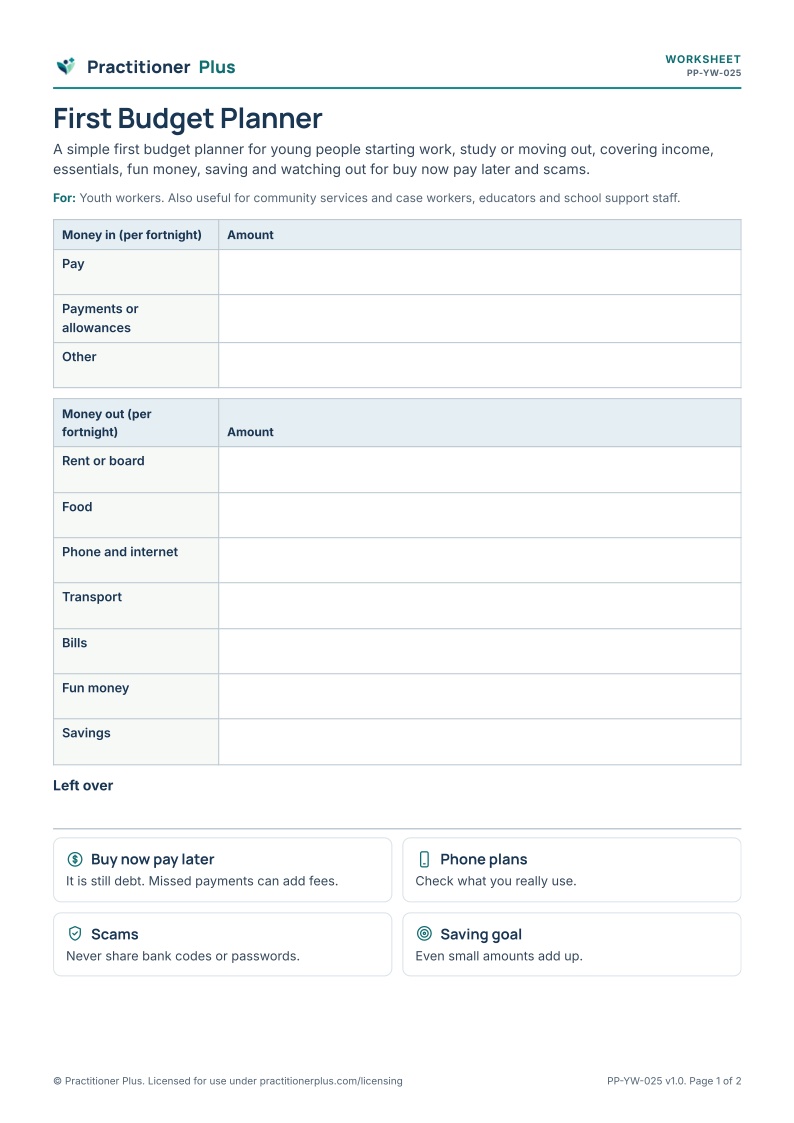
A first budget helps money go further. This planner helps young people list income, essentials, fun money and savings each fortnight, and gives tips about buy now pay later, phone plans and scams.
Purpose
To help young people manage money with confidence from the start.
Who it is for
Primary profession: Youth workers. Also relevant for community services and case workers, educators and school support staff.
Client or participant group: Young people aged about 15 to 25.
Practice setting: Youth services, transition programs and schools.
Suggested uses
- Starting work or study
- Moving out of home
- Leaving care
- Life skills groups
Instructions for practitioners
- Use the young person's real income and costs where they agree.
- Keep it simple and practical.
- Discuss buy now pay later and credit carefully.
- Refer to financial counselling for debt problems.
Instructions for clients or participants
- Write your income.
- Write your costs.
- Plan your savings.
Accessibility considerations
Can be completed on a phone or with a calculator.
Scope and limitations
General money information. It is not financial advice.
Research basis
Debt and financial stress are strongly linked with poorer mental and physical health, so practical financial support is part of holistic care.
- Richardson, T., Elliott, P., & Roberts, R. (2013). The relationship between personal unsecured debt and mental and physical health: A systematic review and meta-analysis. Clinical Psychology Review, 33(8), 1148–1162. https://doi.org/10.1016/j.cpr.2013.08.009
What is included
A 2-page printable A4 PDF, including a practitioner notes page with the research basis (version 1.0).
Originality
Original Practitioner Plus content: wording, activity structure, layout and icons were created for this resource. No third-party worksheets, illustrations or text were reproduced.


