
About this resource
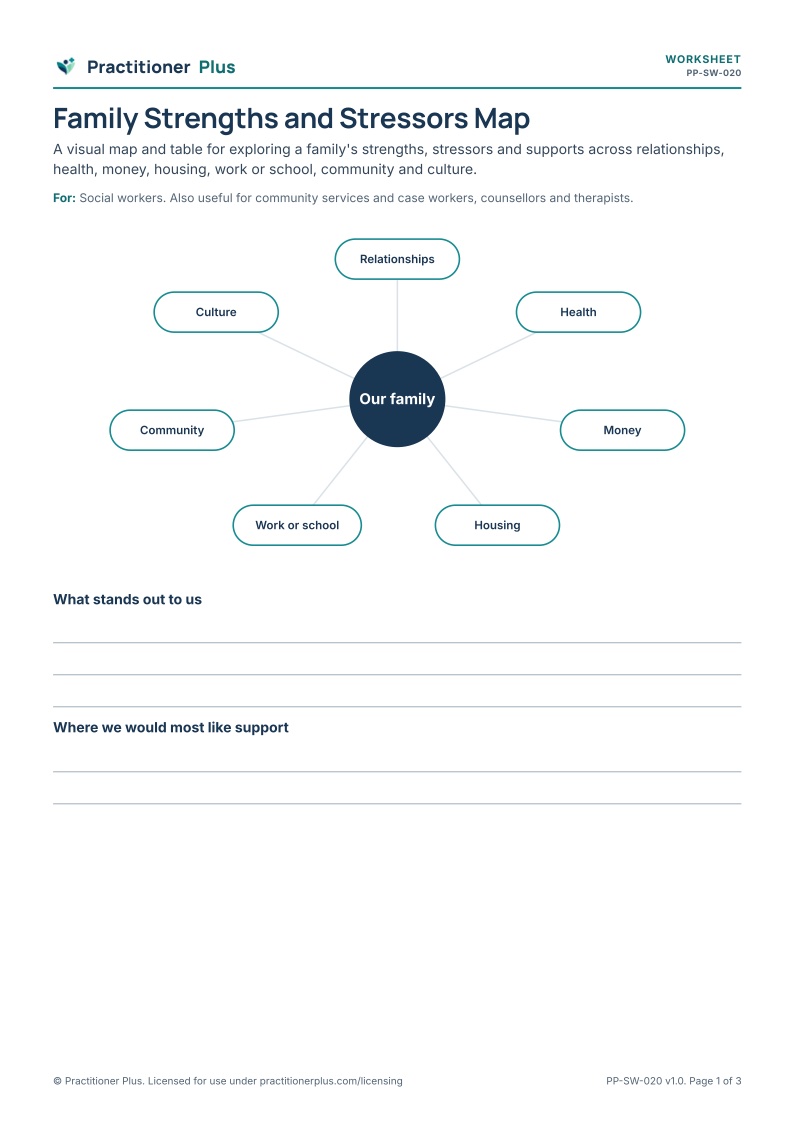
Families have strengths as well as stressors. This map invites families to look at seven areas of life, naming what is going well, what is hard and what support might help, so planning starts from a balanced, shared understanding.
Purpose
To build a balanced, shared picture of what is helping and what is hard for a family.
Who it is for
Primary profession: Social workers. Also relevant for community services and case workers, counsellors and therapists.
Client or participant group: Families working with social workers or family support services.
Practice setting: Family support, health and community services.
Suggested uses
- Family assessment conversations
- Planning family support
- Reviewing progress
- Team case discussions with consent
Instructions for practitioners
- Complete with the family, in their words.
- Start with strengths in each area.
- Respect cultural understandings of family.
- Use findings to plan supports with the family.
Instructions for clients or participants
- Talk about each area together.
- Write strengths and stressors.
- Choose where support would help most.
Accessibility considerations
Use drawings, interpreters and flexible completion.
Scope and limitations
A conversation and planning tool. It is not a risk assessment or child protection assessment.
Research basis
Genograms are a widely used way of mapping family relationships and patterns. The strengths model, a recovery-oriented approach, builds on people's own abilities, interests and resources. Biopsychosocial and ecological models describe how health, relationships and wider systems interact in a person's life.
- Bronfenbrenner, U. (1979). The Ecology of Human Development: Experiments by Nature and Design. Harvard University Press. https://doi.org/10.4159/9780674028845
- Engel, G. L. (1977). The Need for a New Medical Model: A Challenge for Biomedicine. Science, 196(4286), 129–136. https://doi.org/10.1126/science.847460
- McGoldrick, M., Gerson, R., & Petry, S. (2020). Genograms: Assessment and Treatment (4th ed.). W. W. Norton.
- Rapp, C. A., & Goscha, R. J. (2012). The strengths model: A recovery-oriented approach to mental health services (3rd ed.). Oxford University Press.
What is included
A 3-page printable A4 PDF, including a practitioner notes page with the research basis (version 1.0).
Originality
Original Practitioner Plus content: wording, activity structure, layout and icons were created for this resource. No third-party worksheets, illustrations or text were reproduced.


