
About this resource
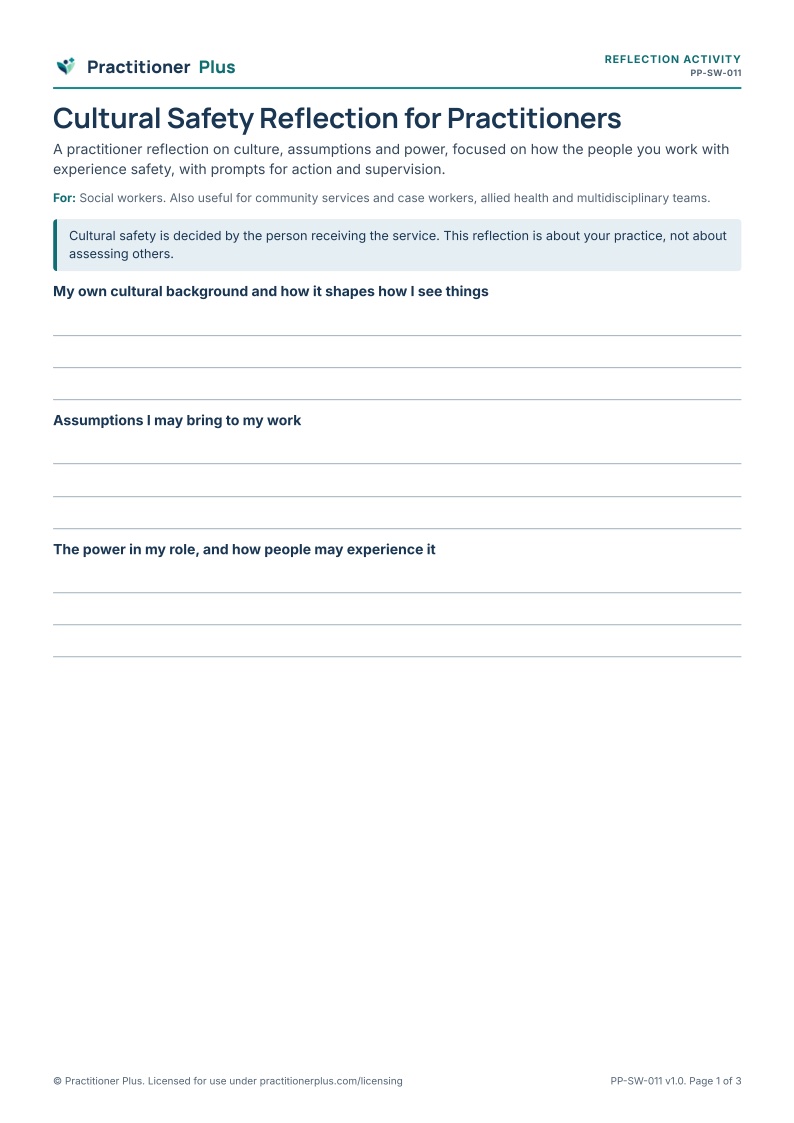
Cultural safety is defined by the people receiving a service, not by the practitioner. This reflection prompts practitioners to consider their own cultural background and assumptions, the power in their role, how people they work with may experience their service and what they will do differently, with prompts to bring to supervision.
Purpose
To support ongoing reflection on how culture, assumptions and power shape practice, so services are experienced as culturally safe.
Who it is for
Primary profession: Social workers. Also relevant for community services and case workers, allied health and multidisciplinary teams.
Client or participant group: Social workers and other practitioners reflecting on their practice.
Practice setting: Supervision, team reflection and individual professional development.
Suggested uses
- Individual and group supervision
- Team professional development
- Reflecting after a challenging interaction
- Planning culturally responsive practice
Instructions for practitioners
- Complete the reflection privately and honestly.
- Bring themes to supervision or cultural supervision.
- Seek guidance from local Aboriginal and Torres Strait Islander community-controlled organisations and cultural advisers where relevant.
- Turn reflection into specific practice changes.
Accessibility considerations
Can be completed in writing or discussed in supervision.
Scope and limitations
A reflective practice tool. It does not replace cultural training, cultural supervision or guidance from communities.
Research basis
Cultural safety asks practitioners to examine their own power and bias, and is defined by the experience of the person receiving care.
- Curtis, E., Jones, R., Tipene-Leach, D., Walker, C., Loring, B., Paine, S. J., & Reid, P. (2019). Why cultural safety rather than cultural competency is required to achieve health equity: a literature review and recommended definition. International Journal for Equity in Health, 18(1), 174. https://doi.org/10.1186/s12939-019-1082-3
What is included
A 3-page printable A4 PDF, including a practitioner notes page with the research basis (version 1.0).
Originality
Original Practitioner Plus content: wording, activity structure, layout and icons were created for this resource. No third-party worksheets, illustrations or text were reproduced.


