
About this resource
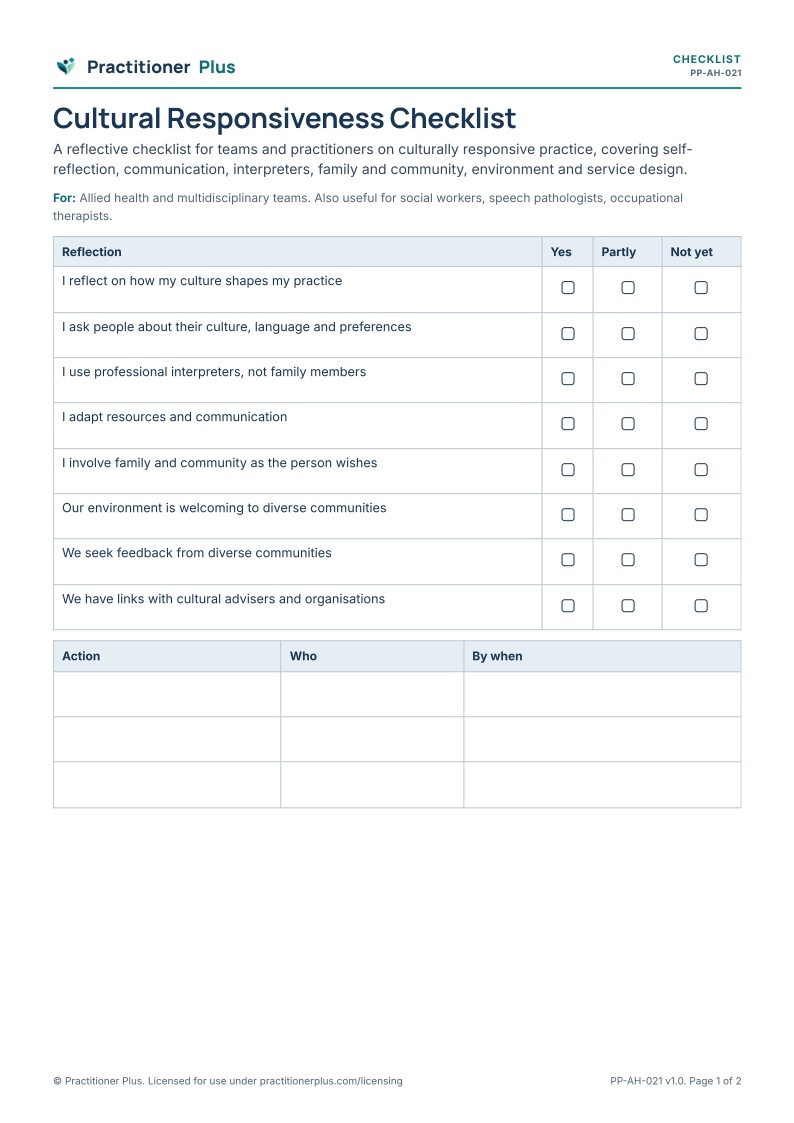
Culturally responsive practice is ongoing work. This checklist prompts practitioners and teams to reflect on their own culture and assumptions, communication and interpreter use, involving family and community as the person wishes, the service environment and how services are designed, with space for actions.
Purpose
To support ongoing reflection and improvement in culturally responsive practice.
Who it is for
Primary profession: Allied health and multidisciplinary teams. Also relevant for social workers, speech pathologists, occupational therapists.
Client or participant group: Allied health practitioners and teams.
Practice setting: Team reflection, supervision and service planning.
Suggested uses
- Team reflection
- Supervision
- Service planning
- Professional development
Instructions for practitioners
- Use as reflection, not as a compliance tick-box.
- Seek feedback from people and communities who use the service.
- Engage cultural advisers and community organisations.
- Plan specific actions and review them.
Accessibility considerations
Editable HTML source available for adaptation.
Scope and limitations
A reflective checklist. It does not replace cultural training, cultural supervision or community guidance.
Research basis
Cultural safety asks practitioners to examine their own power and bias, and is defined by the experience of the person receiving care. Professional interpreters improve communication, understanding and care for people with limited English.
- Curtis, E., Jones, R., Tipene-Leach, D., Walker, C., Loring, B., Paine, S. J., & Reid, P. (2019). Why cultural safety rather than cultural competency is required to achieve health equity: a literature review and recommended definition. International Journal for Equity in Health, 18(1), 174. https://doi.org/10.1186/s12939-019-1082-3
- Karliner, L. S., Jacobs, E. A., Chen, A. H., & Mutha, S. (2007). Do Professional Interpreters Improve Clinical Care for Patients with Limited English Proficiency? A Systematic Review of the Literature. Health Services Research, 42(2), 727–754. https://doi.org/10.1111/j.1475-6773.2006.00629.x
What is included
A 2-page printable A4 PDF, including a practitioner notes page with the research basis (version 1.0).
Originality
Original Practitioner Plus content: wording, activity structure, layout and icons were created for this resource. No third-party worksheets, illustrations or text were reproduced.


