
About this resource
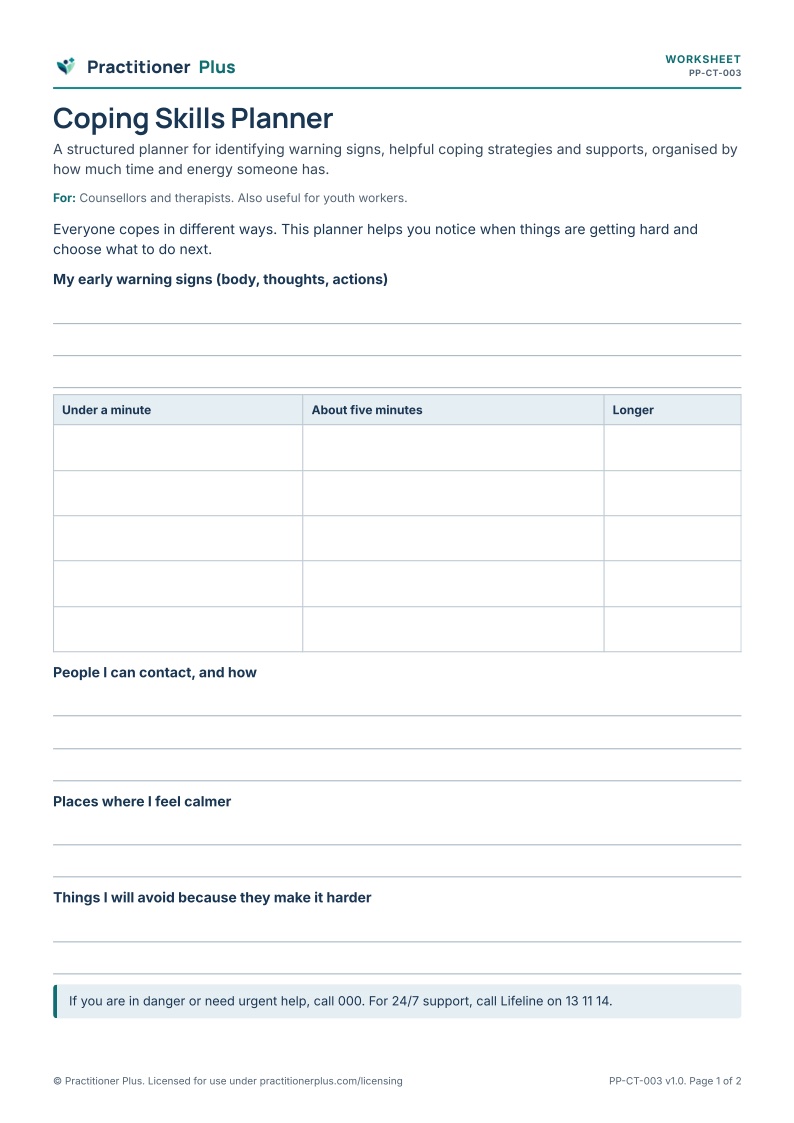
This planner helps people put their coping skills in one place. It prompts them to notice early warning signs, list strategies that take a minute, five minutes or longer, and identify people and places that help.
Purpose
To bring warning signs, coping strategies and supports together in one personal plan.
Who it is for
Primary profession: Counsellors and therapists. Also relevant for youth workers.
Client or participant group: Adolescents and adults working on coping skills with a practitioner.
Practice setting: Counselling sessions with adolescents and adults.
Suggested uses
- Building a personalised coping plan
- Reviewing which strategies have worked and which have not
- Preparing for predictable stressful situations
- Sharing with trusted supports, with the person's consent
Instructions for practitioners
- Start with warning signs: what do they notice in their body, thoughts and behaviour?
- Brainstorm coping strategies together, then sort them by how long they take.
- Identify supportive people and places, including how to contact them.
- Agree where the person will keep the plan and when you will review it.
Instructions for clients or participants
- Write your early warning signs.
- Sort your coping strategies by how long they take.
- List people and places that help.
Accessibility considerations
Can be completed verbally, with symbols, or over several sessions.
Scope and limitations
A coping plan is not a crisis or safety plan. If there are concerns about risk, follow your organisation's risk assessment and safety planning procedures.
Research basis
Understanding, naming and choosing strategies for emotions are central to emotion regulation; putting feelings into words and finer emotion distinctions are linked to better regulation.
- Gross, J. J. (2015). Emotion Regulation: Current Status and Future Prospects. Psychological Inquiry, 26(1), 1–26. https://doi.org/10.1080/1047840x.2014.940781
- Kashdan, T. B., Barrett, L. F., & McKnight, P. E. (2015). Unpacking Emotion Differentiation: Transforming Unpleasant Experience by Perceiving Distinctions in Negativity. Current Directions in Psychological Science, 24(1), 10–16. https://doi.org/10.1177/0963721414550708
- Kircanski, K., Lieberman, M. D., & Craske, M. G. (2012). Feelings Into Words: Contributions of Language to Exposure Therapy. Psychological Science, 23(10), 1086–1091. https://doi.org/10.1177/0956797612443830
What is included
A 2-page printable A4 PDF, including a practitioner notes page with the research basis (version 1.0).
Originality
Original Practitioner Plus content: wording, activity structure and layout were created for this resource. No third-party worksheets, illustrations or text were reproduced.


