
About this resource
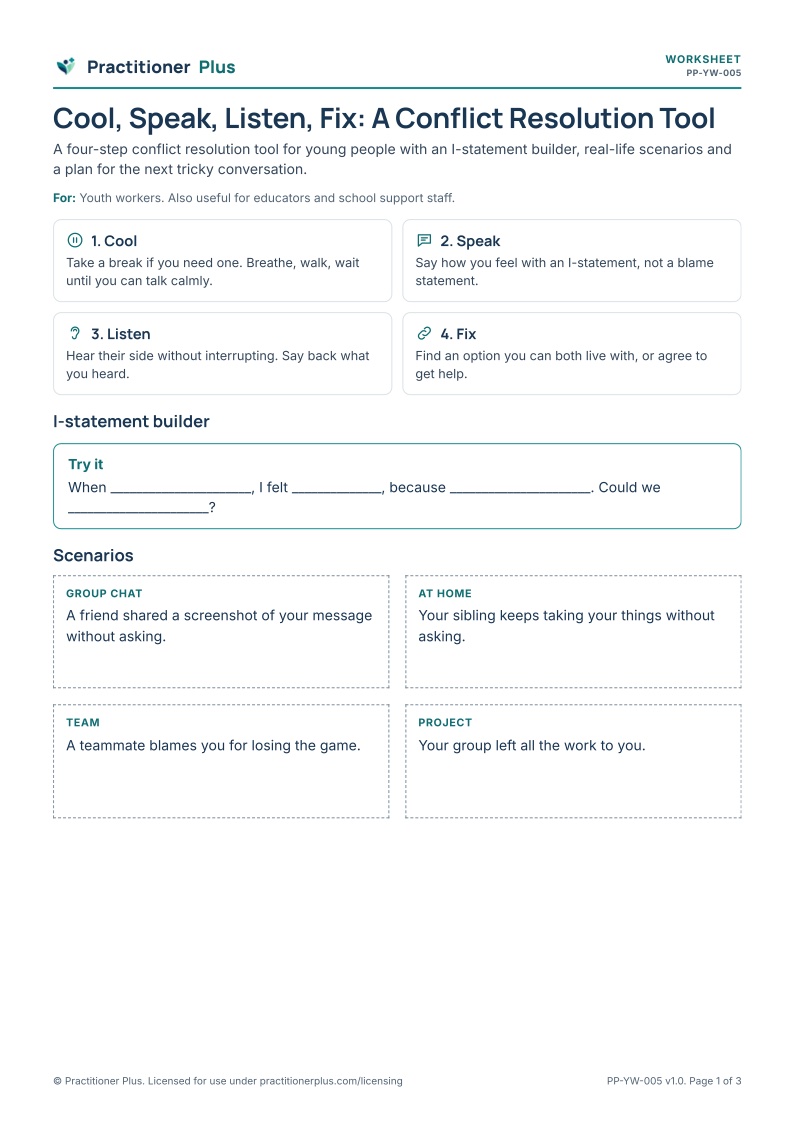
Conflict is part of life, but blow-ups are not inevitable. This tool teaches four steps: cool down, speak up with an I-statement, listen to the other side, and find a fix together. Scenarios and an I-statement builder make it practical and youth friendly.
Purpose
To give young people a simple, memorable process for working through conflict without escalating it.
Who it is for
Primary profession: Youth workers. Also relevant for educators and school support staff.
Client or participant group: Young people aged about 12 to 18, one to one or in groups.
Practice setting: Youth services, schools, residential care and community programs.
Suggested uses
- Group sessions on friendships and conflict
- Restorative conversations after a conflict
- Preparing for a difficult conversation
- Peer mediation programs
Instructions for practitioners
- Introduce the four steps using a neutral example.
- Let young people choose scenarios that feel real to them.
- Practise I-statements out loud.
- Avoid forcing resolution; some conflicts need adult support or space.
Instructions for clients or participants
- Learn the four steps.
- Build an I-statement for a real or practice situation.
- Plan how you will handle the next tricky conversation.
Accessibility considerations
Steps are short and can be shown as cards. Role-play is optional; young people can talk through scenarios instead.
Scope and limitations
A skill-building activity for everyday conflict. It is not suitable for situations involving bullying, violence or abuse, which require adult intervention under your organisation's procedures.
Research basis
School-based social and emotional learning programs improve students' social skills, behaviour and academic results.
- Durlak, J. A., Weissberg, R. P., Dymnicki, A. B., Taylor, R. D., & Schellinger, K. B. (2011). The Impact of Enhancing Students’ Social and Emotional Learning: A Meta-Analysis of School-Based Universal Interventions. Child Development, 82(1), 405–432. https://doi.org/10.1111/j.1467-8624.2010.01564.x
What is included
A 3-page printable A4 PDF, including a practitioner notes page with the research basis (version 1.0).
Originality
Original Practitioner Plus content: wording, activity structure, layout and icons were created for this resource. No third-party worksheets, illustrations or text were reproduced.


