
About this resource
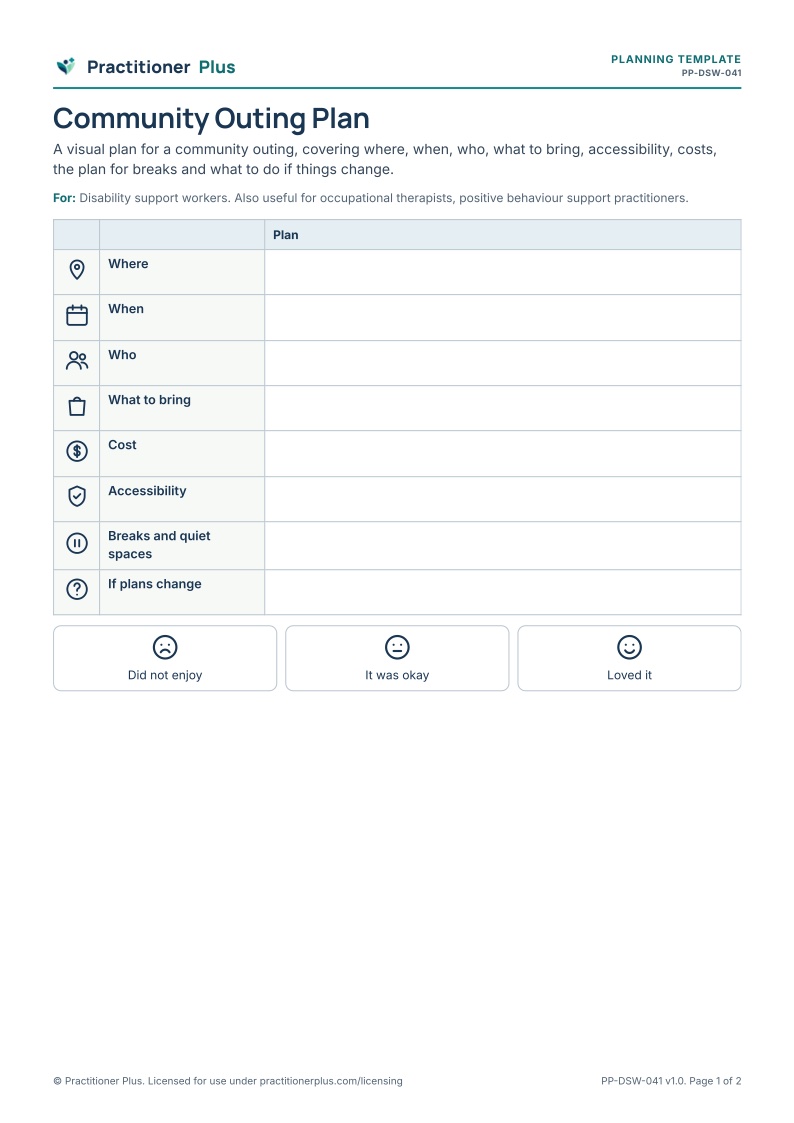
Planning makes outings more enjoyable. This plan covers where, when and who, what to bring, accessibility, costs, plans for breaks and quiet spaces, and what to do if things change, made with the person.
Purpose
To plan enjoyable, well-prepared outings with the person.
Who it is for
Primary profession: Disability support workers. Also relevant for occupational therapists, positive behaviour support practitioners.
Client or participant group: Adults and young people planning community outings with support.
Practice setting: Community access.
Suggested uses
- Community access shifts
- New places
- Group outings
- Building independence
Instructions for practitioners
- Plan with the person.
- Check accessibility in advance.
- Plan breaks and a backup.
- Review afterwards.
Instructions for clients or participants
- Choose where to go.
- Pack what you need.
- Know the plan.
Accessibility considerations
Add photos of the destination.
Scope and limitations
A planning tool.
Research basis
Active support, which gives people real opportunities and just-enough help to take part in everyday activities, increases engagement for people with intellectual disability. Occupational therapy models describe how the person, their environment and their activities interact, and how a balance of meaningful activity supports health and participation.
- Law, M., Cooper, B., Strong, S., Stewart, D., Rigby, P., & Letts, L. (1996). The Person-Environment-Occupation Model: A Transactive Approach to Occupational Performance. Canadian Journal of Occupational Therapy, 63(1), 9–23. https://doi.org/10.1177/000841749606300103
- Mansell, J., & Beadle-Brown, J. (2012). Active support: Enabling and empowering people with intellectual disabilities. Jessica Kingsley Publishers.
- Wagman, P., Håkansson, C., & Björklund, A. (2012). Occupational balance as used in occupational therapy: A concept analysis. Scandinavian Journal of Occupational Therapy, 19(4), 322–327. https://doi.org/10.3109/11038128.2011.596219
- World Health Organization. (2001). International classification of functioning, disability and health (ICF). WHO. https://www.who.int/standards/classifications/international-classification-of-functioning-disability-and-health
What is included
A 2-page printable A4 PDF, including a practitioner notes page with the research basis (version 1.0).
Originality
Original Practitioner Plus content: wording, activity structure, layout and icons were created for this resource. No third-party worksheets, illustrations or text were reproduced. Symbols are original line drawings created for Practitioner Plus.


