
About this resource
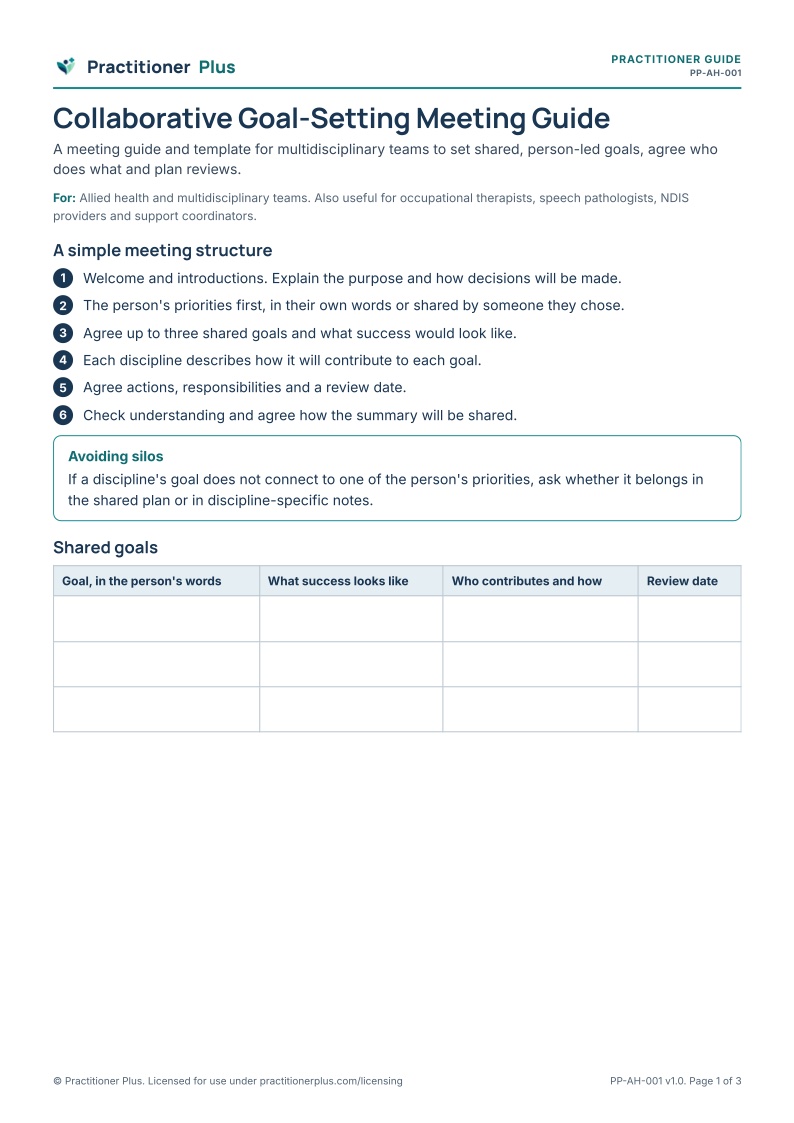
When several disciplines set their own goals, people can end up with long, disconnected lists. This guide gives teams a simple structure: hear the person's priorities first, agree shared goals in the person's words, map each discipline's contribution and set a review date.
Purpose
To keep the person's priorities at the centre of team goal setting and to turn discipline-specific input into a small number of shared goals.
Who it is for
Primary profession: Allied health and multidisciplinary teams. Also relevant for occupational therapists, speech pathologists, NDIS providers and support coordinators.
Client or participant group: Multidisciplinary teams working with a person and their family or supporters.
Practice setting: Team goal-setting or case conference meetings in hospital, community health, disability, aged care or private practice.
Suggested uses
- Initial goal-setting meetings
- Case conferences and family meetings
- Re-setting goals after a change in circumstances
- Training new team members in person-led practice
Instructions for practitioners
- Ask the person, before the meeting, what matters most to them and how they would like to take part.
- Open the meeting with the person's priorities, in their words.
- Agree no more than three shared goals and what success would look like.
- Map each discipline's contribution to each goal, rather than writing separate goals.
- Close with actions, a review date and an accessible summary for the person.
Instructions for clients or participants
- Tell the team what matters most to you.
- Say what a good result would look like.
- Check you are happy with the goals before the meeting ends.
Accessibility considerations
Offer the person ways to contribute beforehand, such as writing, recording or a support person speaking with them. Provide the summary in plain language or Easy Read.
Scope and limitations
A team process guide. It does not replace discipline-specific assessment, clinical governance or formal outcome measures.
Research basis
Specific goals, if-then plans and regular progress monitoring all improve the chances of reaching goals. Interprofessional collaboration interventions may improve professional practice and outcomes, although the evidence is still limited.
- Gollwitzer, P. M., & Sheeran, P. (2006). Implementation Intentions and Goal Achievement: A Meta‐analysis of Effects and Processes. Advances in Experimental Social Psychology, 69–119. https://doi.org/10.1016/s0065-2601(06)38002-1
- Harkin, B., Webb, T. L., Chang, B. P. I., Prestwich, A., Conner, M., Kellar, I., Benn, Y., & Sheeran, P. (2016). Does monitoring goal progress promote goal attainment? A meta-analysis of the experimental evidence. Psychological Bulletin, 142(2), 198–229. https://doi.org/10.1037/bul0000025
- Locke, E. A., & Latham, G. P. (2002). Building a practically useful theory of goal setting and task motivation: A 35-year odyssey. American Psychologist, 57(9), 705–717. https://doi.org/10.1037/0003-066x.57.9.705
- Reeves, S., Pelone, F., Harrison, R., Goldman, J., & Zwarenstein, M. (2017). Interprofessional collaboration to improve professional practice and healthcare outcomes. Cochrane Database of Systematic Reviews, Article CD000072. https://doi.org/10.1002/14651858.cd000072.pub3
What is included
A 3-page printable A4 PDF, including a practitioner notes page with the research basis (version 1.0).
Originality
Original Practitioner Plus content: wording, activity structure, layout and icons were created for this resource. No third-party worksheets, illustrations or text were reproduced. Reflects widely described person-centred and collaborative goal-setting principles.


