
About this resource
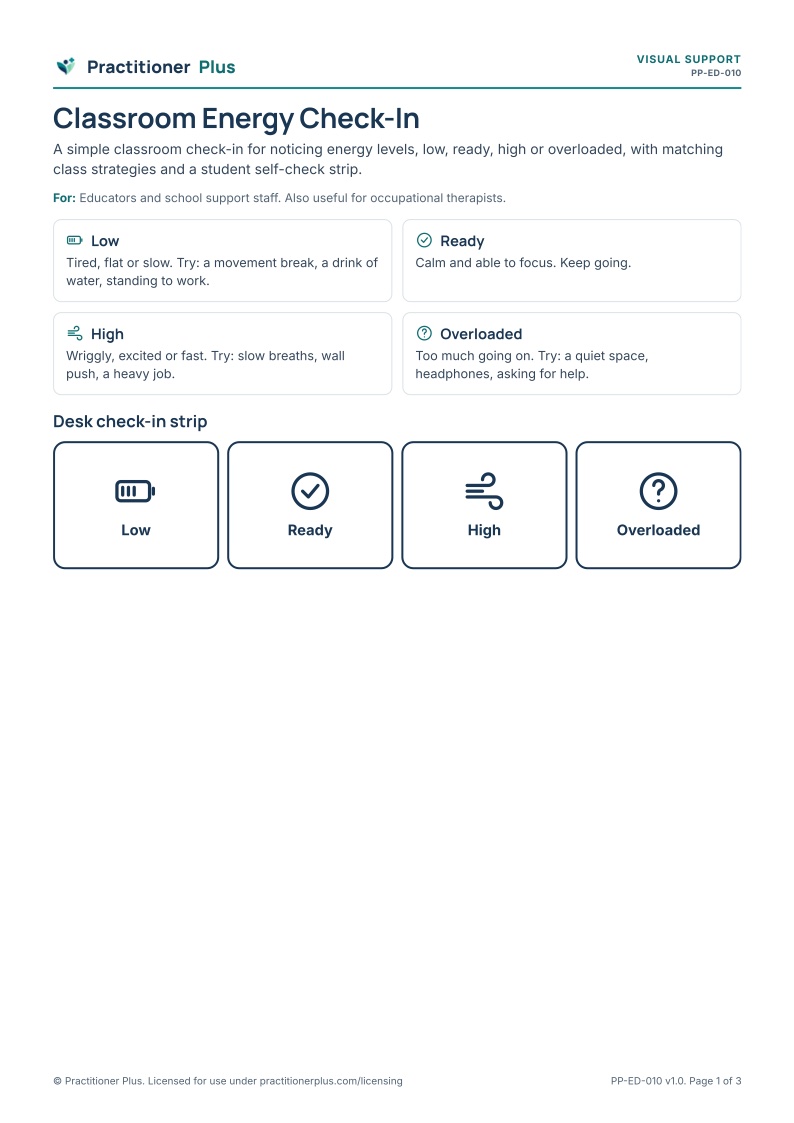
Students learn best when their energy matches the task. This check-in helps students notice whether they feel low, ready, high or overloaded, and pairs each level with simple class strategies, plus a self-check strip for desks.
Purpose
To help students notice their energy level and choose a strategy that helps them get ready to learn.
Who it is for
Primary profession: Educators and school support staff. Also relevant for occupational therapists.
Client or participant group: Primary classes.
Practice setting: Primary classrooms, at the start of lessons or after breaks.
Suggested uses
- Start-of-lesson check-ins
- After lunch and transitions
- Teaching students to notice their bodies
- Individual desk supports
Instructions for practitioners
- Teach the four levels using examples, without judging any level.
- Model your own check-in.
- Offer strategies, not consequences.
- Talk privately with students who often feel overloaded and consult the wellbeing team.
Instructions for clients or participants
- Notice how your energy feels.
- Point to your level.
- Try a strategy.
Accessibility considerations
Use colours and symbols. Students can respond privately.
Scope and limitations
A general classroom activity. It is not a screening tool. Persistent concerns should be followed up with the school wellbeing team.
Research basis
Children learn to self-regulate through warm, responsive co-regulation from adults and predictable environments. Understanding, naming and choosing strategies for emotions are central to emotion regulation; putting feelings into words and finer emotion distinctions are linked to better regulation.
- Gross, J. J. (2015). Emotion Regulation: Current Status and Future Prospects. Psychological Inquiry, 26(1), 1–26. https://doi.org/10.1080/1047840x.2014.940781
- Kashdan, T. B., Barrett, L. F., & McKnight, P. E. (2015). Unpacking Emotion Differentiation: Transforming Unpleasant Experience by Perceiving Distinctions in Negativity. Current Directions in Psychological Science, 24(1), 10–16. https://doi.org/10.1177/0963721414550708
- Kircanski, K., Lieberman, M. D., & Craske, M. G. (2012). Feelings Into Words: Contributions of Language to Exposure Therapy. Psychological Science, 23(10), 1086–1091. https://doi.org/10.1177/0956797612443830
- Murray, D. W., Rosanbalm, K., Christopoulos, C., & Hamoudi, A. (2015). Self-regulation and toxic stress: Foundations for understanding self-regulation from an applied developmental perspective (OPRE Report 2015-21). Office of Planning, Research and Evaluation, US Department of Health and Human Services. https://acf.gov/opre/report/self-regulation-and-toxic-stress-foundations-understanding-self-regulation-applied
What is included
A 3-page printable A4 PDF, including a practitioner notes page with the research basis (version 1.0).
Originality
Original Practitioner Plus content: wording, activity structure, layout and icons were created for this resource. No third-party worksheets, illustrations or text were reproduced.


