
About this resource
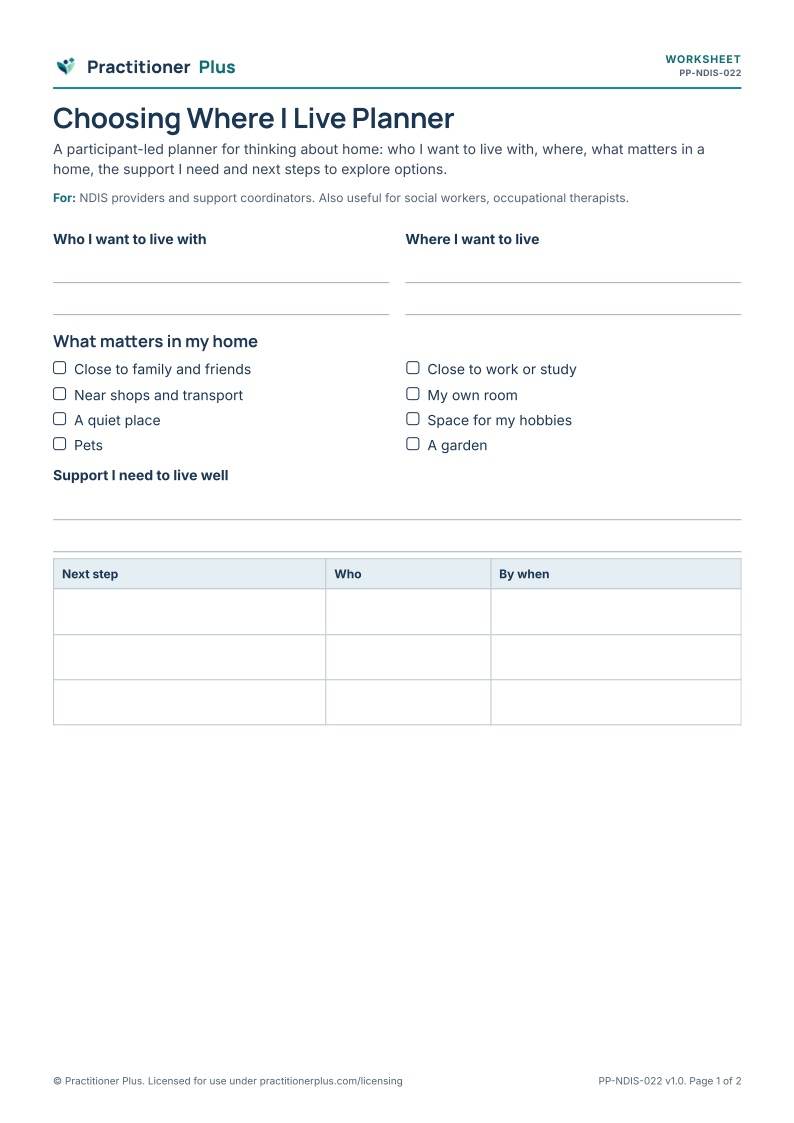
Where we live shapes our whole life. This planner helps participants think about who they want to live with, where, what matters in a home, the support they need to live well and next steps to explore options, with their own voice at the centre.
Purpose
To help participants think through home and living choices in their own terms.
Who it is for
Primary profession: NDIS providers and support coordinators. Also relevant for social workers, occupational therapists.
Client or participant group: Participants thinking about where and how they want to live, with families and support coordinators.
Practice setting: Support coordination and planning conversations.
Suggested uses
- Home and living conversations
- Planning for leaving the family home
- Reviewing current living arrangements
- Preparing for planning meetings
Instructions for practitioners
- Let the participant lead and dream before focusing on constraints.
- Use visuals and visits to explore options.
- Involve family with the participant's agreement.
- Check current NDIS guidance on home and living supports.
Instructions for clients or participants
- Think about where you want to live.
- Write what matters to you.
- Choose next steps.
Accessibility considerations
Use photos, symbols and visits. Offer an Easy Read version.
Scope and limitations
A planning tool. It does not determine eligibility for supports or funding.
Research basis
Person-centred planning shows positive but limited evidence of improving community participation and everyday choice for people with intellectual disability. Human rights frameworks and research on the dignity of risk support people's right to make their own choices, including choices that involve some risk. Supported decision-making research from Australia describes practical steps for supporting people with cognitive disability to make their own decisions.
- Bigby, C., Douglas, J., Carney, T., Then, S., Wiesel, I., & Smith, E. (2017). Delivering decision making support to people with cognitive disability: What has been learned from pilot programs in Australia from 2010 to 2015. Australian Journal of Social Issues, 52(3), 222–240. https://doi.org/10.1002/ajs4.19
- Douglas, J., & Bigby, C. (2020). Development of an evidence-based practice framework to guide decision making support for people with cognitive impairment due to acquired brain injury or intellectual disability. Disability and Rehabilitation, 42(3), 434–441. https://doi.org/10.1080/09638288.2018.1498546
- Ibrahim, J. E., & Davis, M. (2013). Impediments to applying the ‘dignity of risk’ principle in residential aged care services. Australasian Journal on Ageing, 32(3), 188–193. https://doi.org/10.1111/ajag.12014
- Ratti, V., Hassiotis, A., Crabtree, J., Deb, S., Gallagher, P., & Unwin, G. (2016). The effectiveness of person-centred planning for people with intellectual disabilities: A systematic review. Research in Developmental Disabilities, 57, 63–84. https://doi.org/10.1016/j.ridd.2016.06.015
- United Nations. (2006). Convention on the Rights of Persons with Disabilities. https://www.ohchr.org/en/instruments-mechanisms/instruments/convention-rights-persons-disabilities
What is included
A 2-page printable A4 PDF, including a practitioner notes page with the research basis (version 1.0).
Originality
Original Practitioner Plus content: wording, activity structure, layout and icons were created for this resource. No third-party worksheets, illustrations or text were reproduced.


