
About this resource
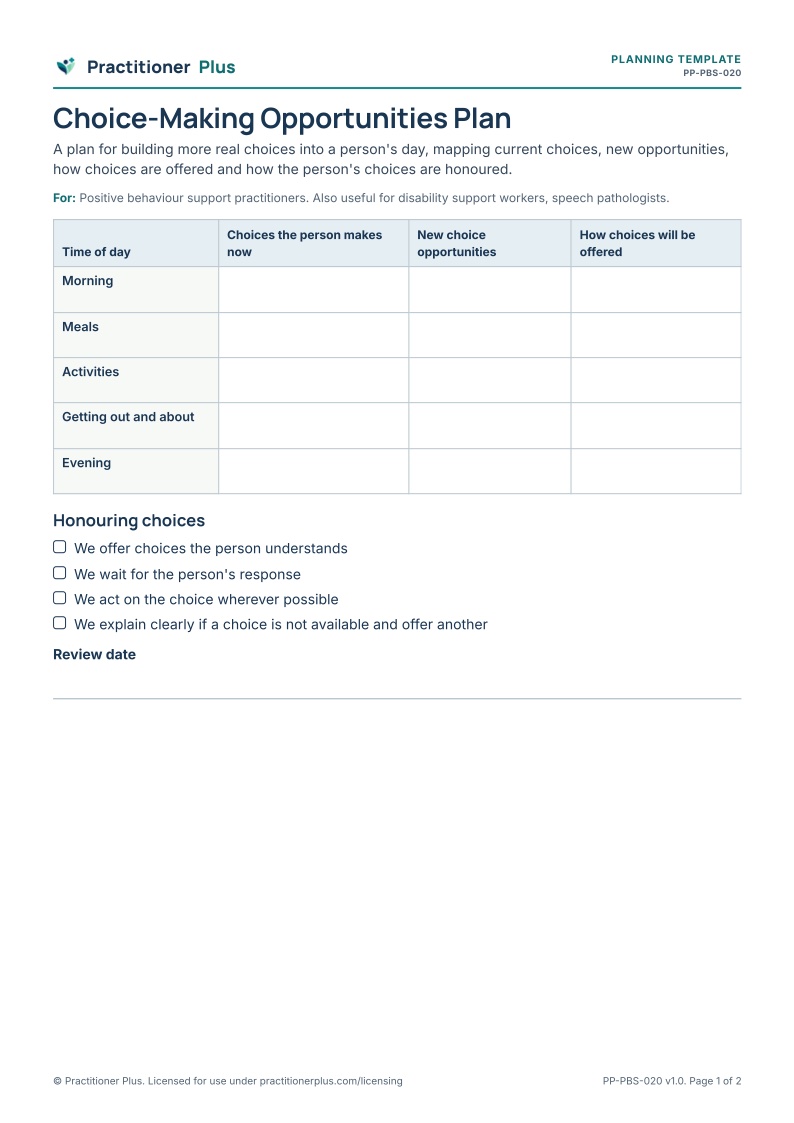
Having choices is a basic right, and more choice can improve wellbeing and reduce distress. This plan maps the choices the person makes now, finds new opportunities across the day, sets out how choices will be offered in ways the person understands and how their choices will be honoured.
Purpose
To increase meaningful choice and control in everyday life.
Who it is for
Primary profession: Positive behaviour support practitioners. Also relevant for disability support workers, speech pathologists.
Client or participant group: Teams supporting people who have limited opportunities for choice.
Practice setting: Supported living, day programs, schools and family homes.
Suggested uses
- Behaviour support planning
- Active support
- Team training
- Quality of life reviews
Instructions for practitioners
- Map current choices honestly.
- Offer choices in the person's communication style.
- Honour choices, or explain clearly when a choice is not available.
- Review whether choices are increasing over time.
Accessibility considerations
Use objects, photos, symbols or speech according to the person's communication.
Scope and limitations
A planning tool. It is not a behaviour support plan.
Research basis
Human rights frameworks and research on the dignity of risk support people's right to make their own choices, including choices that involve some risk. Positive behaviour support aims to improve quality of life and reduce behaviours of concern by understanding their function and changing environments and skills. Person-centred planning shows positive but limited evidence of improving community participation and everyday choice for people with intellectual disability.
- Allen, D., James, W., Evans, J., Hawkins, S., & Jenkins, R. (2005). Positive Behavioural Support: Definition, Current Status and Future Directions. Tizard Learning Disability Review, 10(2), 4–11. https://doi.org/10.1108/13595474200500014
- Ibrahim, J. E., & Davis, M. (2013). Impediments to applying the ‘dignity of risk’ principle in residential aged care services. Australasian Journal on Ageing, 32(3), 188–193. https://doi.org/10.1111/ajag.12014
- NDIS Quality and Safeguards Commission. NDIS Practice Standards and Quality Indicators. https://www.ndiscommission.gov.au/rules-and-standards/ndis-practice-standards
- Ratti, V., Hassiotis, A., Crabtree, J., Deb, S., Gallagher, P., & Unwin, G. (2016). The effectiveness of person-centred planning for people with intellectual disabilities: A systematic review. Research in Developmental Disabilities, 57, 63–84. https://doi.org/10.1016/j.ridd.2016.06.015
- United Nations. (2006). Convention on the Rights of Persons with Disabilities. https://www.ohchr.org/en/instruments-mechanisms/instruments/convention-rights-persons-disabilities
What is included
A 2-page printable A4 PDF, including a practitioner notes page with the research basis (version 1.0).
Originality
Original Practitioner Plus content: wording, activity structure, layout and icons were created for this resource. No third-party worksheets, illustrations or text were reproduced.


