
About this resource
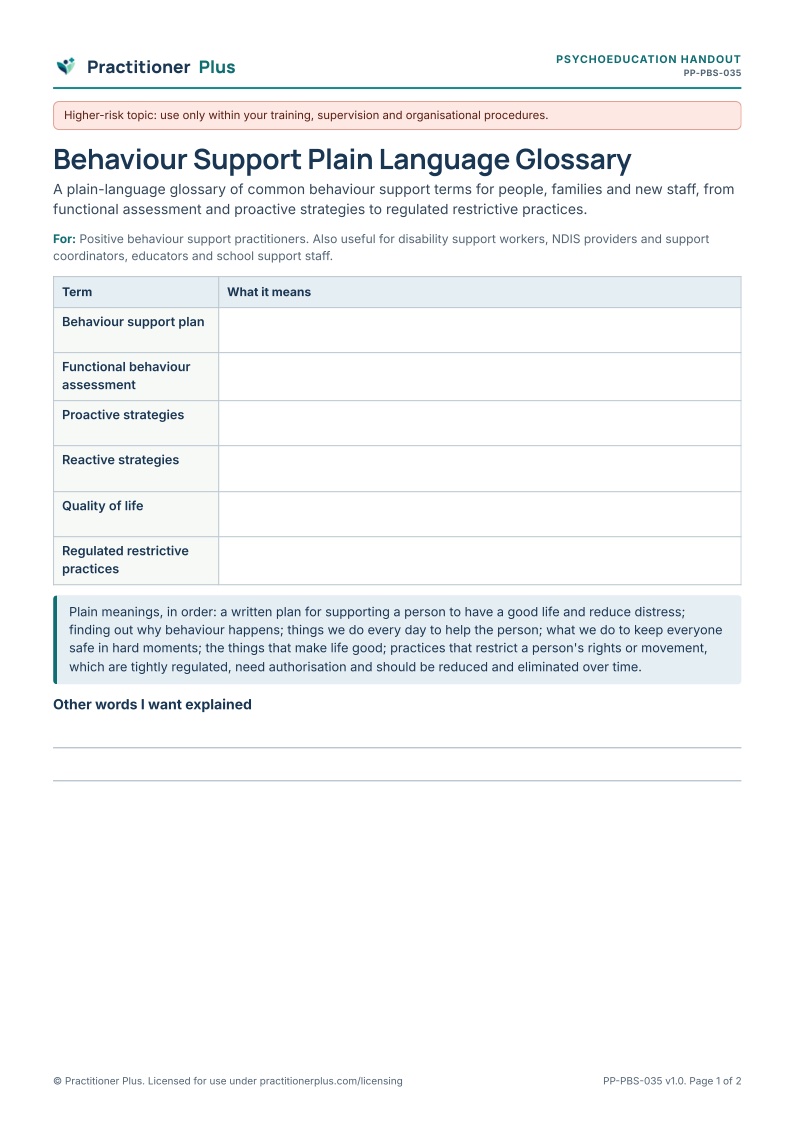
Behaviour support uses a lot of jargon. This glossary explains common terms in plain language, including behaviour support plan, functional assessment, proactive strategies, reactive strategies, quality of life and regulated restrictive practices, so everyone can take part in conversations.
Purpose
To make behaviour support language understandable.
Who it is for
Primary profession: Positive behaviour support practitioners. Also relevant for disability support workers, NDIS providers and support coordinators, educators and school support staff.
Client or participant group: People receiving behaviour support, families and new staff.
Practice setting: Behaviour support services and onboarding.
Suggested uses
- Family information
- New staff orientation
- Planning meetings
- Easy reference
Instructions for practitioners
- Share at the start of behaviour support.
- Explain terms in conversation too.
- Check current definitions under the NDIS Quality and Safeguards Commission rules.
- Invite questions.
Accessibility considerations
Plain language. Can be read aloud.
Scope and limitations
General plain-language definitions. It does not recommend or authorise restrictive practices. Formal definitions are set by legislation and the NDIS Quality and Safeguards Commission.
Higher-risk topic: use only within your training, supervision and organisational procedures.
Research basis
Positive behaviour support aims to improve quality of life and reduce behaviours of concern by understanding their function and changing environments and skills. Easy Read standards and disability rights frameworks support people's right to accessible information; test Easy Read materials with the people who will use them.
- Allen, D., James, W., Evans, J., Hawkins, S., & Jenkins, R. (2005). Positive Behavioural Support: Definition, Current Status and Future Directions. Tizard Learning Disability Review, 10(2), 4–11. https://doi.org/10.1108/13595474200500014
- Inclusion Europe. (2009). Information for all: European standards for making information easy to read and understand. https://www.inclusion-europe.eu/easy-to-read-standards-guidelines/
- NDIS Quality and Safeguards Commission. NDIS Practice Standards and Quality Indicators. https://www.ndiscommission.gov.au/rules-and-standards/ndis-practice-standards
- United Nations. (2006). Convention on the Rights of Persons with Disabilities. https://www.ohchr.org/en/instruments-mechanisms/instruments/convention-rights-persons-disabilities
What is included
A 2-page printable A4 PDF, including a practitioner notes page with the research basis (version 1.0).
Originality
Original Practitioner Plus content: wording, activity structure, layout and icons were created for this resource. No third-party worksheets, illustrations or text were reproduced.


