
About this resource
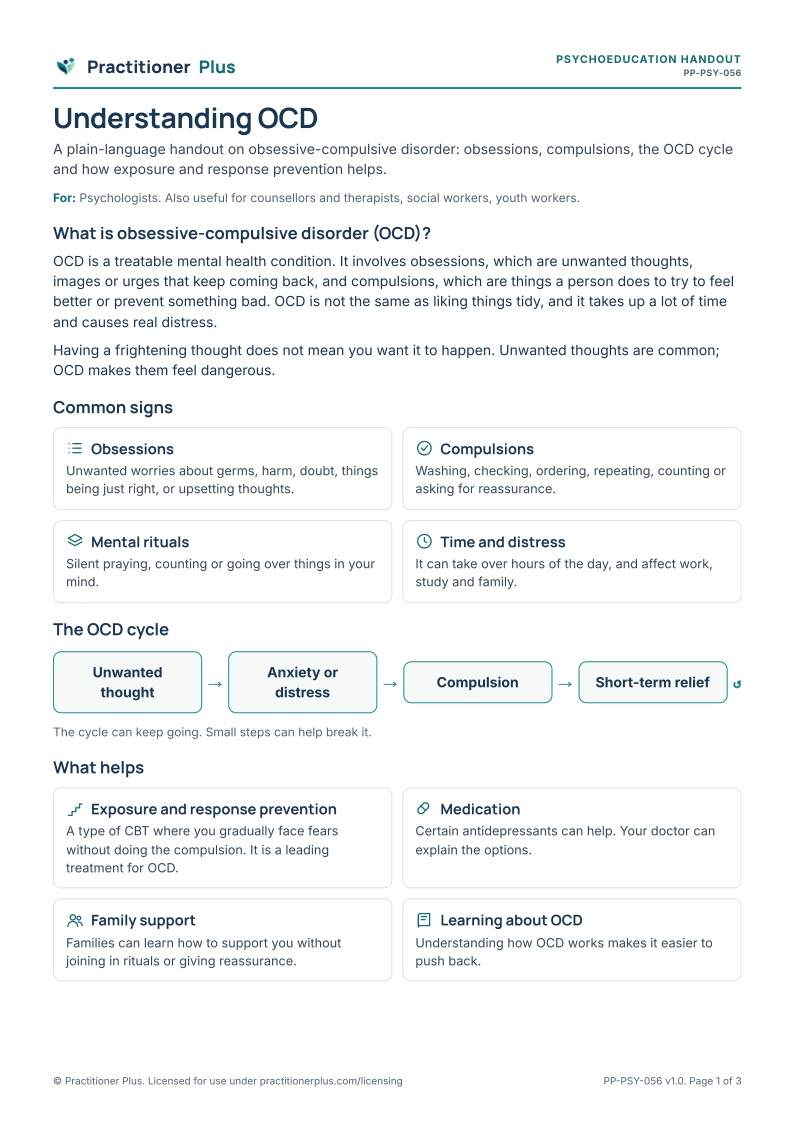
OCD is a treatable mental health condition. It involves obsessions, which are unwanted thoughts, images or urges that keep coming back, and compulsions, which are things a person does to try to feel better or prevent something bad. OCD is not the same as liking things tidy, and it takes up a lot of time and causes real distress. This handout explains common signs, what helps and gives space for a personal plan.
Purpose
To give clear, accurate information about obsessive-compulsive disorder (OCD) and what helps.
Who it is for
Primary profession: Psychologists. Also relevant for counsellors and therapists, social workers, youth workers.
Client or participant group: People living with obsessive-compulsive disorder (OCD), and their families and supporters.
Practice setting: Counselling, psychology and mental health services, as part of psychoeducation.
Suggested uses
- Psychoeducation after diagnosis
- Helping someone decide to seek assessment
- Sessions with family or supporters
- Goal setting and treatment planning
Instructions for practitioners
- Check what the person already knows and has been told.
- Go through the handout together, linking it to their own experience.
- Choose one or two things to try first.
- Talk with the person's GP or treating team about assessment, diagnosis and medication.
- Complete a risk assessment conversation where needed.
Instructions for clients or participants
- Read this with your practitioner or someone you trust.
- Tick the things that sound like you.
- Write down questions for your practitioner or doctor.
Accessibility considerations
Plain language. Can be read aloud or worked through with an interpreter or supporter.
Scope and limitations
General psychoeducation. It is not a diagnostic tool and does not replace assessment or treatment by a doctor, psychiatrist or other qualified clinician. Questions about medication should go to the prescribing doctor.
Research basis
Reviews identify exposure and response prevention, a form of cognitive behavioural therapy, and serotonin reuptake inhibitors as first-line treatments for OCD.
- Hirschtritt, M. E., Bloch, M. H., & Mathews, C. A. (2017). Obsessive-Compulsive Disorder: Advances in Diagnosis and Treatment. JAMA, 317(13), 1358. https://doi.org/10.1001/jama.2017.2200
What is included
A 3-page printable A4 PDF, including a practitioner notes page with the research basis (version 1.0).
Originality
Original Practitioner Plus content: wording, activity structure, layout and icons were created for this resource. No third-party worksheets, illustrations or text were reproduced. Written for Practitioner Plus from the guidelines and research listed in the research basis; no third-party handout was used.


