
About this resource
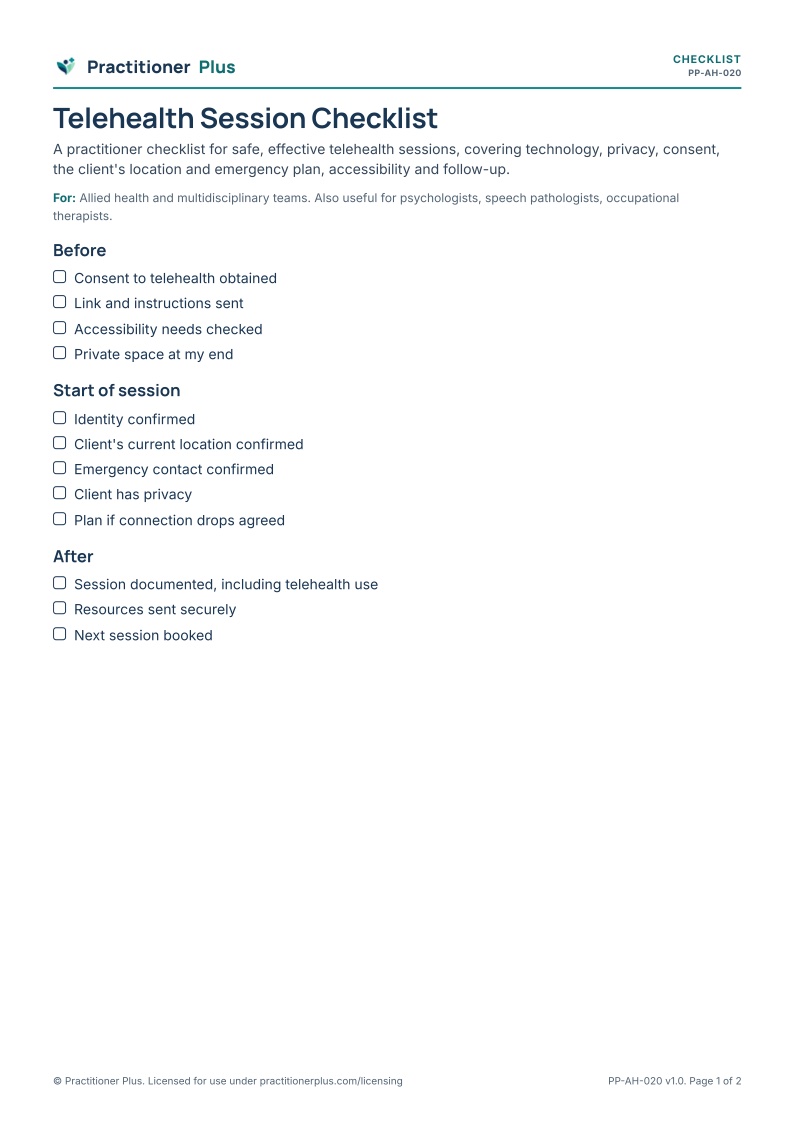
Telehealth works well with good preparation. This checklist covers technology checks, privacy at both ends, consent to telehealth, confirming the client's location and an emergency plan, accessibility adjustments, what to do if the connection drops and follow-up.
Purpose
To support consistent, safe telehealth practice.
Who it is for
Primary profession: Allied health and multidisciplinary teams. Also relevant for psychologists, speech pathologists, occupational therapists.
Client or participant group: Allied health practitioners delivering telehealth.
Practice setting: Video and phone sessions.
Suggested uses
- Every telehealth session
- Setting up telehealth services
- Staff orientation
- Quality audits
Instructions for practitioners
- Confirm the client's location and emergency contact at each session.
- Agree what happens if the connection drops.
- Check privacy at both ends.
- Document that telehealth was used.
Accessibility considerations
Offer captions, interpreters, phone options and practice calls.
Scope and limitations
A practice checklist. Check your professional body's telehealth guidance.
Research basis
A strong working alliance and routine progress feedback are among the most consistent predictors of good outcomes in therapy.
- Flückiger, C., Del Re, A. C., Wampold, B. E., & Horvath, A. O. (2018). The alliance in adult psychotherapy: A meta-analytic synthesis. Psychotherapy, 55(4), 316–340. https://doi.org/10.1037/pst0000172
- Lambert, M. J., Whipple, J. L., & Kleinstäuber, M. (2018). Collecting and delivering progress feedback: A meta-analysis of routine outcome monitoring. Psychotherapy, 55(4), 520–537. https://doi.org/10.1037/pst0000167
What is included
A 2-page printable A4 PDF, including a practitioner notes page with the research basis (version 1.0).
Originality
Original Practitioner Plus content: wording, activity structure, layout and icons were created for this resource. No third-party worksheets, illustrations or text were reproduced.


