
About this resource
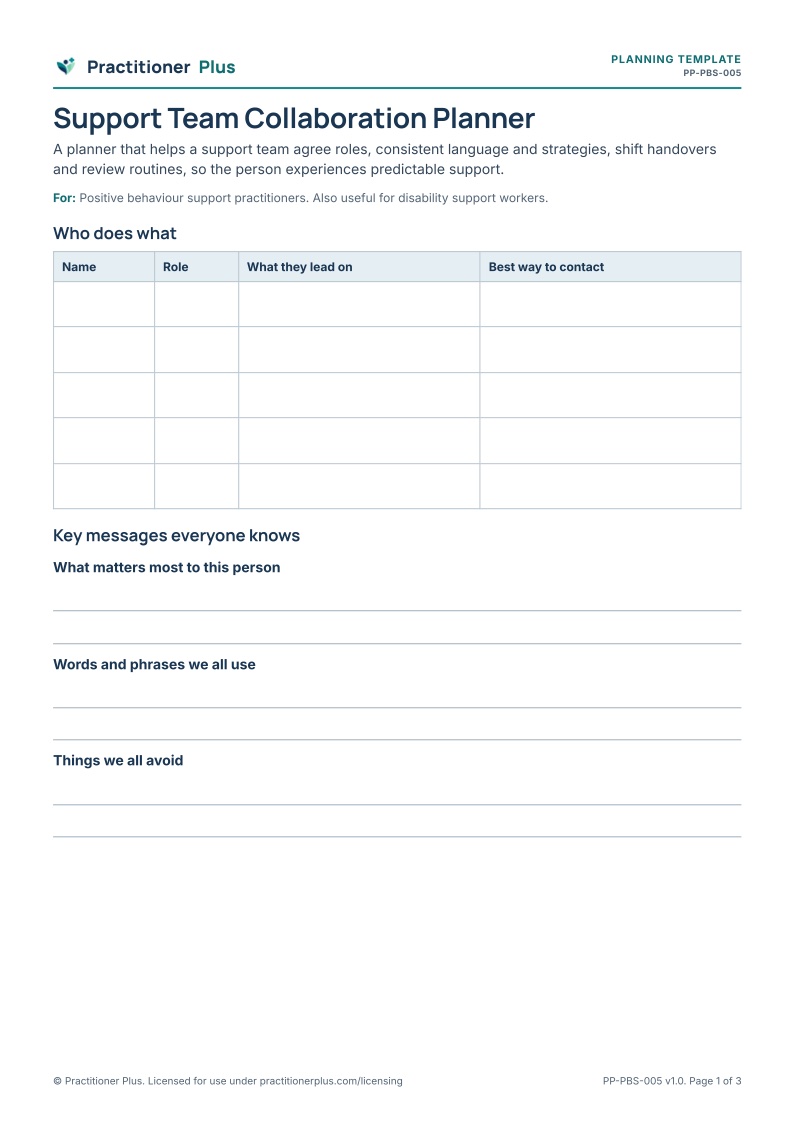
Even good strategies lose their effect when every worker does them differently. This planner helps a team agree who does what, the key messages and words everyone uses, a consistent handover format and how the team will review and share learning with the behaviour support practitioner.
Purpose
To improve consistency across a support team so proactive strategies are used the same way by everyone.
Who it is for
Primary profession: Positive behaviour support practitioners. Also relevant for disability support workers.
Client or participant group: Support teams, families and behaviour support practitioners working with one person.
Practice setting: Supported living, shared support teams, day programs and family homes.
Suggested uses
- Setting up a new support team
- Restoring consistency after staff changes
- Agreeing a handover format between shifts
- Preparing for review meetings with the behaviour support practitioner
Instructions for practitioners
- Bring the team together, including family where appropriate.
- Agree roles and the key messages about the person, in respectful language.
- Agree the handover format and where information is recorded.
- Schedule regular reviews and share learning with the behaviour support practitioner.
Accessibility considerations
Keep key messages short and visible. Include the person's own views about what helps, using their preferred communication method.
Scope and limitations
A team coordination tool. It is not a behaviour support plan and does not recommend restrictive practices. Strategies in a behaviour support plan take precedence.
Research basis
Interprofessional collaboration interventions may improve professional practice and outcomes, although the evidence is still limited. Positive behaviour support aims to improve quality of life and reduce behaviours of concern by understanding their function and changing environments and skills.
- Allen, D., James, W., Evans, J., Hawkins, S., & Jenkins, R. (2005). Positive Behavioural Support: Definition, Current Status and Future Directions. Tizard Learning Disability Review, 10(2), 4–11. https://doi.org/10.1108/13595474200500014
- NDIS Quality and Safeguards Commission. NDIS Practice Standards and Quality Indicators. https://www.ndiscommission.gov.au/rules-and-standards/ndis-practice-standards
- Reeves, S., Pelone, F., Harrison, R., Goldman, J., & Zwarenstein, M. (2017). Interprofessional collaboration to improve professional practice and healthcare outcomes. Cochrane Database of Systematic Reviews, Article CD000072. https://doi.org/10.1002/14651858.cd000072.pub3
What is included
A 3-page printable A4 PDF, including a practitioner notes page with the research basis (version 1.0).
Originality
Original Practitioner Plus content: wording, activity structure, layout and icons were created for this resource. No third-party worksheets, illustrations or text were reproduced.


