
About this resource
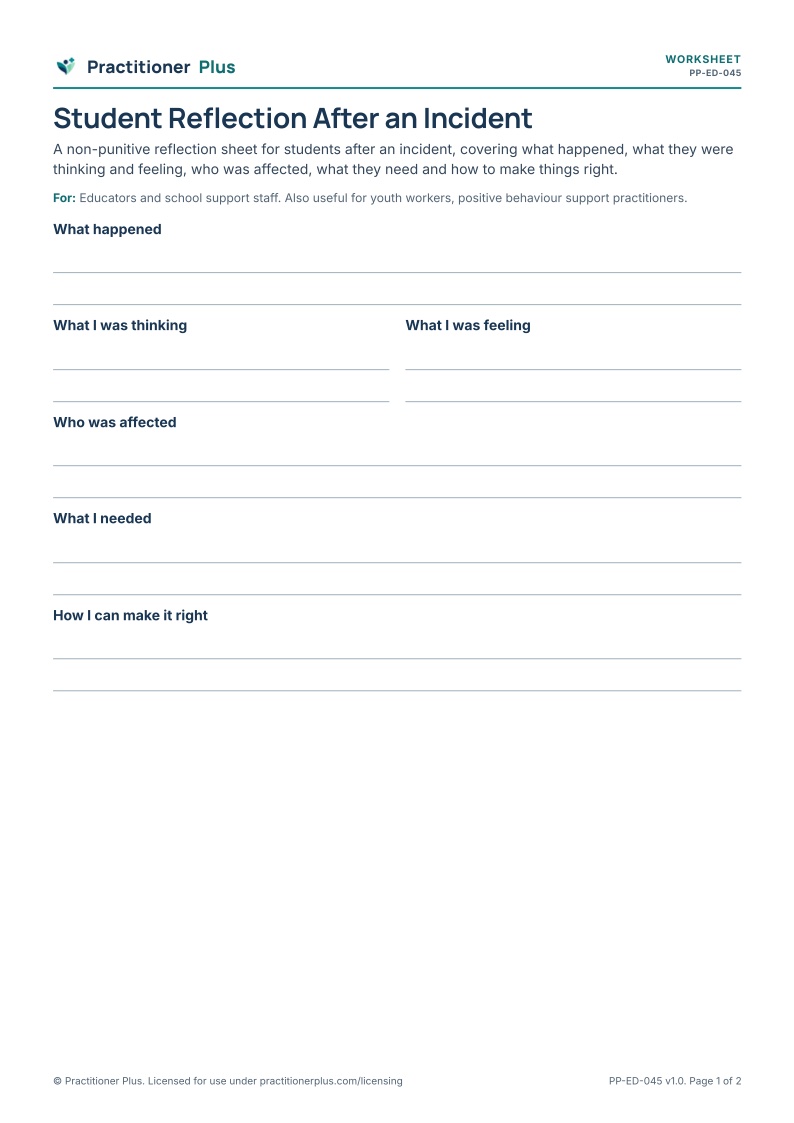
After an incident, reflection helps students learn and repair. This sheet asks what happened, what the student was thinking and feeling, who was affected, what they needed and how they can make things right, used in a calm, supportive conversation.
Purpose
To support reflection, learning and repair.
Who it is for
Primary profession: Educators and school support staff. Also relevant for youth workers, positive behaviour support practitioners.
Client or participant group: Primary and secondary students.
Practice setting: Schools, after incidents, once the student is calm.
Suggested uses
- After incidents
- Restorative conversations
- Wellbeing support
- Behaviour support planning
Instructions for practitioners
- Wait until the student is calm.
- Use as a conversation, not a punishment.
- Listen for unmet needs.
- Follow up on agreed actions.
Instructions for clients or participants
- Write or draw what happened.
- Think about who was affected.
- Plan how to make it right.
Accessibility considerations
Students can draw or talk. Adults can scribe.
Scope and limitations
A reflective tool. It is not a disciplinary record.
Research basis
School-based social and emotional learning programs improve students' social skills, behaviour and academic results. Clear expectations, explicit teaching of routines and frequent positive feedback are evidence-based classroom practices; adjustments for students with disability are required under the Disability Standards for Education.
- Australian Government. Disability Standards for Education 2005. https://www.education.gov.au/disability-standards-education-2005
- Durlak, J. A., Weissberg, R. P., Dymnicki, A. B., Taylor, R. D., & Schellinger, K. B. (2011). The Impact of Enhancing Students’ Social and Emotional Learning: A Meta-Analysis of School-Based Universal Interventions. Child Development, 82(1), 405–432. https://doi.org/10.1111/j.1467-8624.2010.01564.x
- Simonsen, B., Fairbanks, S., Briesch, A., Myers, D., & Sugai, G. (2008). Evidence-based practices in classroom management: Considerations for research to practice. Education and Treatment of Children, 31, 351–380. https://doi.org/10.1353/etc.0.0007
What is included
A 2-page printable A4 PDF, including a practitioner notes page with the research basis (version 1.0).
Originality
Original Practitioner Plus content: wording, activity structure, layout and icons were created for this resource. No third-party worksheets, illustrations or text were reproduced.


