
About this resource
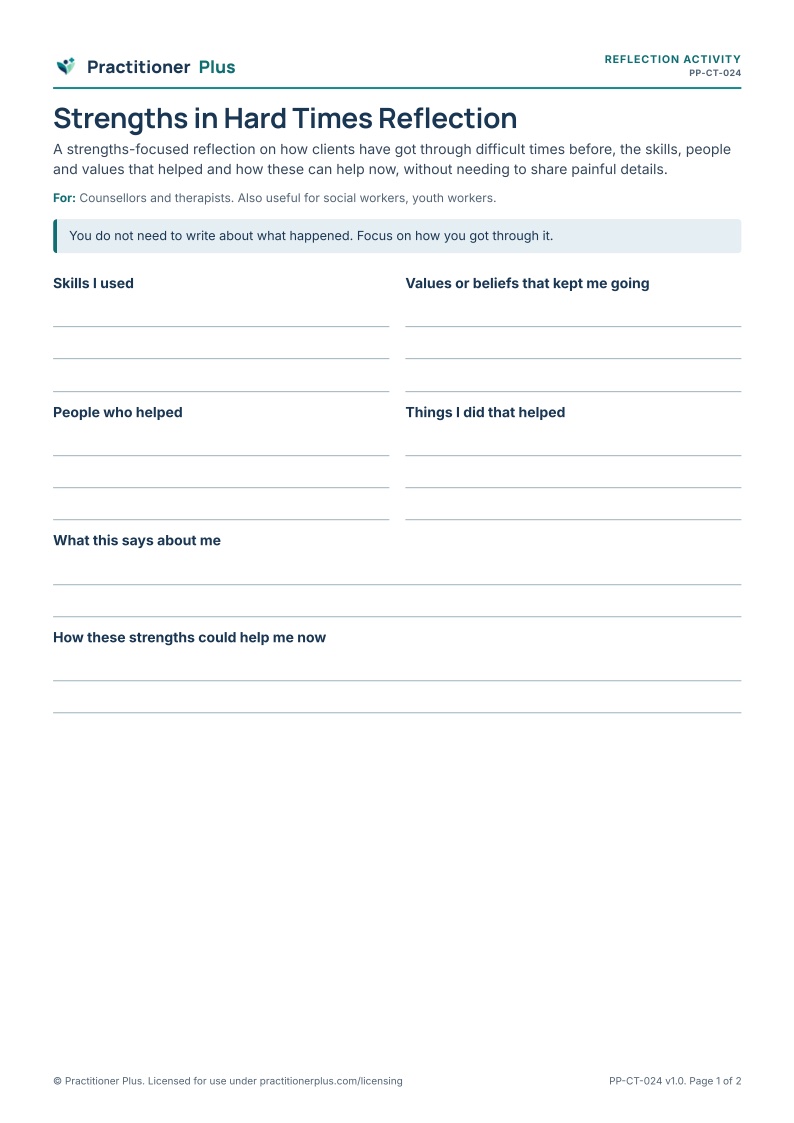
People who are struggling often overlook how they have coped before. This reflection asks clients to think about a past hard time, without needing to share painful details, and notice the skills, people, values and beliefs that helped them get through, then consider how these could help now.
Purpose
To help clients recognise the strengths and resources they have already used to cope.
Who it is for
Primary profession: Counsellors and therapists. Also relevant for social workers, youth workers.
Client or participant group: Adolescents and adults in counselling.
Practice setting: Individual counselling.
Suggested uses
- Building hope
- Strengths-based counselling
- Before setting goals
- Relapse prevention
Instructions for practitioners
- Make clear the client does not need to describe painful details.
- Notice and name strengths the client may overlook.
- Link past strengths to current challenges.
- Use a trauma-informed approach and go at the client's pace.
Instructions for clients or participants
- Think of a hard time you got through.
- Write what helped.
- Write how this could help now.
Accessibility considerations
Can be completed verbally or through drawing.
Scope and limitations
A reflective activity. It is not a trauma processing tool.
Research basis
The strengths model, a recovery-oriented approach, builds on people's own abilities, interests and resources. Understanding, naming and choosing strategies for emotions are central to emotion regulation; putting feelings into words and finer emotion distinctions are linked to better regulation.
- Gross, J. J. (2015). Emotion Regulation: Current Status and Future Prospects. Psychological Inquiry, 26(1), 1–26. https://doi.org/10.1080/1047840x.2014.940781
- Kashdan, T. B., Barrett, L. F., & McKnight, P. E. (2015). Unpacking Emotion Differentiation: Transforming Unpleasant Experience by Perceiving Distinctions in Negativity. Current Directions in Psychological Science, 24(1), 10–16. https://doi.org/10.1177/0963721414550708
- Kircanski, K., Lieberman, M. D., & Craske, M. G. (2012). Feelings Into Words: Contributions of Language to Exposure Therapy. Psychological Science, 23(10), 1086–1091. https://doi.org/10.1177/0956797612443830
- Rapp, C. A., & Goscha, R. J. (2012). The strengths model: A recovery-oriented approach to mental health services (3rd ed.). Oxford University Press.
What is included
A 2-page printable A4 PDF, including a practitioner notes page with the research basis (version 1.0).
Originality
Original Practitioner Plus content: wording, activity structure, layout and icons were created for this resource. No third-party worksheets, illustrations or text were reproduced.


