
About this resource
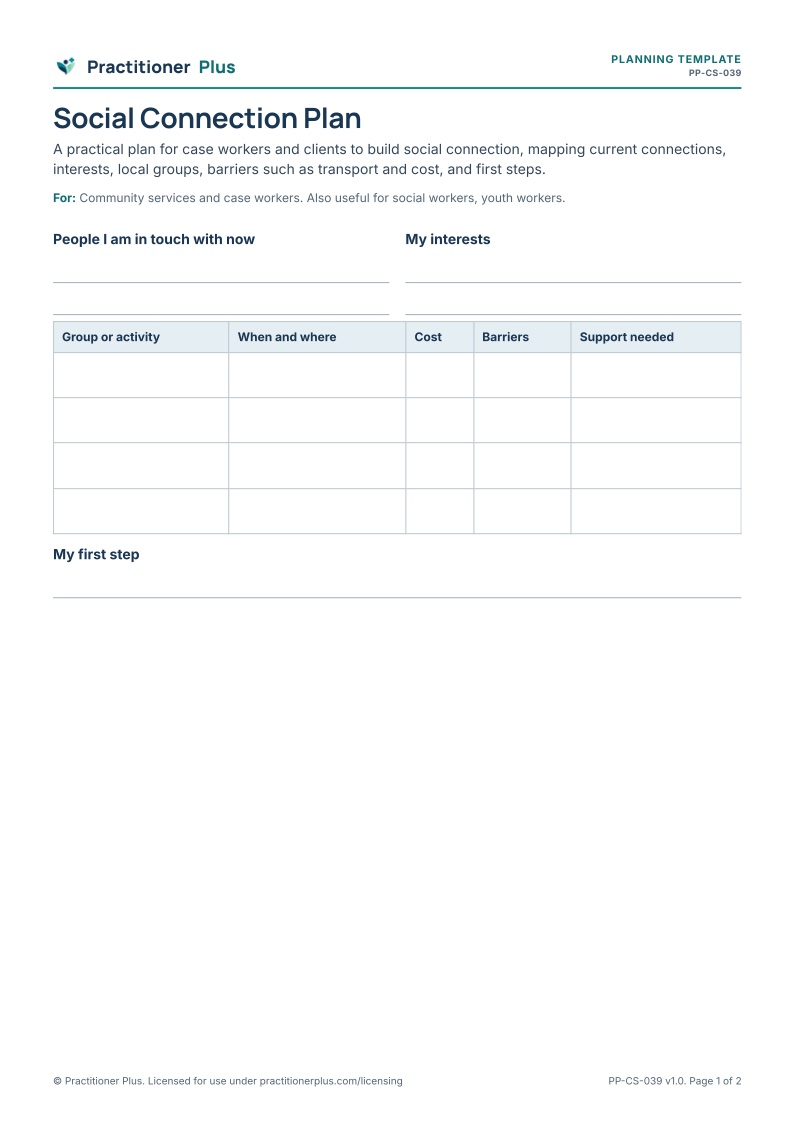
Connection is good for wellbeing and it can be hard to start. This plan maps current connections, interests, local groups and activities, practical barriers such as transport, cost and confidence, and first steps, with support from the case worker.
Purpose
To turn a wish for more connection into a practical plan.
Who it is for
Primary profession: Community services and case workers. Also relevant for social workers, youth workers.
Client or participant group: Clients experiencing isolation, and their case workers.
Practice setting: Community, housing and outreach services.
Suggested uses
- Case planning
- Isolation and loneliness
- After a move
- Recovery planning
Instructions for practitioners
- Ask what kind of connection the client wants.
- Research local options together.
- Address practical barriers.
- Offer to attend the first time if appropriate.
Instructions for clients or participants
- Write your interests.
- Choose a group or activity.
- Plan your first step.
Accessibility considerations
Interpreters and verbal completion.
Scope and limitations
A planning tool.
Research basis
Interventions that address social connection and unhelpful social thinking can reduce loneliness. Case management practice standards describe assessment, planning, coordination, review and planned exits with the person at the centre.
- Case Management Society of Australia and New Zealand. (2013). National standards of practice for case management (3rd ed.). https://www.cmsa.org.au/
- Masi, C. M., Chen, H. Y., Hawkley, L. C., & Cacioppo, J. T. (2011). A Meta-Analysis of Interventions to Reduce Loneliness. Personality and Social Psychology Review, 15(3), 219–266. https://doi.org/10.1177/1088868310377394
What is included
A 2-page printable A4 PDF, including a practitioner notes page with the research basis (version 1.0).
Originality
Original Practitioner Plus content: wording, activity structure, layout and icons were created for this resource. No third-party worksheets, illustrations or text were reproduced.


