
About this resource
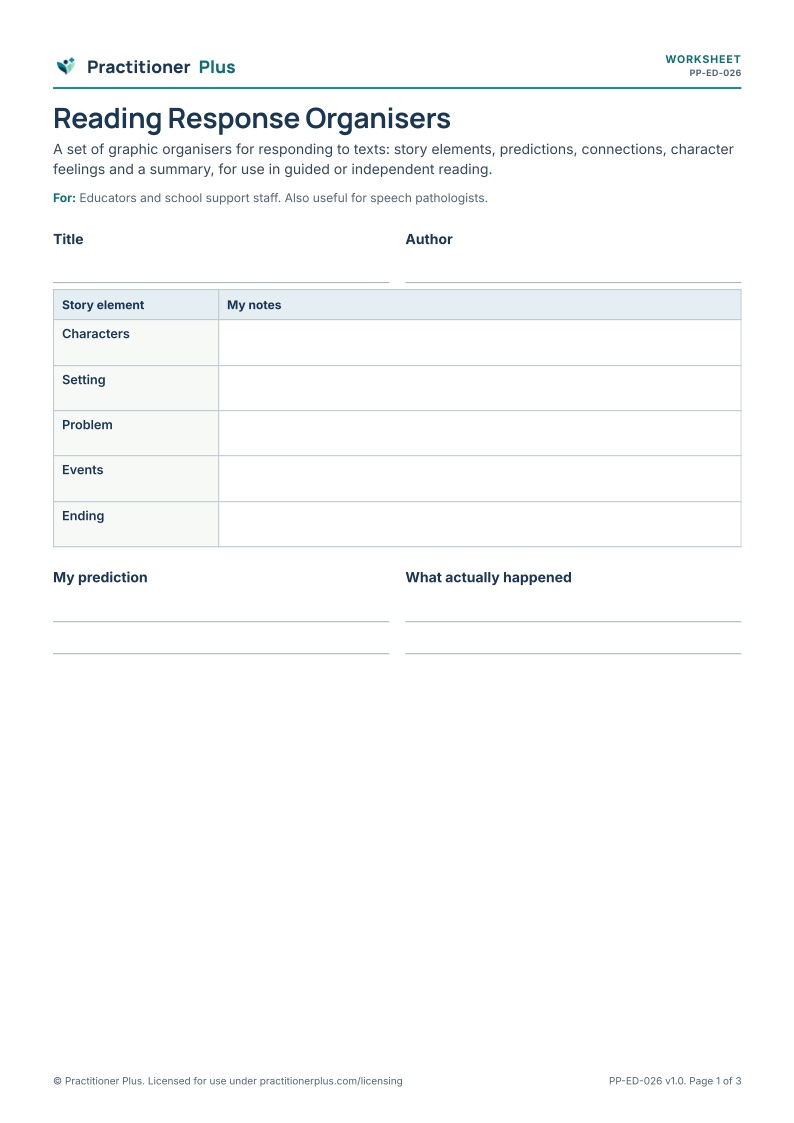
Graphic organisers give students structure for thinking about what they read. This set includes organisers for story elements, predictions, connections, character feelings and summaries, suitable for guided and independent reading.
Purpose
To scaffold students' thinking and talking about texts.
Who it is for
Primary profession: Educators and school support staff. Also relevant for speech pathologists.
Client or participant group: Primary and lower secondary students.
Practice setting: Classroom reading programs.
Suggested uses
- Guided reading
- Independent reading
- Book clubs
- Homework
Instructions for practitioners
- Model each organiser with a shared text.
- Choose one organiser at a time.
- Encourage discussion before writing.
- Adjust for students' language and literacy levels.
Instructions for clients or participants
- Read the text.
- Fill in the organiser.
- Share your ideas.
Accessibility considerations
Students can draw, speak or type responses.
Scope and limitations
Classroom resources.
Research basis
Explicit teaching of phonics, fluency, vocabulary and comprehension supports reading development. Practice testing and spaced study are among the most effective learning strategies, and self-regulated learning skills can be taught.
- Castles, A., Rastle, K., & Nation, K. (2018). Ending the Reading Wars: Reading Acquisition From Novice to Expert. Psychological Science in the Public Interest, 19(1), 5–51. https://doi.org/10.1177/1529100618772271
- Dunlosky, J., Rawson, K. A., Marsh, E. J., Nathan, M. J., & Willingham, D. T. (2013). Improving Students’ Learning With Effective Learning Techniques: Promising Directions From Cognitive and Educational Psychology. Psychological Science in the Public Interest, 14(1), 4–58. https://doi.org/10.1177/1529100612453266
- Zimmerman, B. J. (2002). Becoming a Self-Regulated Learner: An Overview. Theory Into Practice, 41(2), 64–70. https://doi.org/10.1207/s15430421tip4102_2
What is included
A 3-page printable A4 PDF, including a practitioner notes page with the research basis (version 1.0).
Originality
Original Practitioner Plus content: wording, activity structure, layout and icons were created for this resource. No third-party worksheets, illustrations or text were reproduced.


