
About this resource
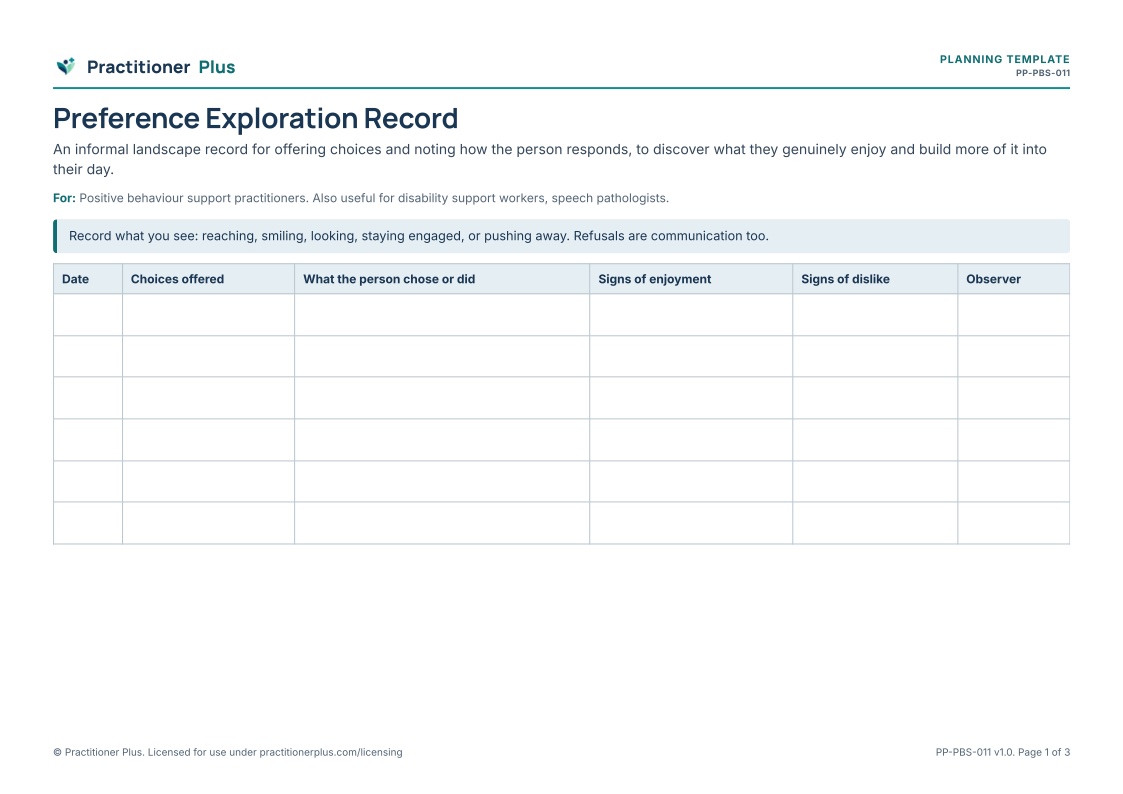
Some people cannot easily tell others what they like. This record helps teams offer choices, observe how the person responds, such as reaching, smiling, engaging or turning away, and notice patterns over several sessions, so preferences can shape everyday life.
Purpose
To discover genuine preferences through offered choices and careful observation.
Who it is for
Primary profession: Positive behaviour support practitioners. Also relevant for disability support workers, speech pathologists.
Client or participant group: People who find it hard to say what they like, and the teams who support them.
Practice setting: Supported living, day programs and family homes, guided by a behaviour support practitioner.
Suggested uses
- Discovering preferred activities and items
- Planning meaningful days
- Updating interests after life changes
- Supporting choice for people who communicate without words
Instructions for practitioners
- Offer choices in calm, familiar settings.
- Record what the person does, not what you assume.
- Repeat over several sessions before drawing conclusions.
- Respect refusals as communication.
- Share findings with the team and behaviour support practitioner.
Accessibility considerations
Offer choices visually and physically. Allow time for responses.
Scope and limitations
An informal record. It is not a formal preference assessment and is not used to make access to preferred items conditional.
Research basis
Person-centred planning shows positive but limited evidence of improving community participation and everyday choice for people with intellectual disability. Human rights frameworks and research on the dignity of risk support people's right to make their own choices, including choices that involve some risk.
- Ibrahim, J. E., & Davis, M. (2013). Impediments to applying the ‘dignity of risk’ principle in residential aged care services. Australasian Journal on Ageing, 32(3), 188–193. https://doi.org/10.1111/ajag.12014
- Ratti, V., Hassiotis, A., Crabtree, J., Deb, S., Gallagher, P., & Unwin, G. (2016). The effectiveness of person-centred planning for people with intellectual disabilities: A systematic review. Research in Developmental Disabilities, 57, 63–84. https://doi.org/10.1016/j.ridd.2016.06.015
- United Nations. (2006). Convention on the Rights of Persons with Disabilities. https://www.ohchr.org/en/instruments-mechanisms/instruments/convention-rights-persons-disabilities
What is included
A 3-page printable A4 PDF, including a practitioner notes page with the research basis (version 1.0).
Originality
Original Practitioner Plus content: wording, activity structure, layout and icons were created for this resource. No third-party worksheets, illustrations or text were reproduced.


