
About this resource
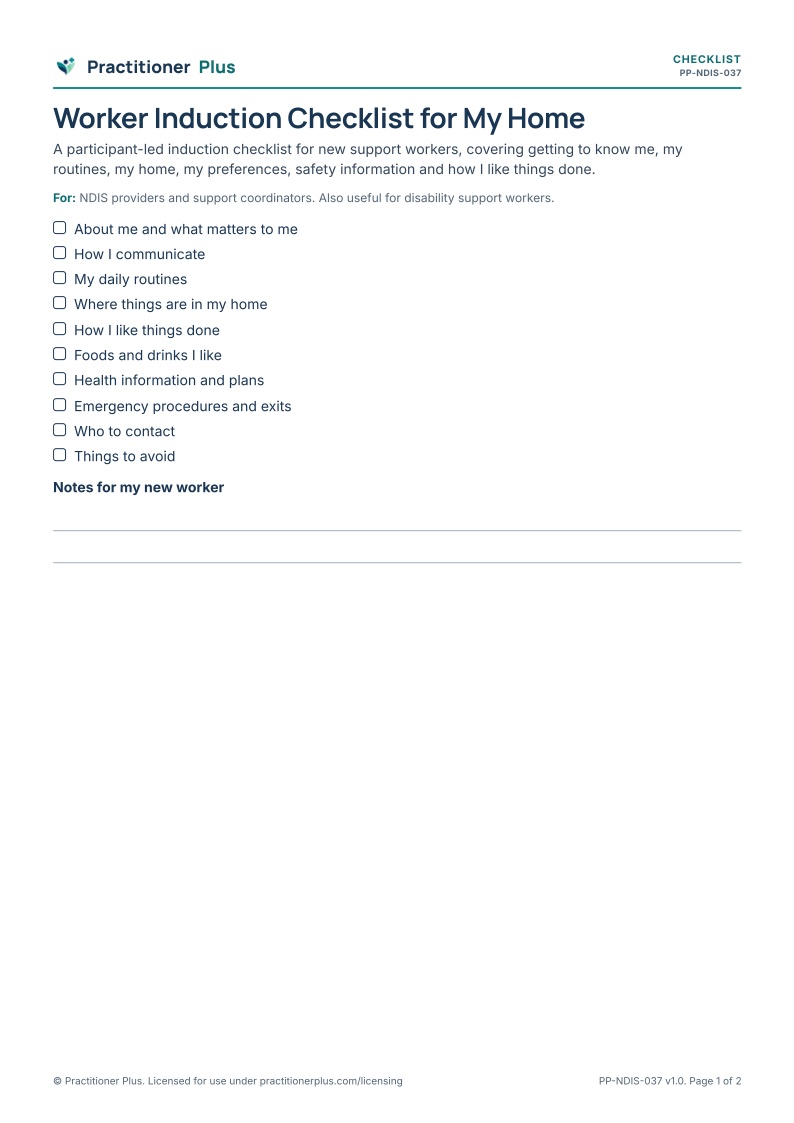
New workers need to know the person, not just the tasks. This checklist helps participants and families induct new workers: getting to know me, my communication, my routines, my home, my preferences, safety information and how I like things done.
Purpose
To help new workers get to know the person and their home on the participant's terms.
Who it is for
Primary profession: NDIS providers and support coordinators. Also relevant for disability support workers.
Client or participant group: Participants and families inducting new support workers.
Practice setting: Participants' homes.
Suggested uses
- New worker shifts
- Agency staff
- Self-managed participants
- Provider onboarding
Instructions for practitioners
- Support the participant to lead the induction.
- Pair with a one-page profile.
- Schedule a buddy shift where possible.
- Review after the first few shifts.
Instructions for clients or participants
- Show your new worker around.
- Tell them what matters to you.
- Tick each item.
Accessibility considerations
Use photos and symbols.
Scope and limitations
An induction checklist. It does not replace provider training requirements.
Research basis
This resource is designed to align with the NDIS Practice Standards and Code of Conduct; using it does not by itself demonstrate compliance. Person-centred planning shows positive but limited evidence of improving community participation and everyday choice for people with intellectual disability.
- NDIS Quality and Safeguards Commission. NDIS Code of Conduct. https://www.ndiscommission.gov.au/rules-and-standards/ndis-code-conduct
- NDIS Quality and Safeguards Commission. NDIS Practice Standards and Quality Indicators. https://www.ndiscommission.gov.au/rules-and-standards/ndis-practice-standards
- Ratti, V., Hassiotis, A., Crabtree, J., Deb, S., Gallagher, P., & Unwin, G. (2016). The effectiveness of person-centred planning for people with intellectual disabilities: A systematic review. Research in Developmental Disabilities, 57, 63–84. https://doi.org/10.1016/j.ridd.2016.06.015
What is included
A 2-page printable A4 PDF, including a practitioner notes page with the research basis (version 1.0).
Originality
Original Practitioner Plus content: wording, activity structure, layout and icons were created for this resource. No third-party worksheets, illustrations or text were reproduced.


