
About this resource
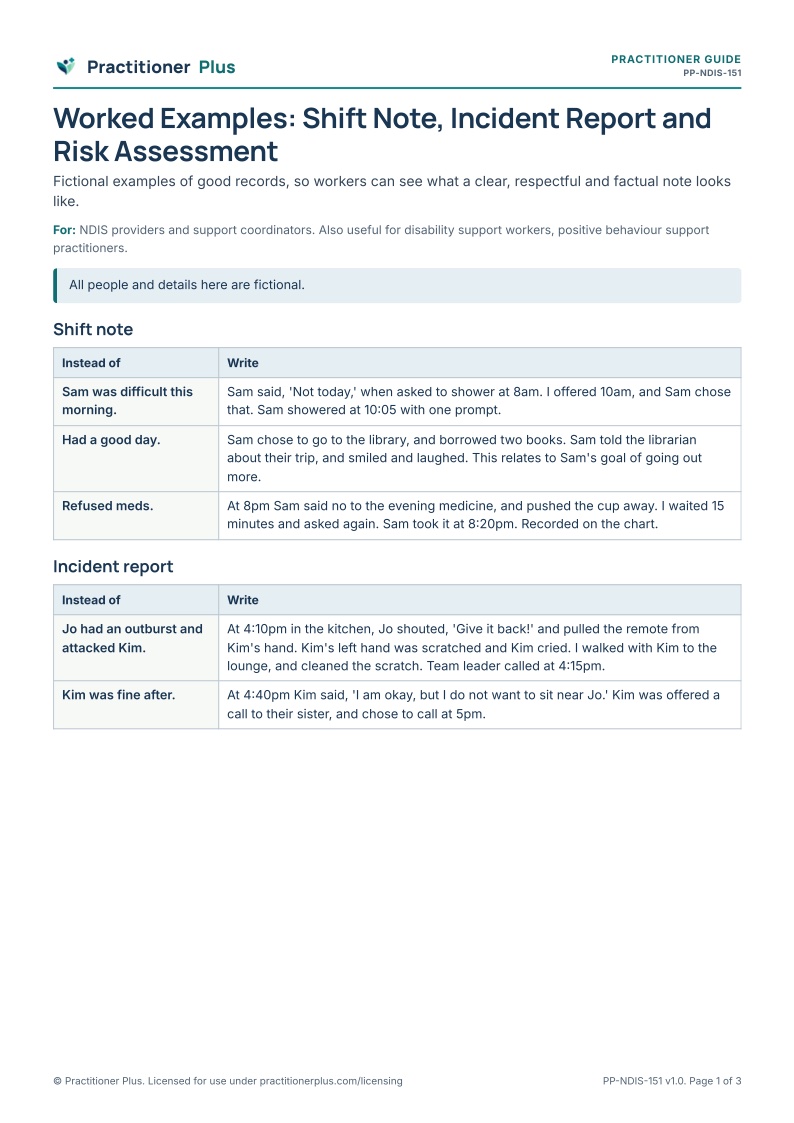
New workers learn fastest from examples. These fictional examples show a shift note that captures the person's voice, an incident report that states facts, and a risk assessment that protects choice, each with notes on why it works. All names are fictional.
Purpose
Fictional examples of good records, so workers can see what a clear, respectful and factual note looks like.
Who it is for
Primary profession: NDIS providers and support coordinators. Also relevant for disability support workers, positive behaviour support practitioners.
Client or participant group: Registered NDIS providers: directors, quality and compliance staff, house and team leaders.
Practice setting: Registered NDIS providers, including supported independent living homes.
Suggested uses
- Day-to-day records for a registered provider
- Audit evidence that a process is used in practice
- Induction and team training
Instructions for practitioners
- Add your organisation's name and details, and delete what does not apply.
- Show workers how and when to use it, and where completed copies are stored.
- Complete it at the time, in plain and respectful language.
- Check a sample regularly and add any improvements to your Continuous Improvement Register.
Accessibility considerations
Clear tables with room to write. The Word version can be filled in on screen.
Scope and limitations
An editable template and practical record. It is not legal advice and does not by itself show that a provider meets the NDIS Practice Standards. Check it against the current Practice Standards, NDIS rules, your registration groups and your state or territory's laws, and adapt it to how your service really works.
Research basis
Registered NDIS providers are assessed against the Core Module of the NDIS Practice Standards. The quality indicators expect documented systems that are used in practice, not only written down. This document is organised around those indicators; using it does not by itself demonstrate compliance. The NDIS incident management rules require registered providers to record, respond to and learn from incidents, keep incident records for 7 years and notify the NDIS Commission of reportable incidents within set timeframes: most within 24 hours of key personnel becoming aware, with a further report within 5 business days.
- National Disability Insurance Scheme (Incident Management and Reportable Incidents) Rules 2018 (Cth). https://www.legislation.gov.au/F2018L00633/latest/text
- National Disability Insurance Scheme (Provider Registration and Practice Standards) Rules 2018 (Cth). https://www.legislation.gov.au/F2018L00631/latest/text
- National Disability Insurance Scheme (Quality Indicators for NDIS Practice Standards) Guidelines 2018 (Cth). https://www.legislation.gov.au/F2018L00700/latest/text
- NDIS Quality and Safeguards Commission. NDIS Practice Standards and Quality Indicators. https://www.ndiscommission.gov.au/rules-and-standards/ndis-practice-standards
- NDIS Quality and Safeguards Commission. Reportable incidents. https://www.ndiscommission.gov.au/providers/registered-ndis-providers/reportable-incidents
What is included
A 3-page printable A4 PDF, including a practitioner notes page with the research basis (version 1.0).
Originality
Original Practitioner Plus content: wording, activity structure, layout and icons were created for this resource. No third-party worksheets, illustrations or text were reproduced. Written for Practitioner Plus from the NDIS Practice Standards and NDIS rules listed in the research basis; no third-party template was used. It is not an NDIS Commission form.


