
About this resource
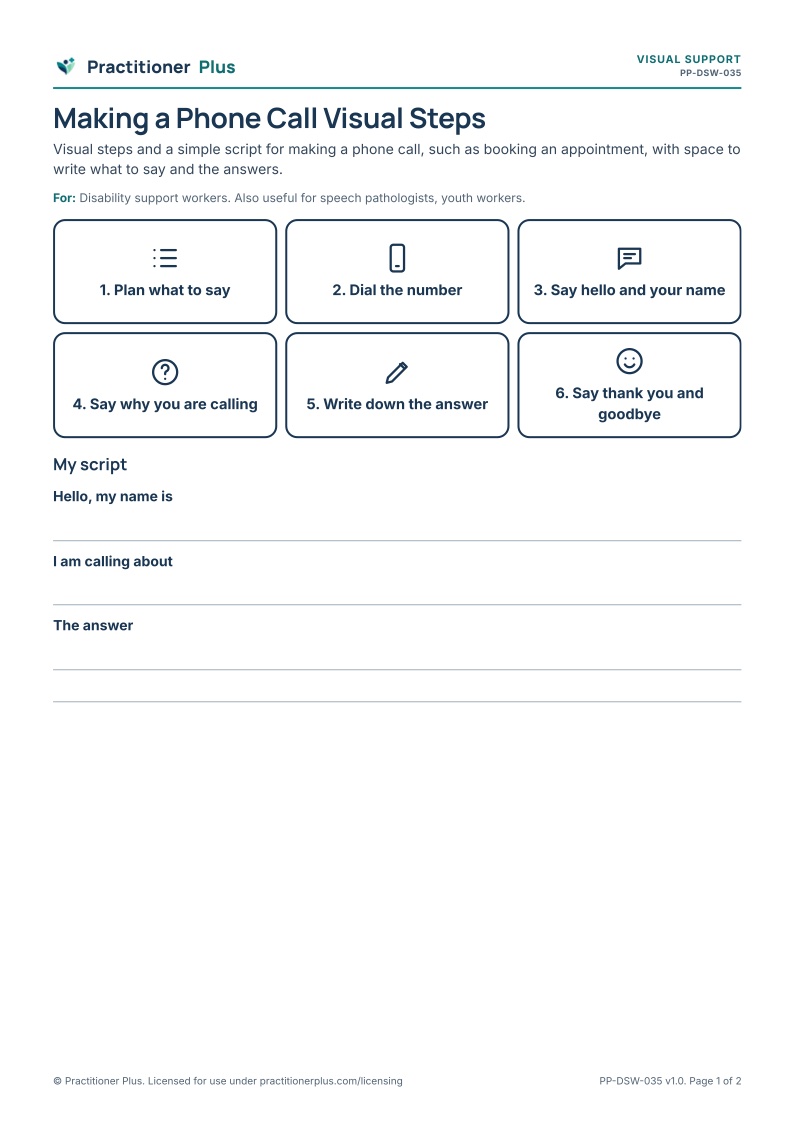
Phone calls can feel stressful. These visual steps and a simple script help people plan what to say, make the call, write down the answers and finish the call politely.
Purpose
To build independence and confidence with phone calls.
Who it is for
Primary profession: Disability support workers. Also relevant for speech pathologists, youth workers.
Client or participant group: Adults and young people building confidence making phone calls.
Practice setting: Home, day programs and community skills sessions.
Suggested uses
- Booking appointments
- Calling services
- Building independence
- Practising with role-play
Instructions for practitioners
- Practise with role-play first.
- Help the person write their script.
- Stay nearby for the first real calls.
- Fade support as confidence grows.
Instructions for clients or participants
- Write what you will say.
- Make the call.
- Write down the answers.
Accessibility considerations
Add pictures. Consider text or online options if phone calls are not accessible.
Scope and limitations
A visual support.
Research basis
Active support, which gives people real opportunities and just-enough help to take part in everyday activities, increases engagement for people with intellectual disability. Visual schedules and other visual supports are established evidence-based practices for autistic children and young people, and are widely used with others who benefit from visual information.
- Knight, V., Sartini, E., & Spriggs, A. D. (2015). Evaluating Visual Activity Schedules as Evidence-Based Practice for Individuals with Autism Spectrum Disorders. Journal of Autism and Developmental Disorders, 45(1), 157–178. https://doi.org/10.1007/s10803-014-2201-z
- Mansell, J., & Beadle-Brown, J. (2012). Active support: Enabling and empowering people with intellectual disabilities. Jessica Kingsley Publishers.
- Steinbrenner, J. R., Hume, K., Odom, S. L., Morin, K. L., Nowell, S. W., Tomaszewski, B., Szendrey, S., McIntyre, N. S., Yücesoy-Özkan, S., & Savage, M. N. (2020). Evidence-based practices for children, youth, and young adults with autism. FPG Child Development Institute, University of North Carolina. https://ncaep.fpg.unc.edu/wp-content/uploads/EBP-Report-2020.pdf
What is included
A 2-page printable A4 PDF, including a practitioner notes page with the research basis (version 1.0).
Originality
Original Practitioner Plus content: wording, activity structure, layout and icons were created for this resource. No third-party worksheets, illustrations or text were reproduced. Symbols are original line drawings created for Practitioner Plus.


