
About this resource
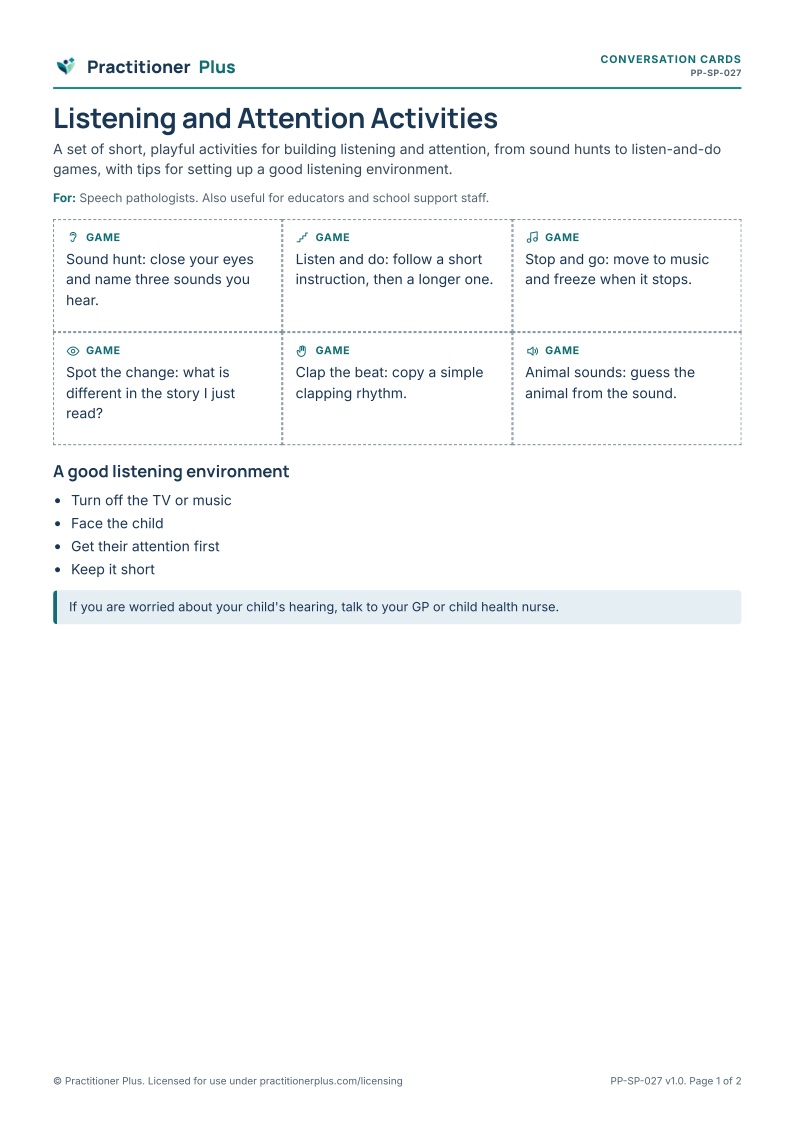
Good listening supports language and learning. These activity cards offer short, playful games such as sound hunts, listen and do, stop and go, and spot the change, with tips for setting up a good listening environment.
Purpose
To provide fun ways to practise listening and attention.
Who it is for
Primary profession: Speech pathologists. Also relevant for educators and school support staff.
Client or participant group: Young children and children with listening or attention difficulties.
Practice setting: Home, early childhood settings, classrooms and speech pathology.
Suggested uses
- Home programs
- Group time
- Speech pathology sessions
- Transition activities
Instructions for practitioners
- Keep activities short and fun.
- Reduce background noise.
- Start easy and build up.
- Praise good listening specifically.
Instructions for clients or participants
- Listen carefully.
- Have fun.
- Try the next level.
Accessibility considerations
Use visual cues alongside sounds.
Scope and limitations
General activities. They do not assess hearing or attention. Concerns about hearing should be checked.
Research basis
Parent-implemented language strategies and interactive shared reading support children's language development.
- Mol, S. E., Bus, A. G., de Jong, M. T., & Smeets, D. J. H. (2008). Added Value of Dialogic Parent–Child Book Readings: A Meta-Analysis. Early Education and Development, 19(1), 7–26. https://doi.org/10.1080/10409280701838603
- Roberts, M. Y., & Kaiser, A. P. (2011). The Effectiveness of Parent-Implemented Language Interventions: A Meta-Analysis. American Journal of Speech-Language Pathology, 20(3), 180–199. https://doi.org/10.1044/1058-0360(2011/10-0055)
What is included
A 2-page printable A4 PDF, including a practitioner notes page with the research basis (version 1.0).
Originality
Original Practitioner Plus content: wording, activity structure, layout and icons were created for this resource. No third-party worksheets, illustrations or text were reproduced.


