
About this resource
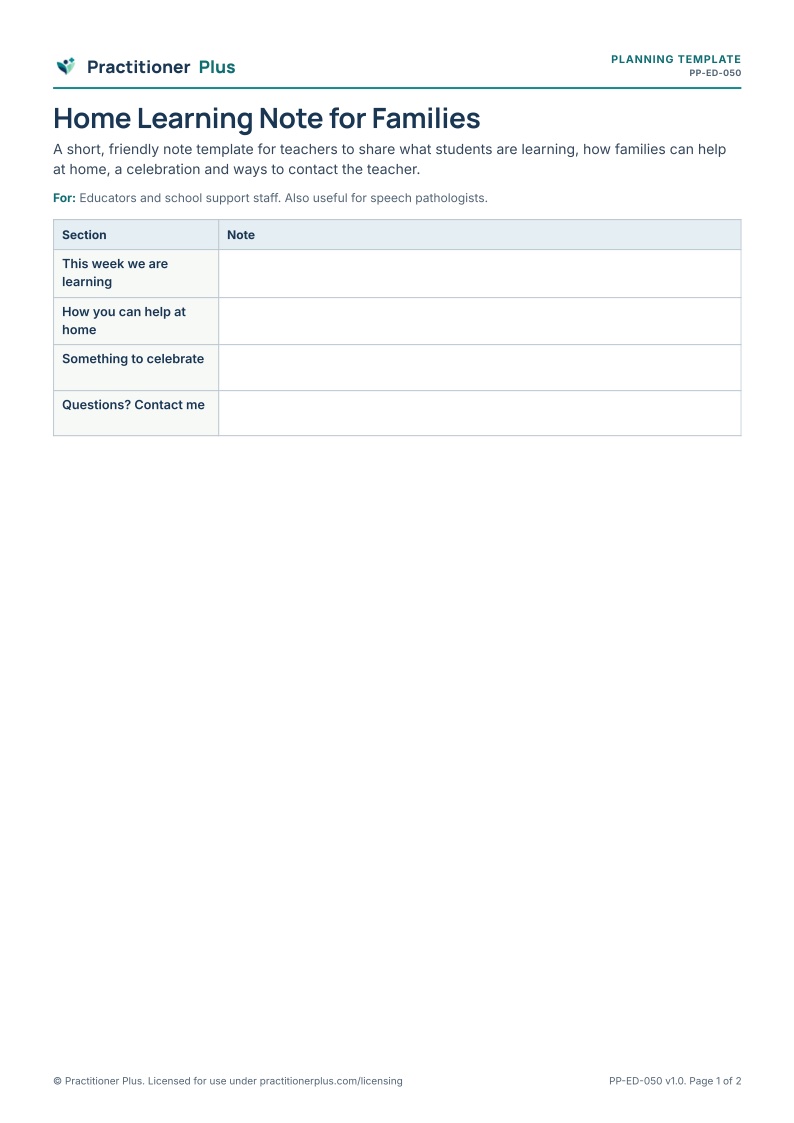
Families can support learning when they know what is happening. This note template shares what students are learning, simple ways families can help at home, a celebration and ways to contact the teacher, in plain language.
Purpose
To strengthen home-school learning partnerships.
Who it is for
Primary profession: Educators and school support staff. Also relevant for speech pathologists.
Client or participant group: Teachers and families.
Practice setting: Primary schools.
Suggested uses
- Weekly or fortnightly notes
- Start of units
- Families new to the school
- Supporting home reading
Instructions for practitioners
- Keep it short and friendly.
- Suggest easy, low-cost activities.
- Translate where needed.
- Invite two-way communication.
Accessibility considerations
Use plain language and translations.
Scope and limitations
A communication template.
Research basis
Practice testing and spaced study are among the most effective learning strategies, and self-regulated learning skills can be taught. Parent support that builds positive interactions, consistent responses and emotional communication improves child behaviour and family wellbeing.
- Dunlosky, J., Rawson, K. A., Marsh, E. J., Nathan, M. J., & Willingham, D. T. (2013). Improving Students’ Learning With Effective Learning Techniques: Promising Directions From Cognitive and Educational Psychology. Psychological Science in the Public Interest, 14(1), 4–58. https://doi.org/10.1177/1529100612453266
- Kaminski, J. W., Valle, L. A., Filene, J. H., & Boyle, C. L. (2008). A meta-analytic review of components associated with parent training program effectiveness. Journal of Abnormal Child Psychology, 36(4), 567–589. https://doi.org/10.1007/s10802-007-9201-9
- Zimmerman, B. J. (2002). Becoming a Self-Regulated Learner: An Overview. Theory Into Practice, 41(2), 64–70. https://doi.org/10.1207/s15430421tip4102_2
What is included
A 2-page printable A4 PDF, including a practitioner notes page with the research basis (version 1.0).
Originality
Original Practitioner Plus content: wording, activity structure, layout and icons were created for this resource. No third-party worksheets, illustrations or text were reproduced.


