
About this resource
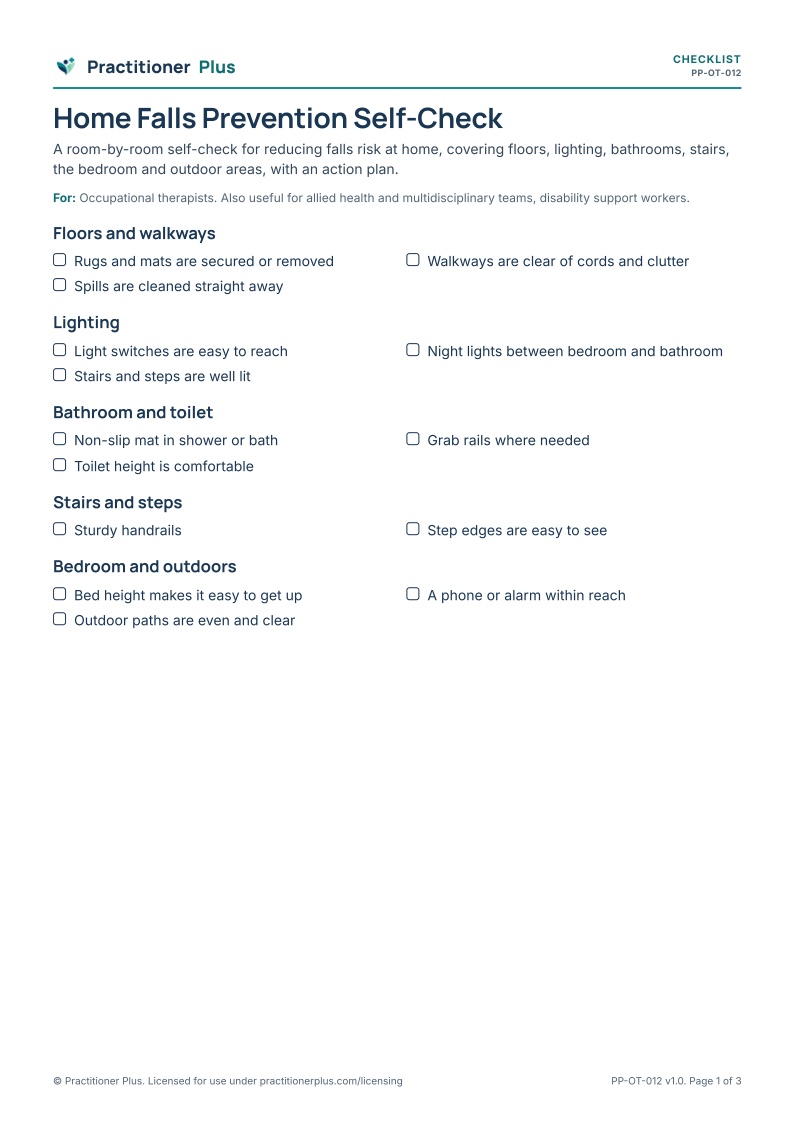
Many falls happen at home and many hazards are easy to fix. This self-check works room by room through floors and rugs, lighting, the bathroom, stairs, the bedroom and outdoor areas, then helps the person plan the changes they want to make and when to ask for help.
Purpose
To help people identify and fix common falls hazards in the home.
Who it is for
Primary profession: Occupational therapists. Also relevant for allied health and multidisciplinary teams, disability support workers.
Client or participant group: Older adults and people with mobility, balance or vision changes, and their families.
Practice setting: Home, often before or alongside an occupational therapy home visit.
Suggested uses
- Preparing for an OT home visit
- Self-check after a fall or hospital stay
- Family conversations about safety
- Community health education
Instructions for practitioners
- Encourage the person to walk through their home with the checklist.
- Prioritise changes the person agrees with.
- Refer for individual assessment where there are falls, near misses or changes in mobility.
- Respect the person's choices about their home.
Instructions for clients or participants
- Walk through each room with the checklist.
- Tick the things that need fixing.
- Choose your first change.
Accessibility considerations
Large print. A family member or worker can complete it with the person.
Scope and limitations
A self-check. It is not an occupational therapy home assessment. Anyone who has fallen or has new mobility or balance changes should see a health professional.
Research basis
Exercise and home hazard reduction both reduce falls in older people living in the community. Occupational therapy models describe how the person, their environment and their activities interact, and how a balance of meaningful activity supports health and participation.
- Clemson, L., Mackenzie, L., Ballinger, C., Close, J. C. T., & Cumming, R. G. (2008). Environmental Interventions to Prevent Falls in Community-Dwelling Older People: A Meta-Analysis of Randomized Trials. Journal of Aging and Health, 20(8), 954–971. https://doi.org/10.1177/0898264308324672
- Law, M., Cooper, B., Strong, S., Stewart, D., Rigby, P., & Letts, L. (1996). The Person-Environment-Occupation Model: A Transactive Approach to Occupational Performance. Canadian Journal of Occupational Therapy, 63(1), 9–23. https://doi.org/10.1177/000841749606300103
- Sherrington, C., Fairhall, N. J., Wallbank, G. K., Tiedemann, A., Michaleff, Z. A., Howard, K., Clemson, L., Hopewell, S., & Lamb, S. E. (2019). Exercise for preventing falls in older people living in the community. Cochrane Database of Systematic Reviews, Article CD012424. https://doi.org/10.1002/14651858.cd012424.pub2
- Wagman, P., Håkansson, C., & Björklund, A. (2012). Occupational balance as used in occupational therapy: A concept analysis. Scandinavian Journal of Occupational Therapy, 19(4), 322–327. https://doi.org/10.3109/11038128.2011.596219
- World Health Organization. (2001). International classification of functioning, disability and health (ICF). WHO. https://www.who.int/standards/classifications/international-classification-of-functioning-disability-and-health
What is included
A 3-page printable A4 PDF, including a practitioner notes page with the research basis (version 1.0).
Originality
Original Practitioner Plus content: wording, activity structure, layout and icons were created for this resource. No third-party worksheets, illustrations or text were reproduced.


